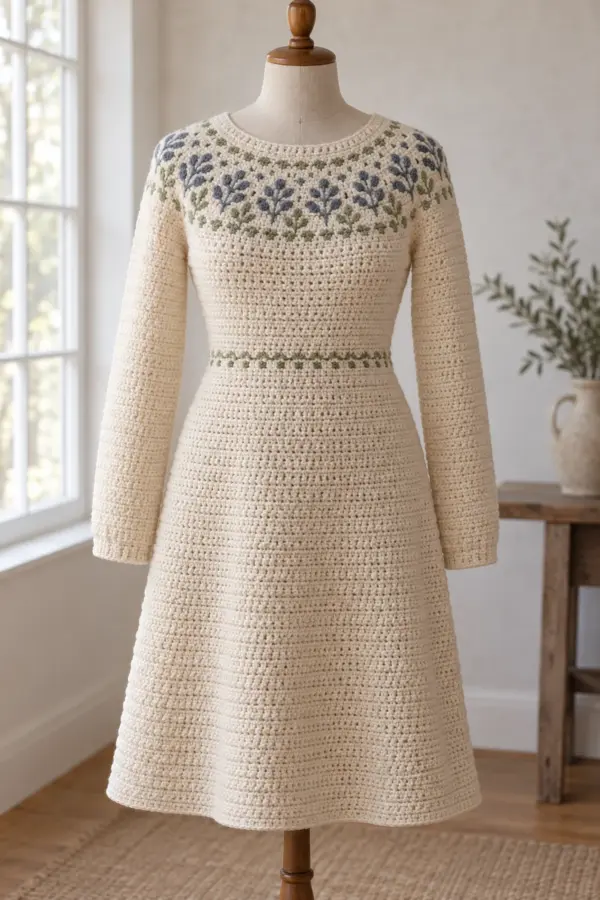
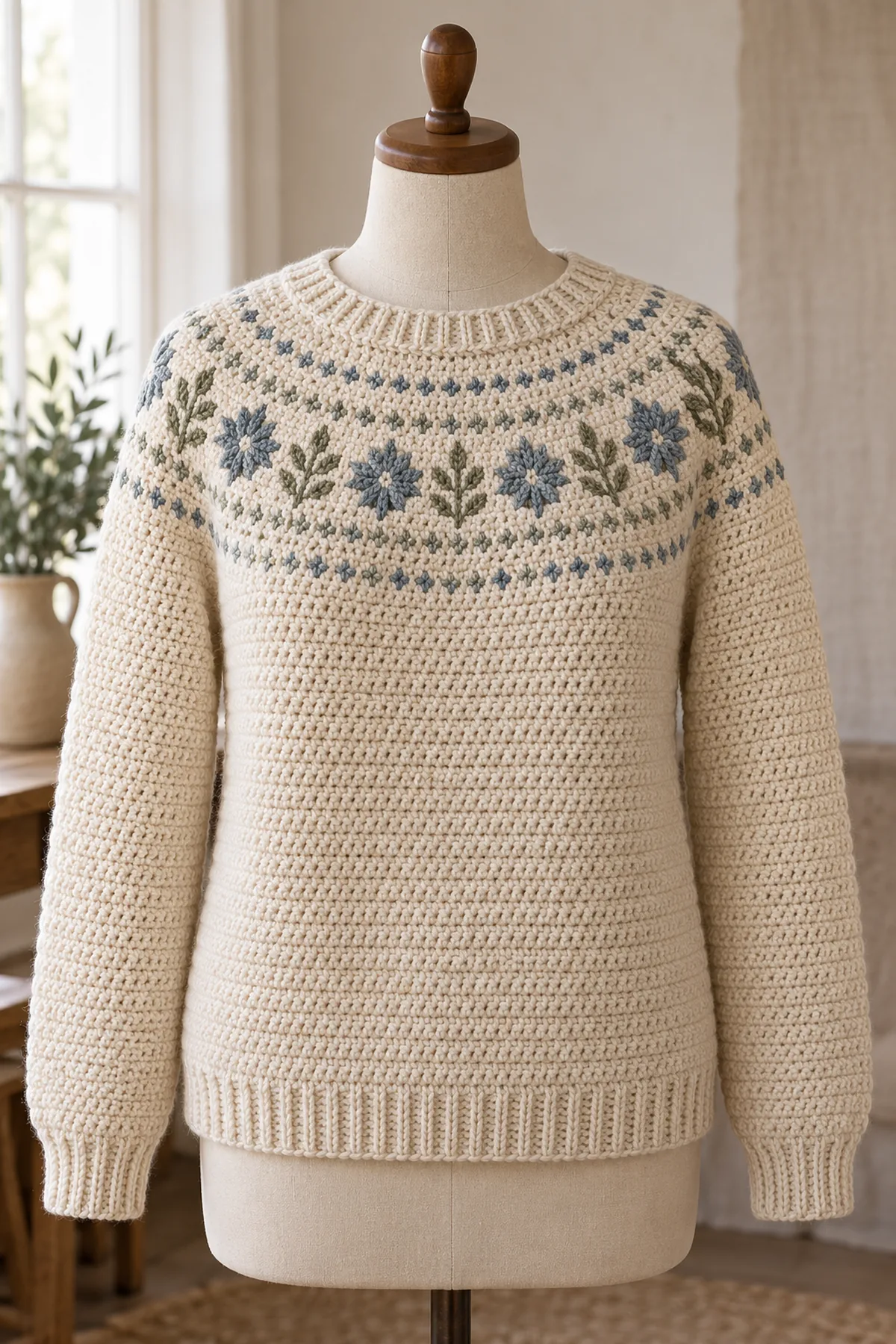
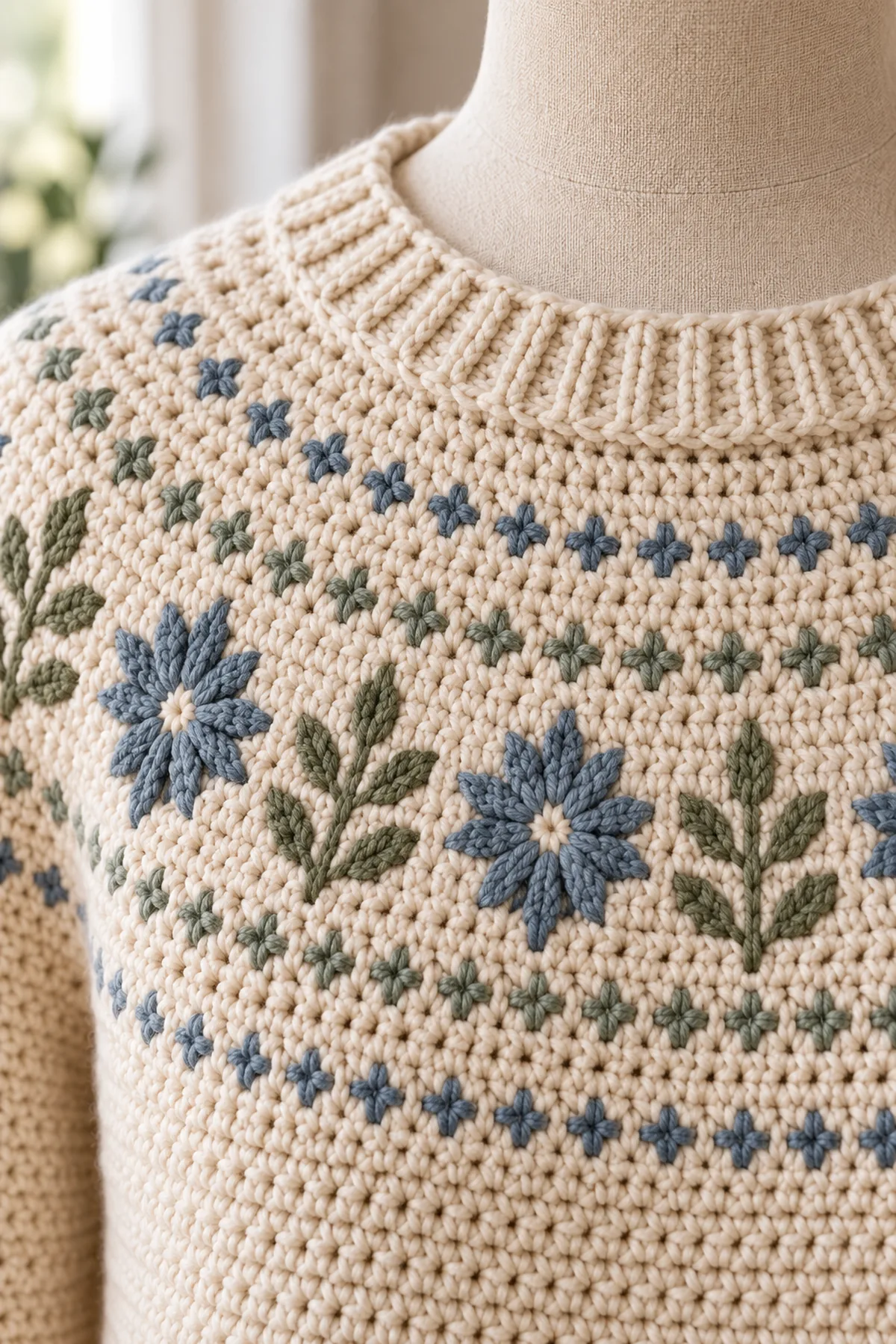
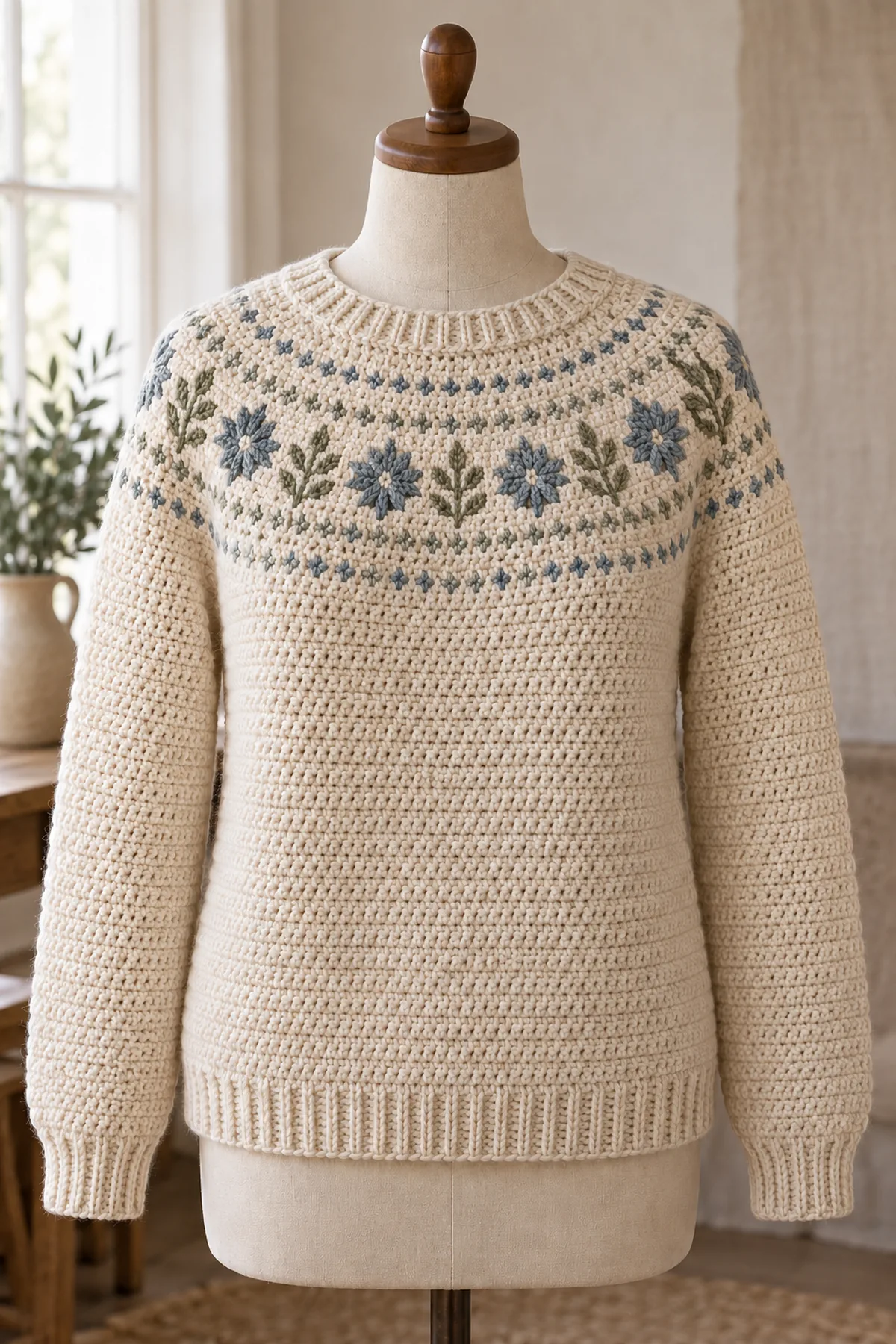
This crochet Nordic yoke sweater pattern is an original adult pullover worked seamlessly from the neckline down. The cream fabric is framed by a small circular band of slate-blue star flowers and sage sprigs. The lower body and long sleeves stay solid so the yoke remains the focal point. This is a pullover with no front opening.
Pattern Details
- Sizes S (M, L, XL), finished chest 36 (40, 44, 48) inches
- Positive ease: about 2 inches; choose by body bust measurement
- Gauge: 18 hdc and 14 joined rounds = 4 inches after washing
- Skill: intermediate; US terms; worsted-weight yarn
Materials
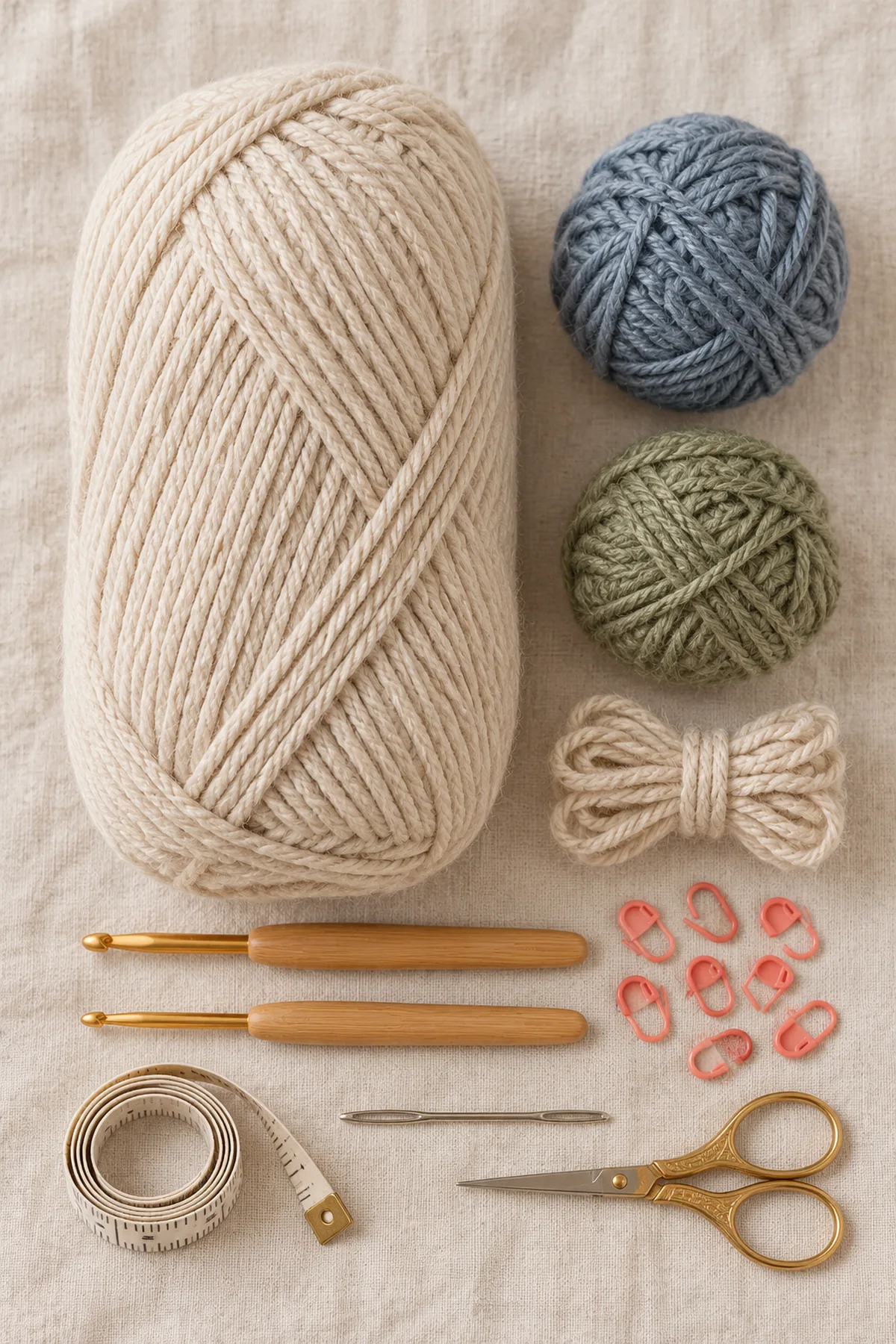
- Oatmeal: 950 (1,100, 1,250, 1,400) yd; slate blue: 90 yd; sage: 70 yd
- 4.5 mm hook for body, 4 mm hook for ribbing, 18 markers, waste yarn, needle and scissors
Gauge and Size Planning
Make a 6-inch swatch in hdc, wash it as the finished pullover will be washed, then measure its center. At 18 stitches per 4 inches, each stitch is one quarter inch. The finished chest targets are 36, 40, 44 and 48 inches. Measure the wearer over the fullest part of the chest and select a size with approximately 2 inches of ease. If your gauge is wider, use a smaller hook; if tighter, use a larger hook. Do not change hook size mid-yoke.
Abbreviations and Colorwork
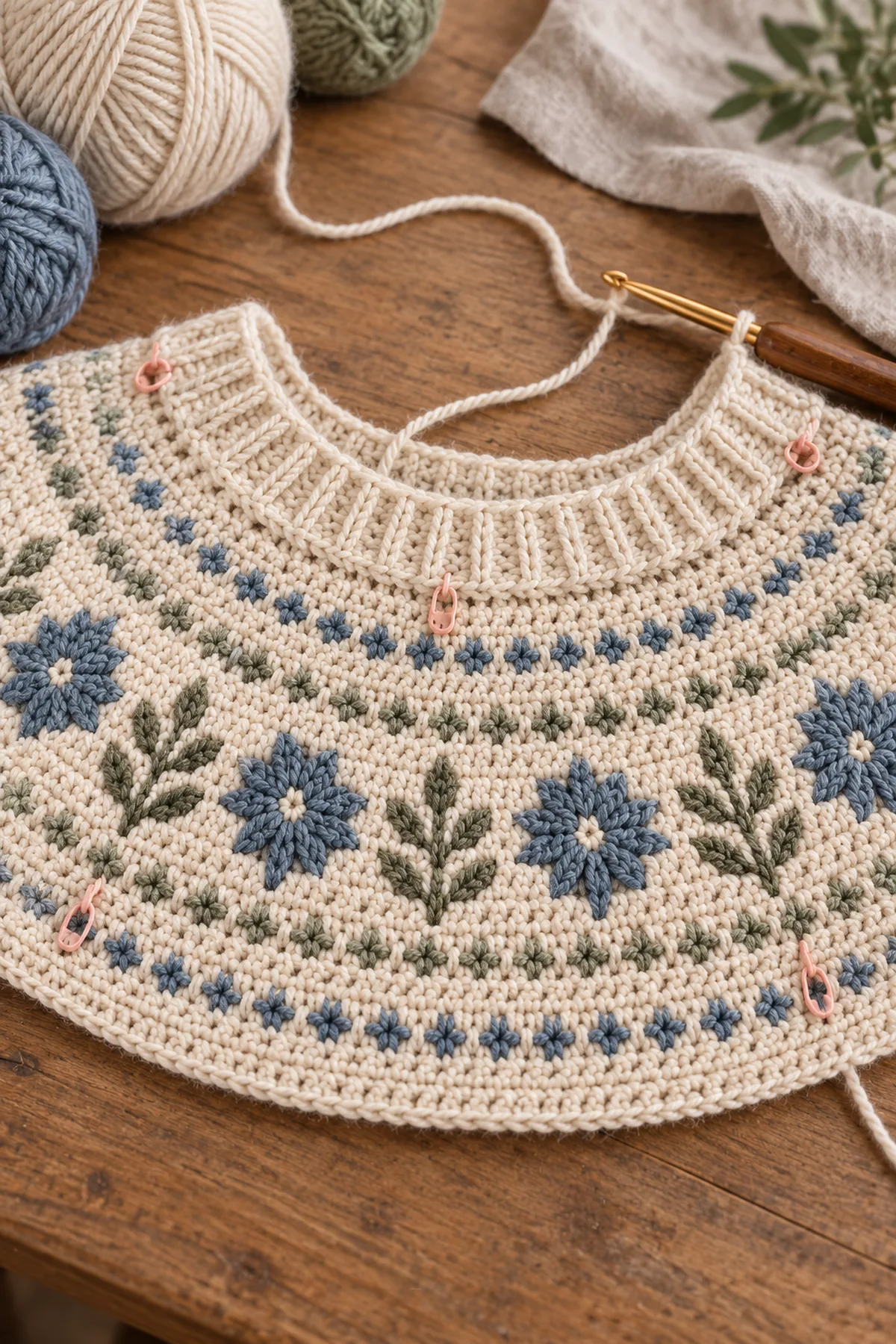
Ch means chain, hdc means half double crochet, sl st means slip stitch, and rnd means round. Beginning chains do not count. Join without turning. The yoke uses 18 evenly spaced increase markers; an increase is 2 hdc in the marked stitch. On chart rounds, change color on the final yarn-over before the new color stitch. Carry the inactive strand behind the work and catch it at least every 4 stitches. The original motif repeats small blue four-point flowers and sage two-stitch sprigs on an oatmeal field; keep the same chart repeat centered between markers.
Instructions
Neck and yoke
- With oatmeal and the 4.5 mm hook, ch 72 and join carefully without twisting. Work 1 hdc in each chain: (72 sts).
- Place 18 markers evenly, one after every 4 stitches. Work one plain hdc round.
- For each increase round, work hdc around, making 2 hdc in each marked stitch and moving each marker to the new increase. Each increase adds 18 stitches. Work one plain round between increases.
- Increase round totals are (90 sts), (108 sts), (126 sts), (144 sts), (162 sts), (180 sts), (198 sts), (216 sts), (234 sts), (252 sts), (270 sts), (288 sts), (306 sts), (324 sts), (342 sts) and (360 sts). Stop at 252 (288, 324, 360) stitches for S (M, L, XL). S uses 10 increase rounds, M 12, L 14, XL 16. Work 20 (24, 28, 32) total yoke rounds, keeping the six-round motif band centered in the upper half.
- On the final yoke round, mark sections in order: front 73 (82, 91, 100), sleeve 53 (62, 71, 80), back 73 (82, 91, 100), sleeve 53 (62, 71, 80). Check that each size totals 252 (288, 324, 360) sts.
Body
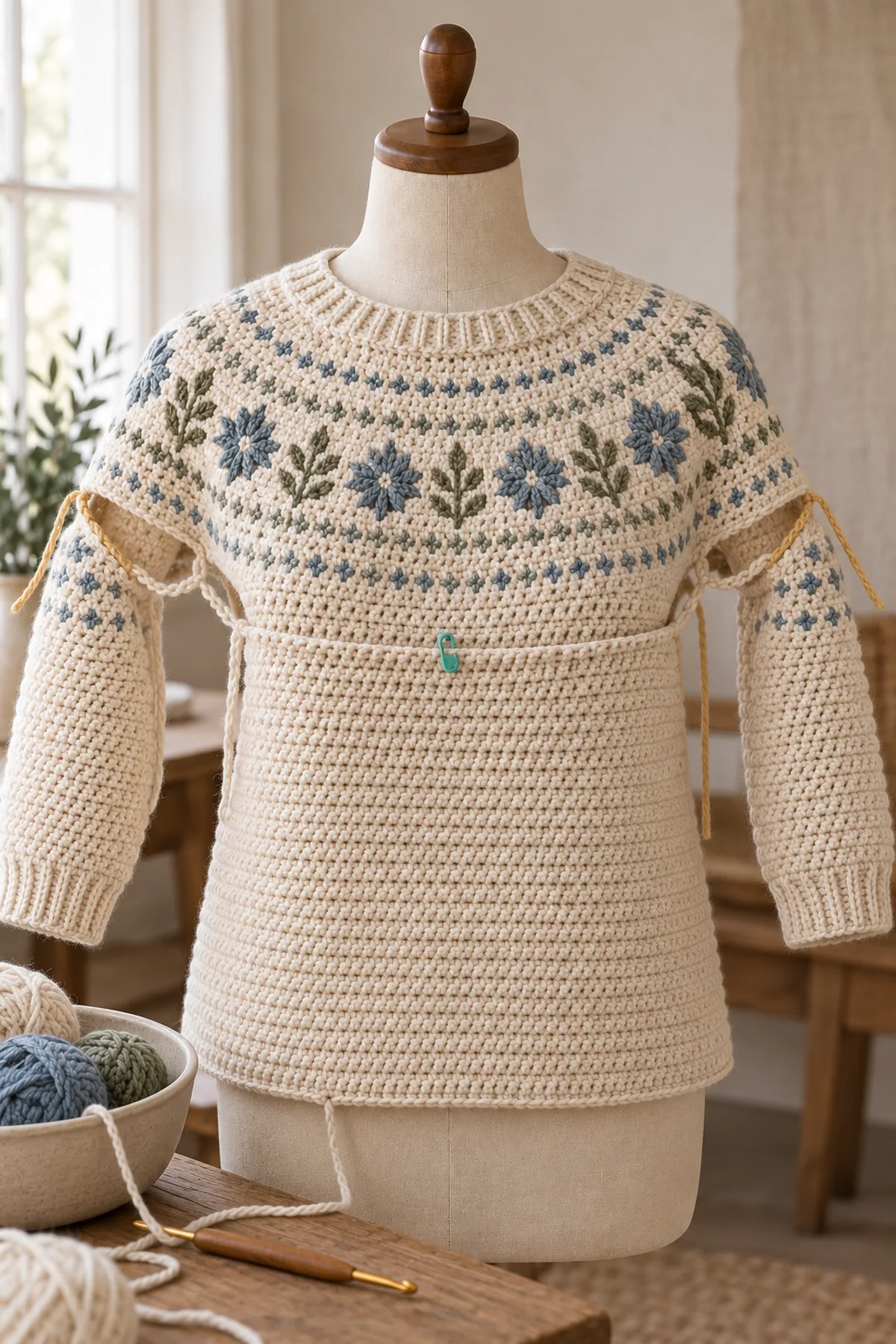
- Work the front stitches, chain 8 for the underarm, skip the first sleeve, work the back, chain 8, and skip the second sleeve. Join: 162 (180, 198, 216) body stitches.
- Work joined hdc rounds without turning until the body measures 12 inches from the underarm, or 2 inches shorter than desired. Keep the two underarm chains centered and count them as body stitches.
- Change to the 4 mm hook. Work 8 rounds of back-loop hdc ribbing, then fasten off. The ribbing adds about 2 inches.
Sleeves
- Return held sleeve stitches to the larger hook, join oatmeal at the center underarm, and work across the sleeve plus 8 underarm chain stitches: 61 (70, 79, 88) sts.
- Work hdc in joined rounds to 15 inches from the underarm. Decrease 2 stitches evenly every 4th round 10 (11, 12, 14) times, leaving 41 (48, 55, 60) stitches.
- Switch to the smaller hook and work 8 rounds of back-loop hdc ribbing. Fasten off. Repeat for the second sleeve.
Finishing
- Weave in ends on the wrong side, splitting long carried strands so they cannot snag.
- Wet-block flat to the listed chest and sleeve measurements; do not stretch the yoke band.
- Check both sleeves have matching decrease counts and lengths, and inspect the underarms for holes.
Tips
- Use a locking marker at the first stitch and at all 18 increase positions.
- After each increase round, count the stitches: the total must rise by exactly 18.
- Try the yoke over the head before separating body and sleeves; add one plain round if depth is short, not an uncounted increase.
- Use washable yarn and follow its care label. Colorwork floats should lie flat, never tight against the wrong side.
Frequently Asked Questions
Can I make the sweater longer?
Yes. Add plain body rounds before the ribbing; each 14-round group adds about 4 inches at gauge. Record the added rounds for matching sleeve length.
Can I change the motif colors?
Yes. Keep the main ground and use two contrasting colors for the small flower and sprig band. Swatch the combination because dark colors can hide stitch definition.
Is this pattern physically tested?
The stitch arithmetic is checked in the written audit, but this draft does not claim a physical fit test. Make and measure a gauge swatch and compare the garment to the listed finished measurements.
Conclusion
The finished pullover combines a simple hdc body with a measured circular yoke, long sleeves and an original Nordic-inspired motif band. Follow the counts for your size, check gauge before starting and block gently to the finished measurements.
Printable Pattern Card
Adult S–XL top-down pullover: 72-stitch neck ring, 18 spaced yoke increases, 252 (288, 324, 360) yoke stitches at split, 162 (180, 198, 216) body stitches after two 8-chain underarms. Use 18 hdc and 14 rounds = 4 inches.