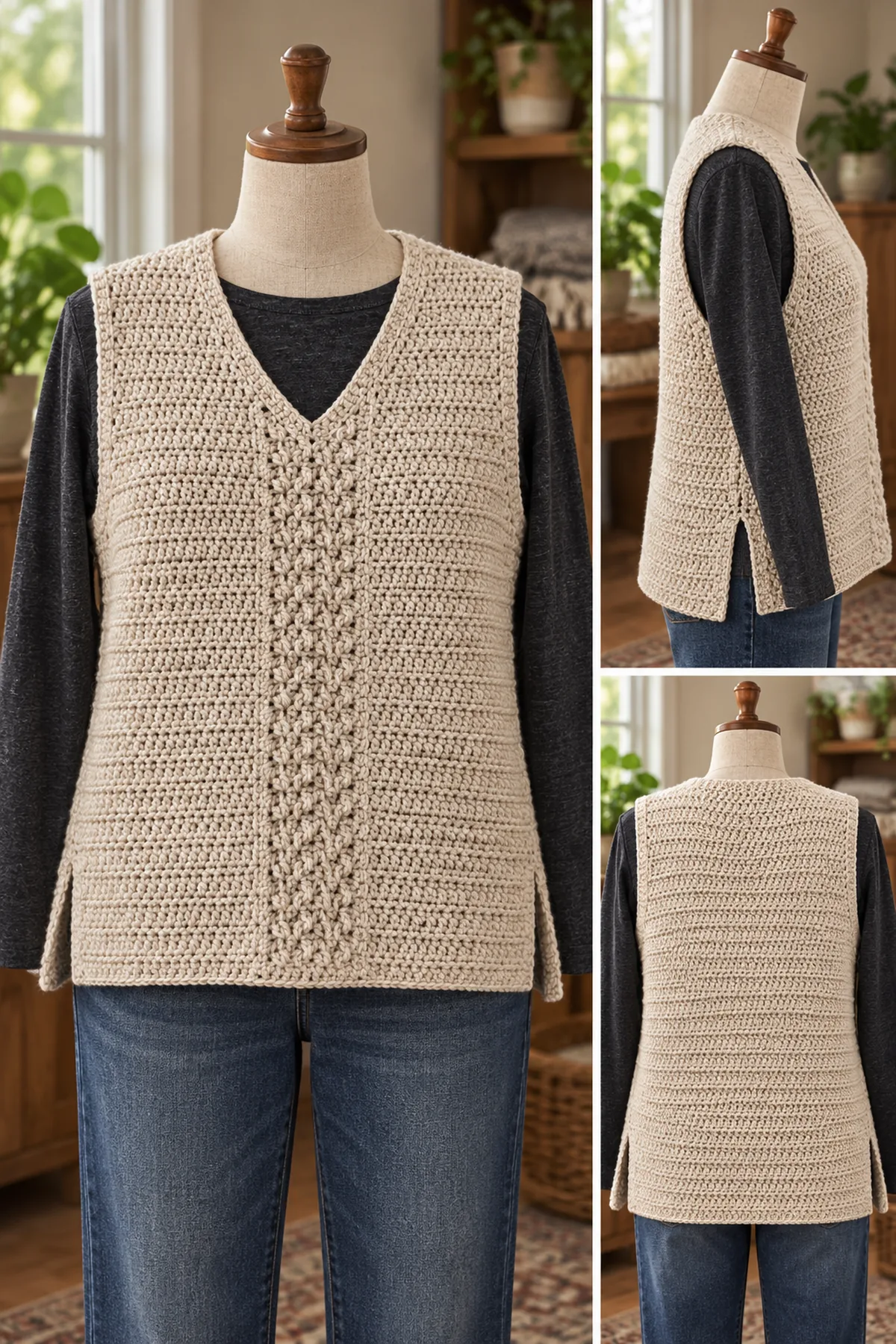
This original crochet sweater vest pattern explains how to make crochet split-hem textured sweater vest from the first counted stitch through final assembly. The design is a practical free tutorial in US terms, with measurements and stitch checkpoints that you can verify as you work.
Crochet one full-width back and one full-width front in rows. The front alone splits into two shoulders for the final 20 rows; one decrease at each V edge on every other row leaves equal shoulder widths. Join shoulders and only the middle side sections, leaving open armholes and measured two-inch hem slits. This is not a cardigan, granny motif or hexagon shrug.
Pattern Details
- Hook Size: 5 mm, adjusted after a washed 20-stitch textured swatch
- Finished Size: S/M/L/XL: 36/40/44/48-inch finished chest, 16/17/18/19-inch body length; intended for approximately 32–34/36–38/40–42/44–46-inch body chest with 2–4 inches positive ease
- Gauge: 16 counted stitches and 16 rows = 4 inches in washed hdc with the centered post-stitch field
- Estimated Time: 14–22 hours by size
- Construction: Two 72/80/88/96-stitch one-piece panels, each 64/68/72/76 rows; front V split for its final 20 rows; 26/30/34/38-stitch shoulder seams
- Skill level: Intermediate
Why You’ll Love This Project
The shape comes from counted stitches rather than an unexplained diagram. You can inspect each stage against the measurements, and the finished object has a clear purpose and a distinct silhouette in photographs.
Materials
- Approximately 800/950/1100/1250 yards oatmeal washable worsted wool-cotton blend for S/M/L/XL, plus 10% swatch and repair allowance
- 5 mm hook or size yielding washed gauge, six locking markers, blunt needle, tape measure and blocking surface
- A dark long-sleeve top for styling only; no buttons, ties or hardware are part of the vest
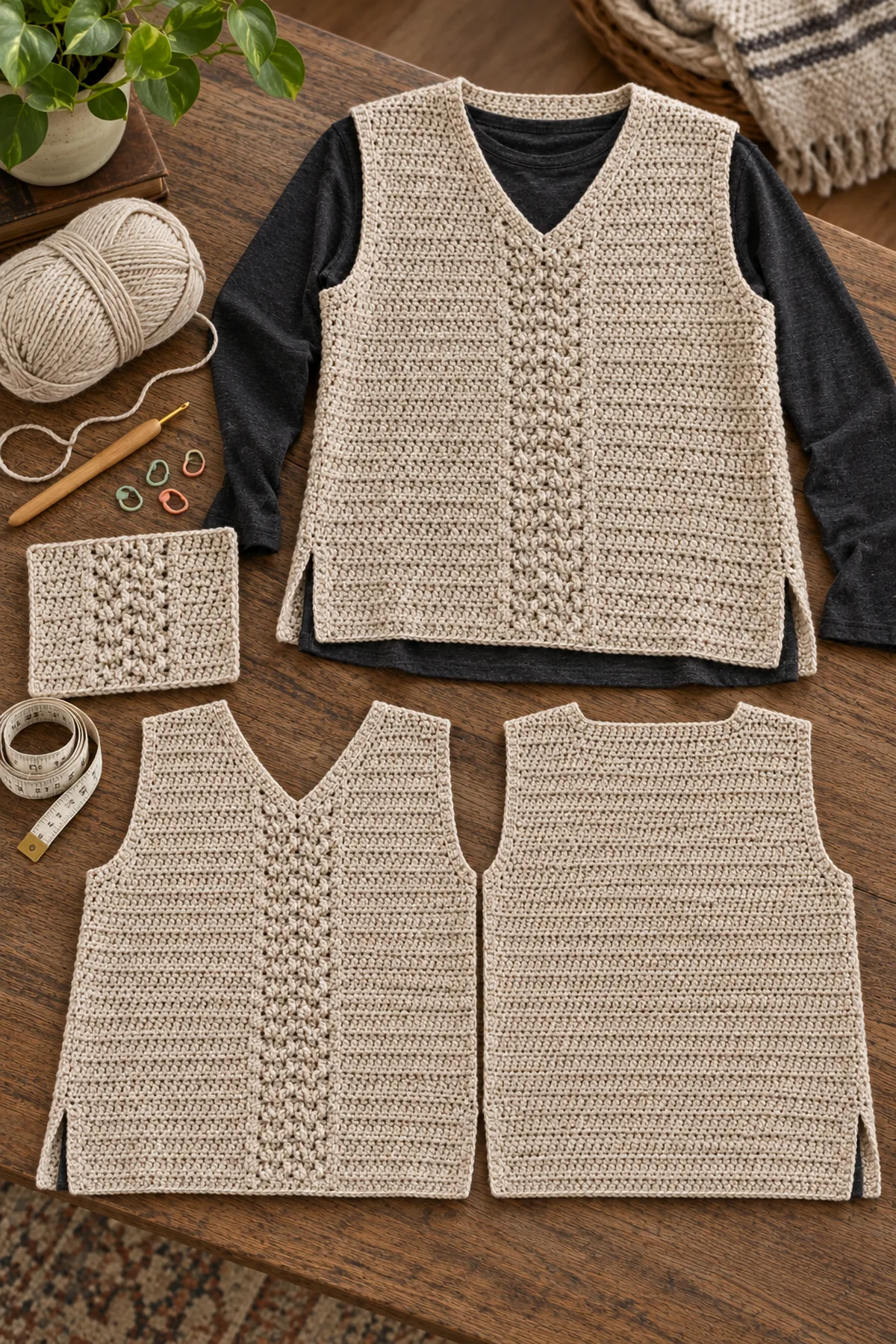
Gauge, Measurements, and Planning
Wash a swatch at least 20 stitches by 20 rows, alternating the same six-row center texture sequence used in the garment. Measure the inner 16 stitches and 16 rows; both should span 4 inches. At this gauge the flat widths are 18/20/22/24 inches and doubled chest circumferences are 36/40/44/48 inches. The completed row counts give 16/17/18/19 inches before trim. Compare a comfortable existing garment and choose by finished chest, not an unverified size label.
Make and wash a gauge swatch before beginning. Measure only after the swatch is completely dry. If the stitch width differs, change hook size rather than pulling the working yarn tighter. Keep a written count at the end of every section so the finished edges remain balanced and the assembly points line up.
Abbreviations and Special Stitches
- ch: chain
- sc: single crochet
- sl st: slip stitch
- st(s): stitch(es)
- rnd: round
- inc: 2 sc in one stitch
- sc2tog: single crochet two stitches together
- hdc: half double crochet
- dc: double crochet
- FPdc: front-post double crochet
- BPdc: back-post double crochet
- hdc2tog: half double crochet two stitches together
Special stitch guidance: Work hdc into both top loops everywhere except the 12 center texture stitches on the front and back body. On the first texture row, make dc in those 12 positions. On right-side rows, work one front-post dc around each corresponding center dc; on wrong-side rows, work one back-post dc. Each post stitch replaces one top-loop stitch: twelve worked positions still equal twelve counted stitches. A V decrease is hdc2tog over the two stitches nearest the inner neck edge; it consumes two and produces one. Ch 1 to turn never counts.
Important Notes
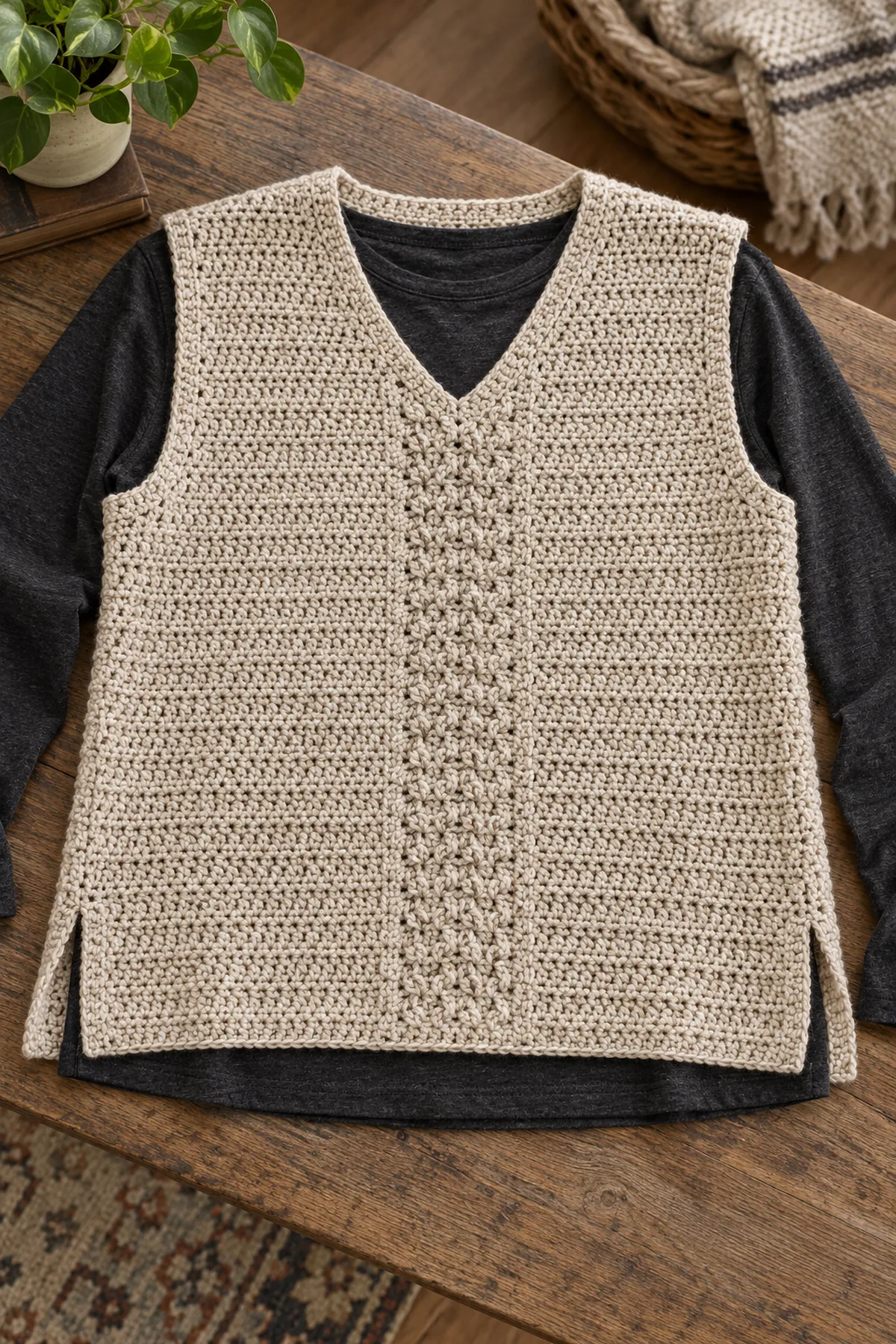
- AI-generated pictures illustrate the intended design; they are not photographs of a physically tested sample. Follow written counts rather than counting stitches in an image.
- The stitch arithmetic has been checked, but gauge, yardage and fit are planning targets until a physical sample is made. Wash a swatch and check measurements before gifting or wearing.
- A beginning ch 1 and a joining sl st never count as a stitch in this pattern. Mark the first counted stitch of each row or round.
- If a row count is wrong, return to that row. Adding an unplanned stitch later changes the shaping and the assembly alignment.
Complete Instructions for Crochet Split-Hem Textured Sweater Vest
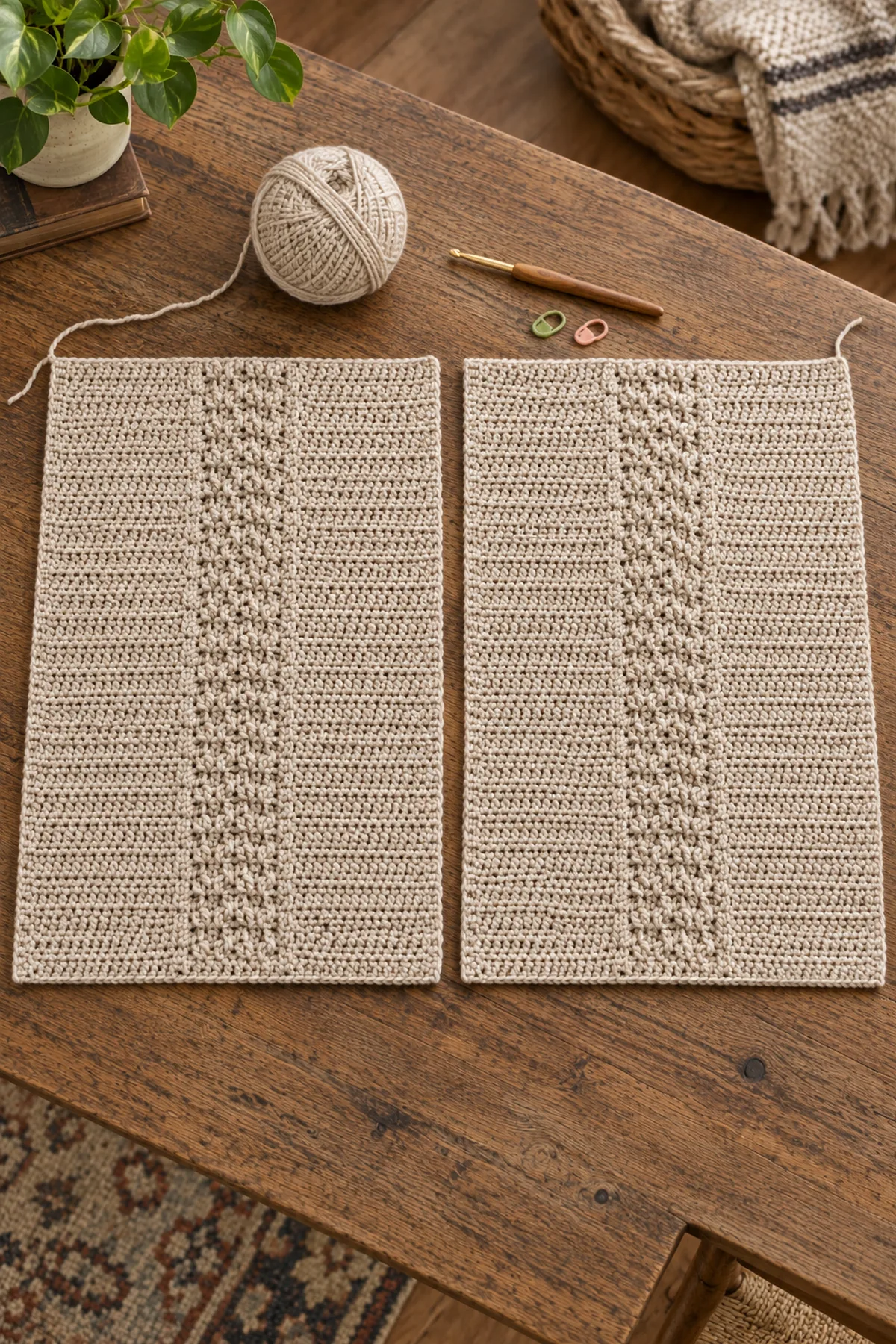
Swatch and Crochet Two Full-Width Body Panels
Numbers throughout are S (M, L, XL). Work front and back separately from hem upward. Mark the center 12 positions: stitches 31–42 (35–46, 39–50, 43–54). Both panels have the same full-width body before neckline shaping.
- Panel Row 1: Ch 73 (81, 89, 97). Hdc in the second chain and every remaining usable chain, turn. (72/80/88/96 sts)
- Panel Row 2: Ch 1, hdc across to the first marked center position, dc in each of the 12 center stitches, hdc to end, turn. The side hdc counts are 30/34/38/42 on each side. (72/80/88/96 sts)
- Panel Row 3: Ch 1, hdc the side positions, FPdc around each of the 12 center dc posts, hdc across the other side, turn. (72/80/88/96 sts)
- Panel Row 4: Ch 1, hdc the sides and BPdc around the same 12 center posts, then hdc to the edge, turn. (72/80/88/96 sts)
- Repeat Rows 3–4, keeping the raised center field on the public face, until the back has 64 (68, 72, 76) rows. Work the front only through Row 44 (48, 52, 56) before splitting for its V. Change to a larger or smaller hook if the washed swatch is off; do not add an unplanned stitch to make a width fit.
Shape the Shallow V and Match Shoulder Widths
At the front split, place a marker between stitches 36/37 (40/41, 44/45, 48/49). Work the two halves independently for 20 rows each. Stop the raised center post sequence at the V split; the shoulder sections are plain hdc for clean shaping.
- Left half, V Row 1: Join at the outer arm edge and hdc across its 36 (40, 44, 48) stitches to the center marker; turn. (36/40/44/48 sts)
- On the left half, V Rows 2, 4, 6, 8, 10, 12, 14, 16, 18 and 20 begin at the inner neck edge: ch 1, hdc2tog over the first two stitches, hdc across the rest and turn. On odd V Rows 3–19, ch 1 and hdc evenly back toward the neck. After ten decreases, the left shoulder has 26 (30, 34, 38) stitches.
- Right half: Join a new strand at the center marker on the opposite half, hdc its 36 (40, 44, 48) stitches out to the arm edge for V Row 1. On even V Rows 2, 4, 6, 8, 10, 12, 14, 16, 18 and 20, begin at the arm edge, hdc to the final two stitches, hdc2tog at the inner neck edge and turn. On odd rows hdc evenly. Do not decrease at the arm edge. Finish with 26 (30, 34, 38) stitches.
- The back top row is unchanged: mark 26 (30, 34, 38) stitches at each outer edge for shoulder seams and leave the central 20 back-neck stitches open. The shoulder arithmetic is 72/80/88/96 minus twenty neck stitches = two groups of 26/30/34/38. Place the panels flat together and check that each front shoulder exactly matches its back group before sewing. Smallest-size stitch audit: Panel Row 1 (72 sts); Rows 2–44 (72 sts).
Sew Shoulders, Side Slits and Clean Edges
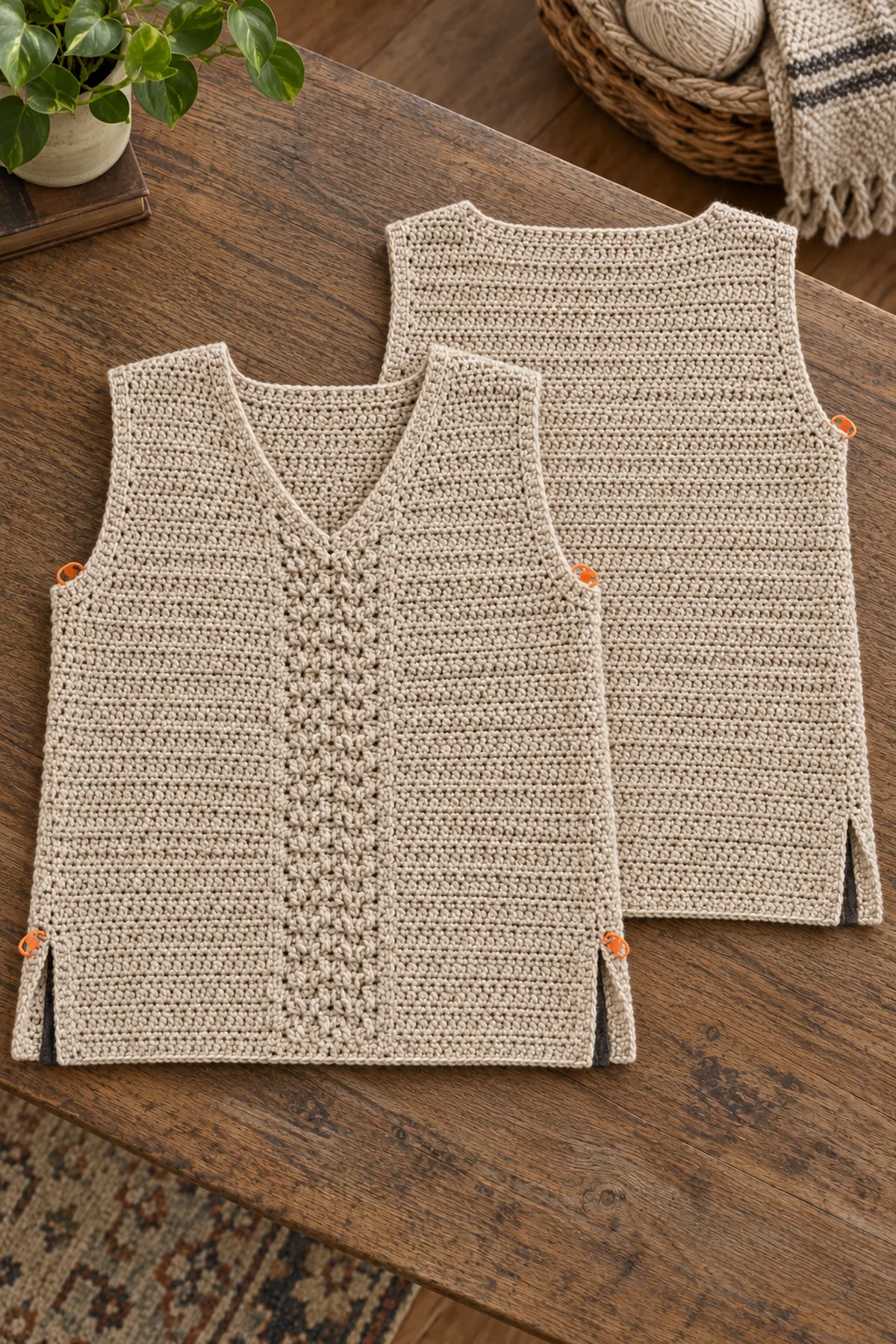
Use a flat mattress seam, not a ridge that shortens the neckline. Match row ends before joining sides.
- With right sides together, mattress-sew each front shoulder to its marked back shoulder stitch for stitch: 26 (30, 34, 38) passes on both sides. Leave the central back 20 stitches open. Turn right side out and confirm the V center sits below the back neck edge.
- Mark Rows 1–8 from each lower hem edge as two-inch side slits. Mark the upper 32 (34, 36, 38) rows as the straight arm openings. Sew the side seams only through Rows 9–32 (9–34, 9–36, 9–38), matching one front row-end bar to one back bar per pass. Thus both a slit and an arm opening remain unsewn on each side.
- For each arm opening, join yarn at the underarm and work one sc into each front and back row end: 64 (68, 72, 76) sc around. Slip stitch to the first sc without counting the join; make one more even sc round if the fabric needs a firmer edge. Do not close the armhole by sewing across it.
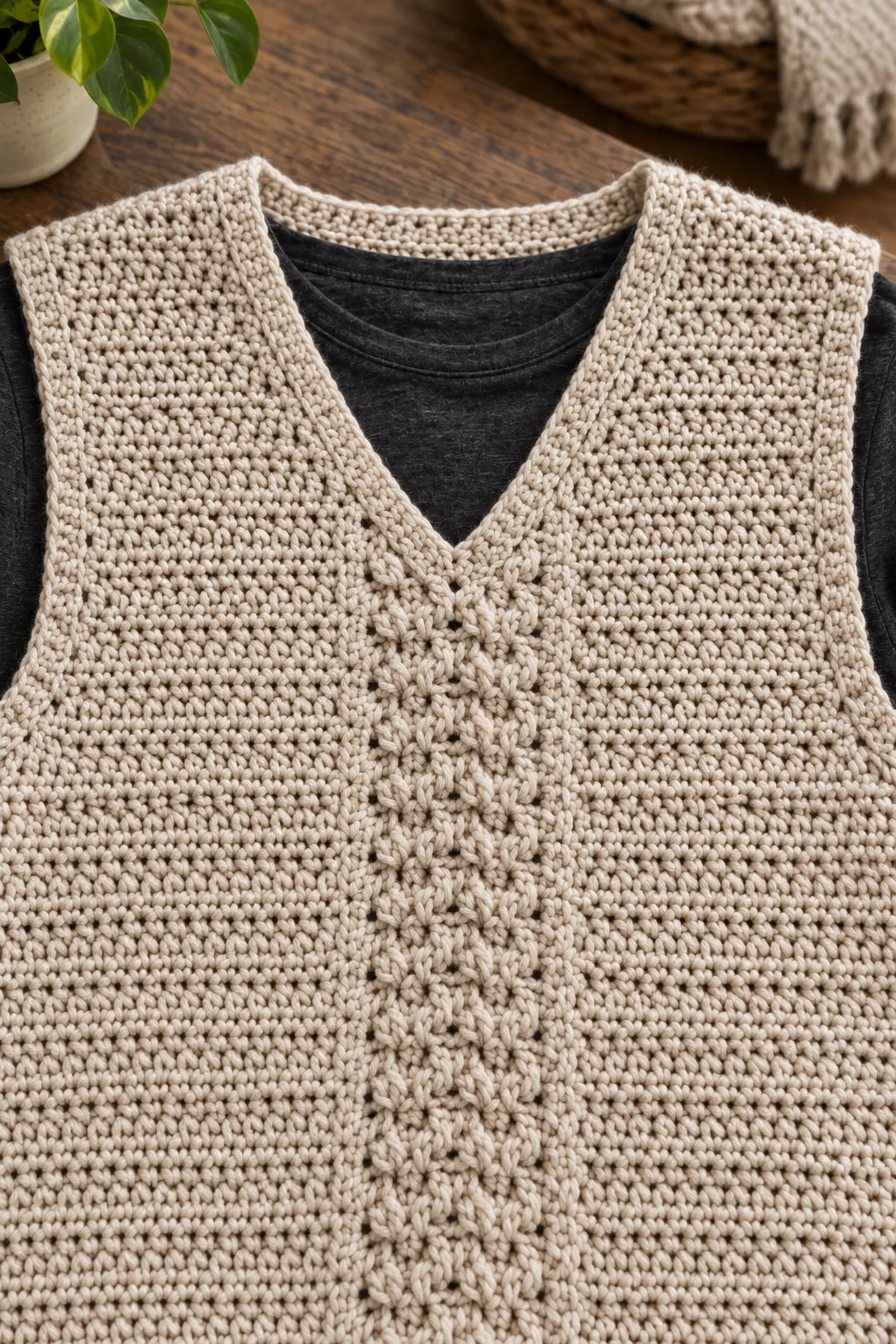
- For the neck, work one sc into each of the 20 front V row ends on each side and one sc in each of the 20 back-neck stitches, for approximately 60 sc. At the V point, work one extra sc in the center space only if needed to prevent pulling; record the resulting count. Work one sc along each two-inch slit edge and hem without bridging the slit opening. Wash, dry flat and measure chest, arm depth, body length and slit length again.
Assembly and Shaping
Each of the two panels starts at the same 72/80/88/96-stitch width. The back ends full width; the front has two independently shaped shoulders. Ten inner-edge decreases per side leave 26/30/34/38 stitches, exactly matching back shoulder groups around a 20-stitch back neck. Side seams exclude the bottom eight row ends and upper 32/34/36/38 row ends.
Lay every component on a flat surface before joining. Match the marked centers first, then divide each remaining edge into equal sections. Work through both layers with consistent tension and pause after each section to check that the fabric lies flat. This measured approach prevents twisting and keeps decorative details facing the intended direction.
Finishing
- Weave each tail along three different paths on the wrong side; reverse direction before trimming.
- Wash or damp-block according to the yarn label and allow the work to dry at its measured shape.
- Inspect every seam, edge and attachment from both faces before first use, then inspect again after laundering.
For a polished result, weave each tail through several same-color stitches, reverse direction once, and trim only after the fabric has been gently stretched. Block to the listed dimensions without flattening textured stitches. Inspect joins, borders, straps, and decorative pieces before the project is used or gifted.
Helpful Tips
- Use contrasting locking markers at shaping points and record the count after every change row.
- Change hook size when the washed swatch differs from the stated gauge; do not compensate with uneven hand tension.
- Photograph the flat components before joining so it is easy to identify an inverted or twisted piece.
Good lighting and a contrasting stitch marker make counting much easier. If a section looks uneven, compare the current count with the previous checkpoint before continuing. Fixing one missed stitch early is faster than compensating later, and it preserves the measurements used by the assembly instructions.
Frequently Asked Questions
How much ease should I choose?
Choose a finished chest about 2–4 inches larger than the intended wearer’s body or a comfortable reference garment. Wash the swatch before deciding; four size labels cannot guarantee fit without the actual measurements.
Can I lengthen the hem?
Add the same number of full-width rows to both panels below the V split, then move the side-seam and armhole markers by that amount. Keep the slit at eight rows and remeasure after washing.
Conclusion
The vest has a clean V-neck, an uninterrupted center texture field below the split and genuinely open side-slit hems. Its fit depends on the washed gauge and the listed finished chest, not the nominal size letters.
BabyYarnie Printable Crochet Pattern Card
BabyYarnie — easy-to-follow crochet for everyday makers.
Project: Crochet Split-Hem Textured Sweater Vest
Skill level: Intermediate Hook: 5 mm, adjusted after a washed 20-stitch textured swatch Yarn: Worsted washable wool-cotton blend
Finished size: S/M/L/XL: 36/40/44/48-inch finished chest, 16/17/18/19-inch body length; intended for approximately 32–34/36–38/40–42/44–46-inch body chest with 2–4 inches positive ease
Card Materials
- Approximately 800/950/1100/1250 yards oatmeal washable worsted wool-cotton blend for S/M/L/XL, plus 10% swatch and repair allowance
- 5 mm hook or size yielding washed gauge, six locking markers, blunt needle, tape measure and blocking surface
- A dark long-sleeve top for styling only; no buttons, ties or hardware are part of the vest
Card Instructions
- Swatch and Crochet Two Full-Width Body Panels: Make two flat panels 72/80/88/96 stitches wide; keep a 12-stitch centered post field, finish the back at 64/68/72/76 rows and stop the front 20 rows sooner.
- Shape the Shallow V and Match Shoulder Widths: Split the front in half for 20 rows; decrease at each V edge on ten even-numbered shaping rows to 26/30/34/38 stitches per shoulder.
- Sew Shoulders, Side Slits and Clean Edges: Join equal shoulders, sew only the middle side rows, leave 8-row hem slits and 32/34/36/38-row armholes, then trim neck and arm openings.
Finish: Check every count, weave in all ends, block to measurement, and inspect each join.