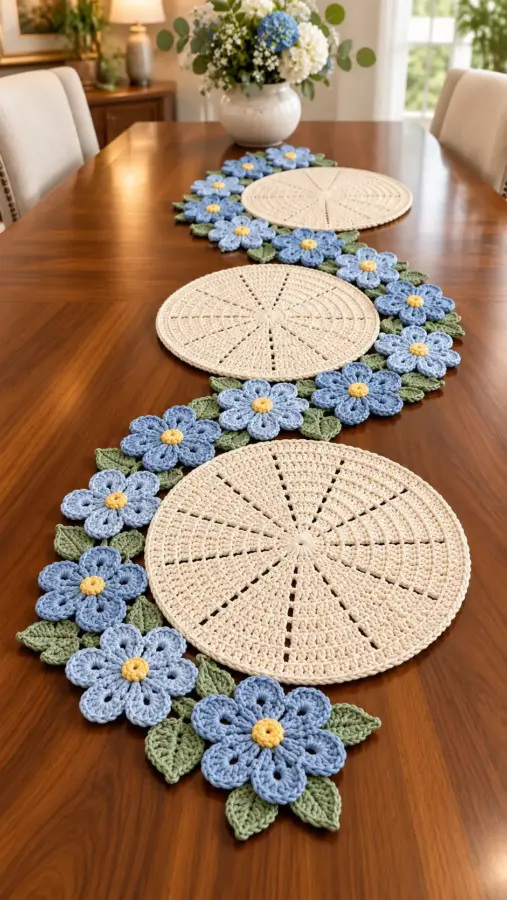
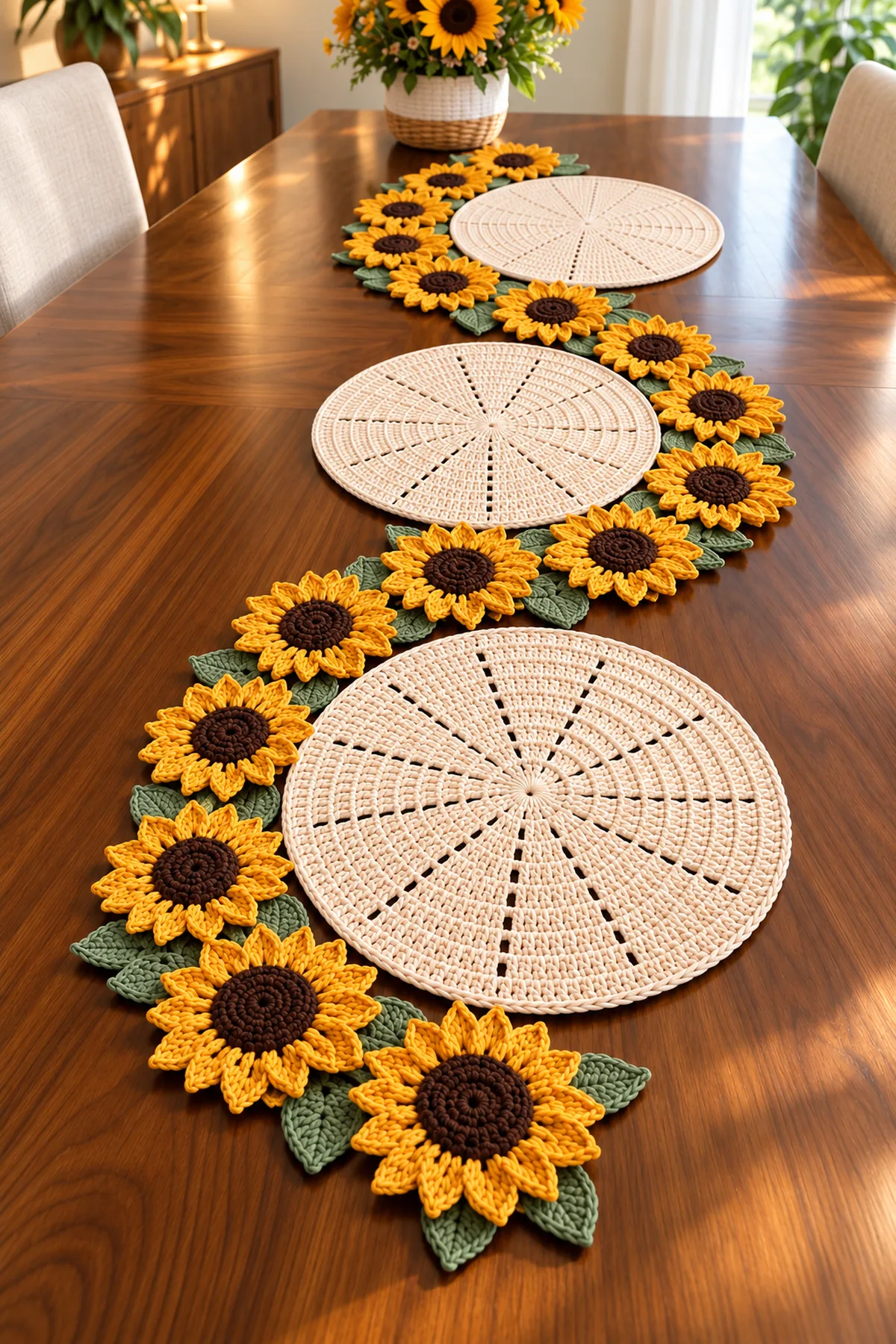
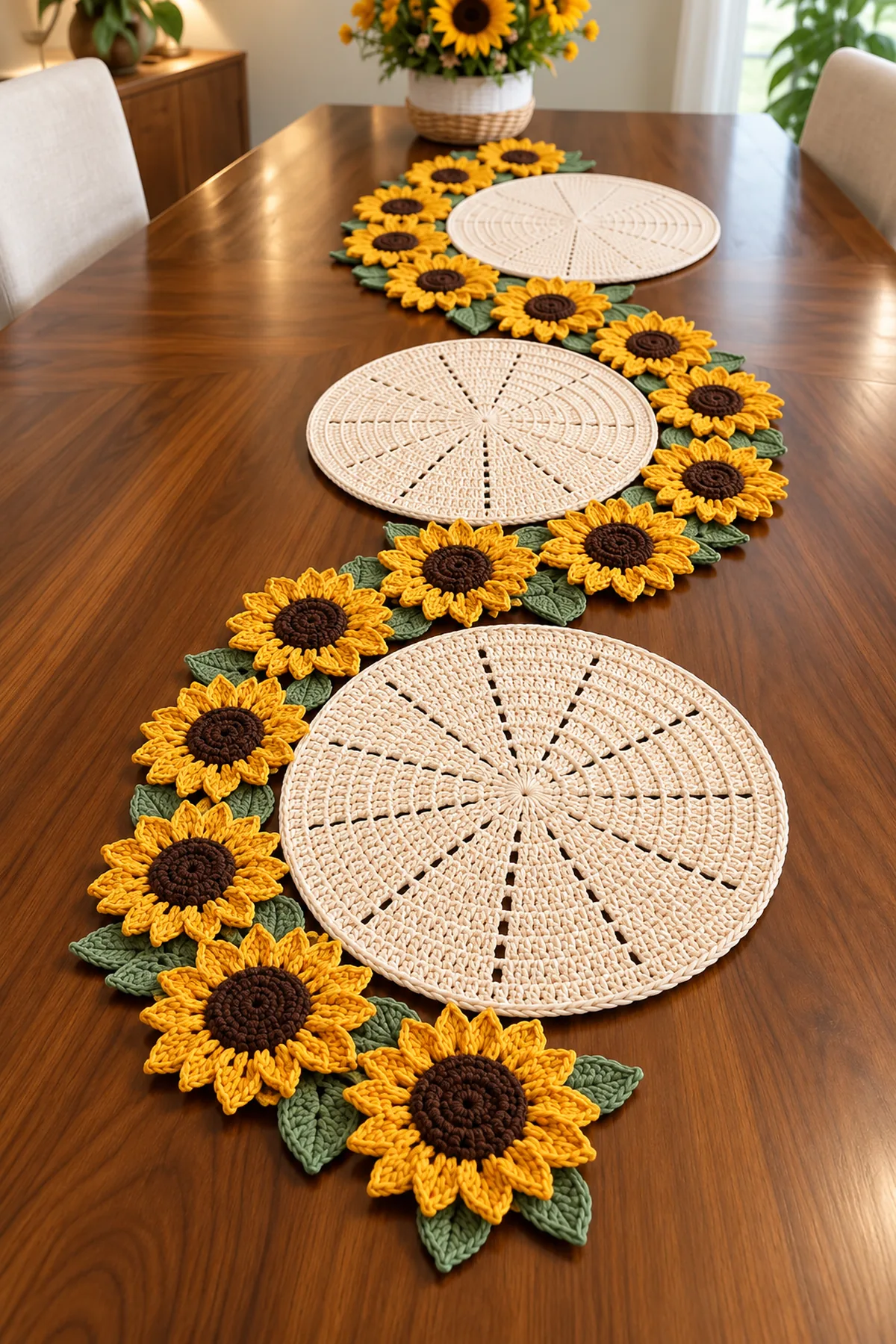
This Rustic Sunflower Crochet Table Runner & Matching Placemats pattern takes its palette and tabletop arrangement from the photo you supplied: a winding chain of golden sunflowers with dark centers and sage leaves beside three cream round placemats. The photo is the required visual reference; the stitch instructions below are an original counted construction. Make the placemats separately, then build the runner from a reinforced green spine, 15 flower motifs and 30 leaves.
Make three ivory mats in joined rounds, increasing one double crochet in each of 12 marked wedges while renewing a chain-one eyelet at every spoke. Separately crochet 15 two-round brown centers, add 16 narrow pointed golden petals to each, and sew them at measured points along a three-row sage spine. Add 30 mirrored leaves. The runner and mats are independent pieces; the mats are not sewn into the floral spine.
Pattern Details
- Hook Size: 3.5 mm (E) starting point; adjust to the washed cotton gauge
- Finished Size: Planning target: three placemats about 12–13 in diameter; runner about 58–62 in long and 6–7 in wide including petals and leaves
- Gauge: 16 dc and 8 joined rounds = 4 in in the placemat fabric; 18 sc and 20 rows = 4 in on runner spine
- Terminology: US
- Estimated Time: Planning estimate 18–26 hours for the complete set
- Construction: Three 14-round, 12-wedge placemats; 15 flowers with 16-sc centers and 16 petals each; 30 leaves; one 270-stitch by 3-row sage spine
- Skill level: Intermediate
Why You’ll Love This Project
The set combines the sculptural petals of a sunflower with the open radial lines of a classic round mat. Each component is worked and counted on its own, so you can check the flower spacing, keep the runner straight and block the placemats flat before assembly.
Materials
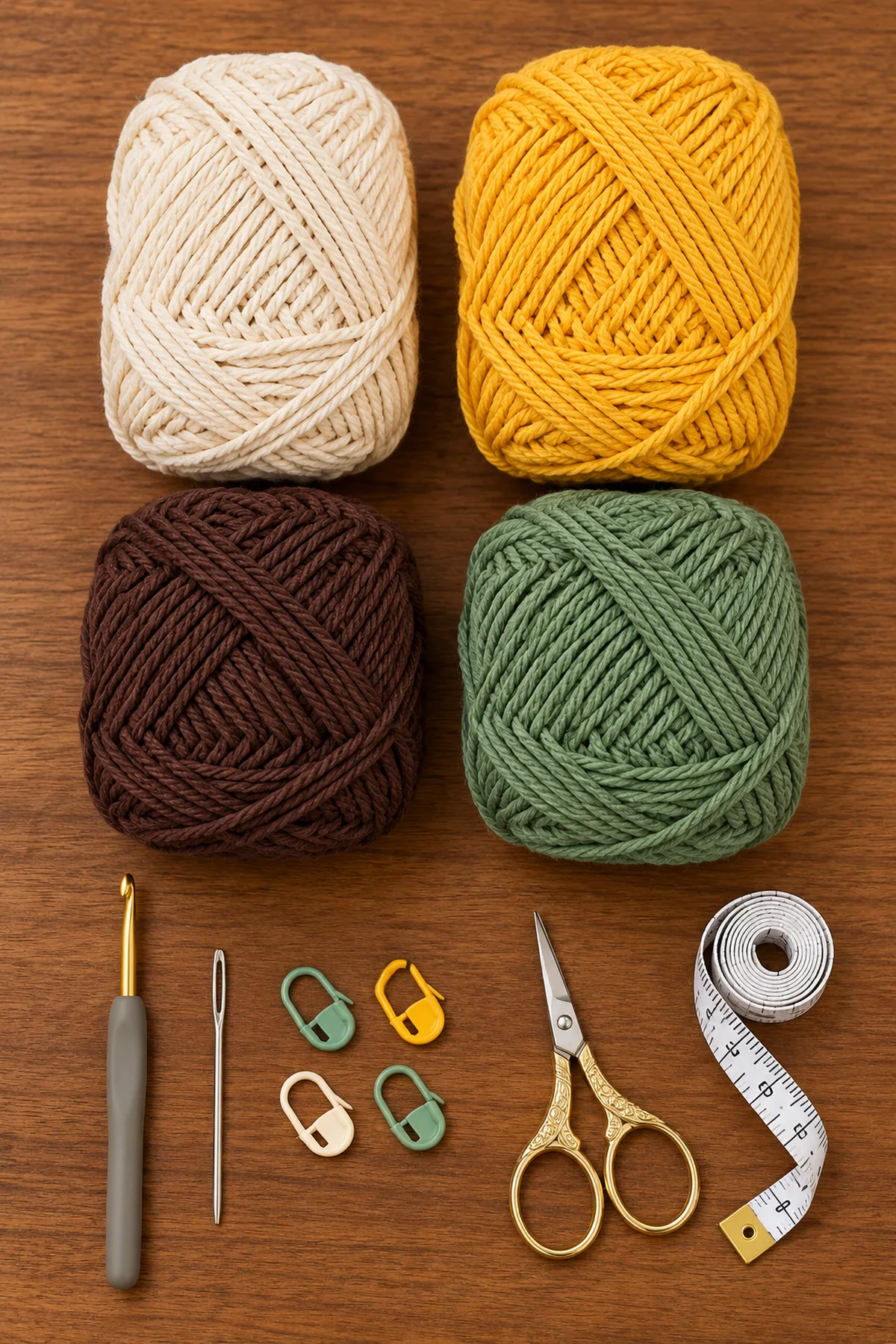
- Planning allowance: 600–800 yd ivory DK 100% cotton for three mats, 250–350 yd golden-yellow, 100–150 yd dark brown, and 200–300 yd sage green, plus swatch allowance
- 3.5 mm (E) hook or size that meets the washed gauge, 4 locking markers, blunt tapestry needle, scissors and tape measure
- Blocking mat or clean towels and rustproof pins; optional removable contrasting thread for marking each 12-wedge spoke and flower center
Gauge, Measurements, and Planning
Wash and dry a 20-stitch by 10-round swatch in the same cotton and dc used for a placemat. The inner 16 dc by 8 rounds should span 4 inches. Also swatch the runner spine in sc: 18 stitches by 20 rows should span 4 inches. At those targets, 270 spine stitches measure about 60 inches; each flower center is placed every 18 stitches, leaving equal 9-stitch margins. The 14-round placemat is expected to finish near 12–13 inches across, but cotton, turning tension and blocking change dimensions. Make and block one mat and one flower before completing the set.
Make and wash a gauge swatch before beginning. Measure only after the swatch is completely dry. If the stitch width differs, change hook size rather than pulling the working yarn tighter. Keep a written count at the end of every section so the finished edges remain balanced and the assembly points line up.
Abbreviations and Special Stitches
- ch: chain
- sc: single crochet
- hdc: half double crochet
- dc: double crochet
- sl st: slip stitch
- st(s): stitch(es)
- sp: space
- inc: two stitches in one stitch
Special stitch guidance: Each mat has 12 marked wedges. In Rounds 3–14, work the wedge’s stated number of dc into its old dc positions, make 2 dc in the final old dc of that wedge, then ch 1 at the spoke; skip the previous spoke chain-space on the next round. Chain spaces are not included in dc stitch counts. Flower petals are worked individually into the 16 gaps between center-round stitches: ch 7, then work sc, hdc, dc, dc, hdc, sc back down the chain and sl st into the same gap. The beginning ch 2 on mat rounds never counts as a dc.
Important Notes
- The supplied photo is the mandatory reference for the golden sunflowers, brown centers, sage leaves, wood-table runner arrangement and three ivory circular mats. Written stitch counts are original and do not reproduce instructions from the image.
- Stitch arithmetic and component counts are checked; no physically made sample, tested yardage, wash durability or final dimensions are claimed. Swatch, block one component of each type and record actual measurements before making the full set.
- Use a beginning ch 2 that does not count as a stitch; join each mat round with a slip stitch to its first dc. Mark each first dc and all 12 wedge boundaries.
- These are decorative cotton table linens, not tested heat-resistant trivets. Keep away from open flames and do not place hot cookware on them.
- Images illustrate the intended design and construction stages; follow written counts if a generated visual differs from the tutorial.
Complete Instructions for Rustic Sunflower Crochet Table Runner & Matching Placemats
Crochet the Three Radial Ivory Placemats
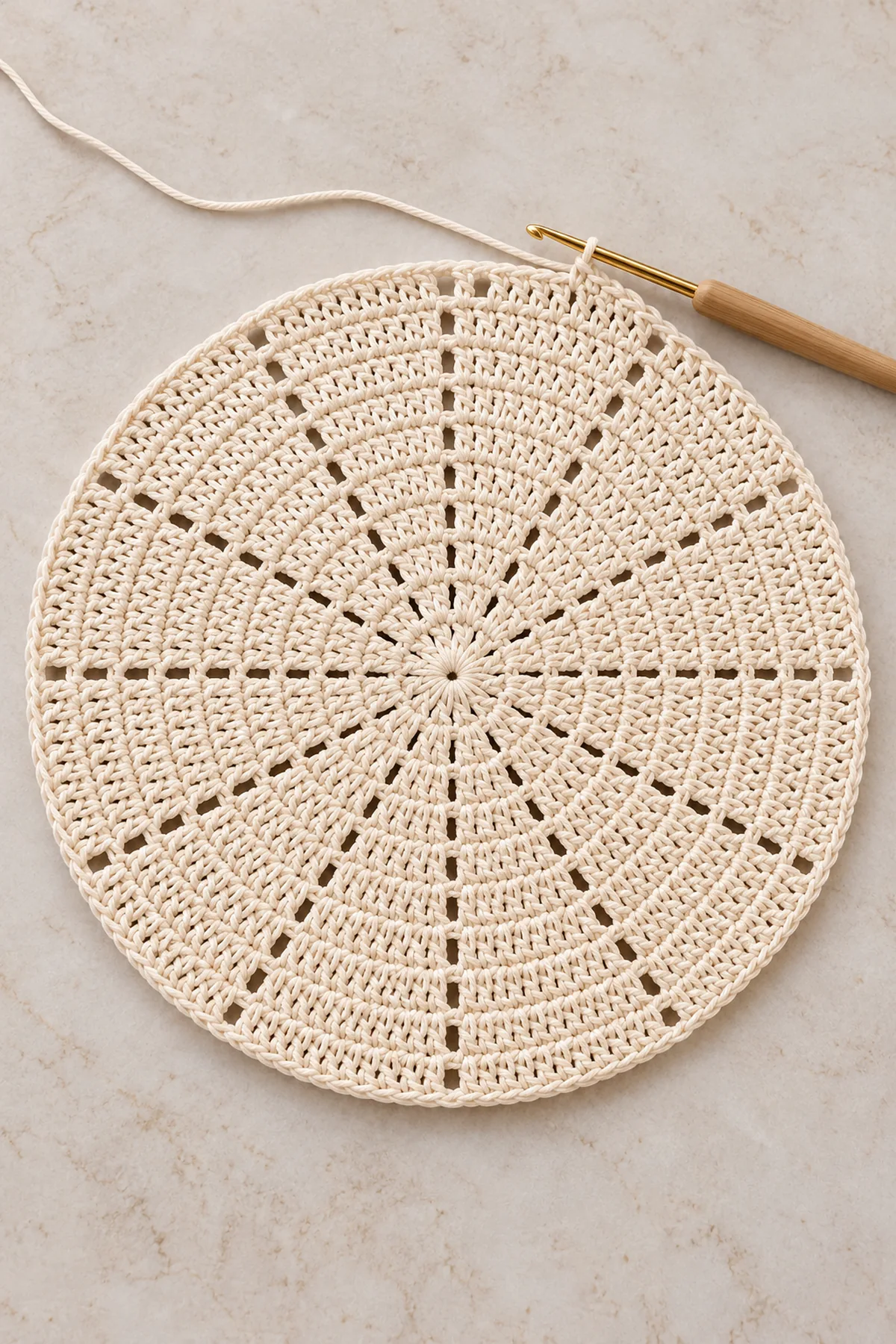
Make three identical mats. Join rounds without turning; the start chain is never counted. Place one marker at the first dc and 11 more at equal wedge boundaries.
- Round 1: With ivory, make a magic ring and ch 2. Work 12 dc into the ring; join to the first dc and tighten the ring. (12 sts)
- Round 2: Ch 2, work 2 dc in each of the 12 old dc, then join. Move the first-stitch marker into the first new dc and mark each 2-stitch wedge. (24 sts)
- Round 3: In each wedge, dc in the first old dc, 2 dc in the next old dc, ch 1 to mark the spoke; skip no dc. Repeat 12 times and join. (36 sts) Plus 12 ch-1 spaces, which do not count as dc stitches.
- Rounds 4–14: At each wedge, work 1 dc in each of the first (2, 3, 4, 5, 6, 7, 8, 9, 10, 11, 12) old dc positions for Rounds 4–14 respectively, then 2 dc in the final old dc of that wedge; ch 1 at the spoke and skip the previous round’s ch-1 space. Join each round. Counts are Round 4 (48 sts), Round 5 (60 sts), Round 6 (72 sts), Round 7 (84 sts), Round 8 (96 sts), Round 9 (108 sts), Round 10 (120 sts), Round 11 (132 sts), Round 12 (144 sts), Round 13 (156 sts), Round 14 (168 sts).
- Round 15, smooth edge: Ch 1. Sc once in each of the 168 dc and once in each of the 12 spoke ch-1 spaces; join to the first sc. (180 sts) Fasten off. Make two more mats, then wash and block all three to equal diameters with the 12 eyelet spokes radiating evenly.
Make Fifteen Sunflower Centers and Pointed Petals
Each sunflower uses a dark center and one round of golden petals. Make 15; keep the petal chains consistent so the flowers sit flat when sewn to the runner.
- Center Round 1: With dark brown, make a magic ring, ch 1 and work 8 sc into it. Join to the first sc and tighten. (8 sts)
- Center Round 2: Ch 1, work 2 sc in each old sc and join. (16 sts) Fasten off with a sewing tail.
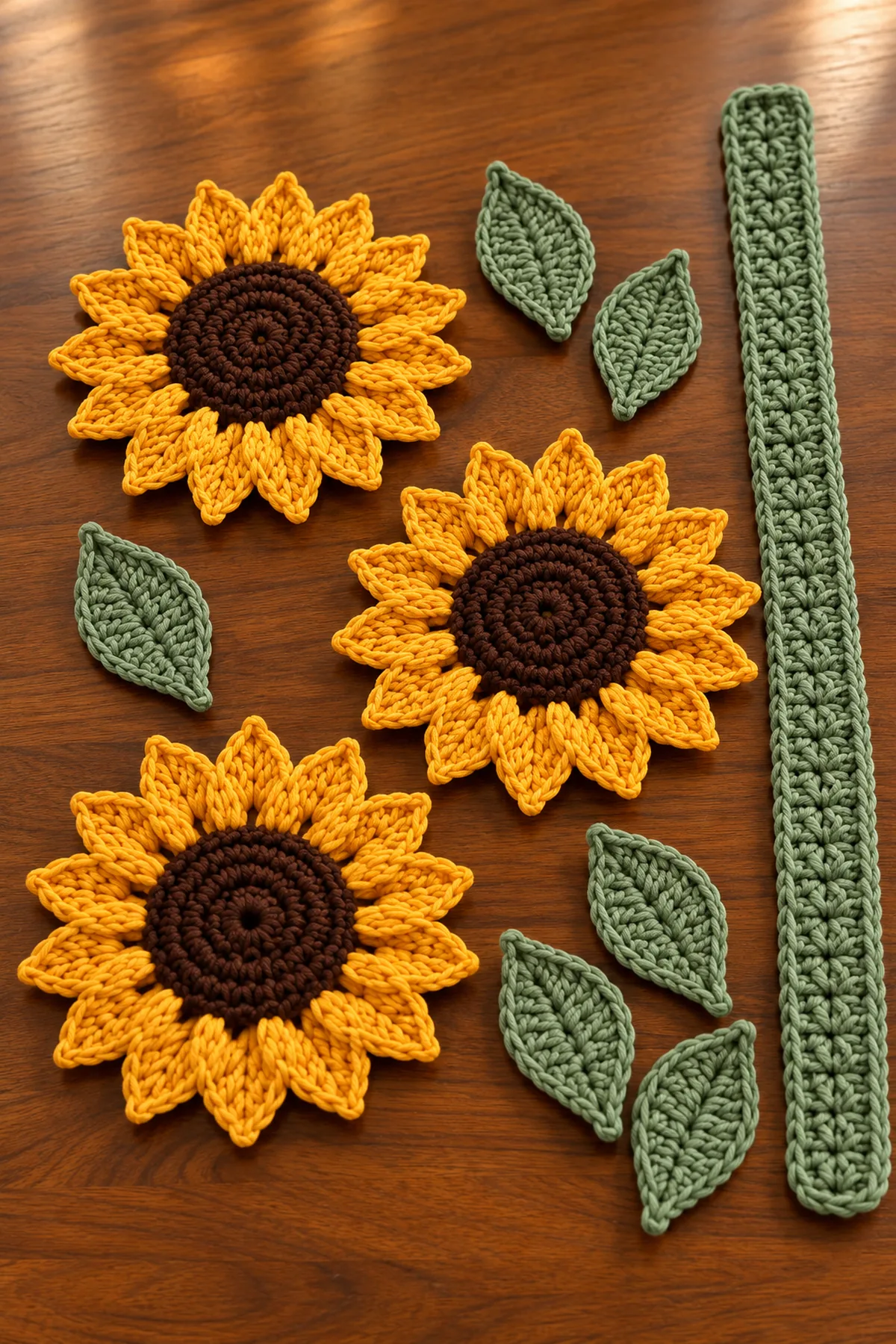
- Petal Round: Join golden yarn with a sl st in any gap between adjacent center stitches. Repeat in each of the 16 gaps: ch 7; starting in the second chain from hook, work sc, hdc, dc, dc, hdc and sc into the next six chains; sl st back into the same center gap. One complete repeat forms one pointed petal. Join invisibly to the first gap and fasten off. Count 16 petals around each center.
- Repeat the center and petal rounds until you have 15 complete flowers. Gently arrange the petals in a circle without pulling the brown center into a cup; if the flower ruffles, remake with a larger hook or loosen the chain tension.
Crochet the Runner Spine and Thirty Sage Leaves
The spine is a three-row flat strip. Keep a marker at both ends and do not twist it before attaching flowers.
- Spine Row 1: With sage, ch 271. Sc in the second chain from hook and each remaining chain across; turn. (270 sts)
- Spine Rows 2–3: Ch 1, sc in each of the 270 stitches and turn. The turning chain never counts. Fasten off after Row 3. (270 sts each row)
- Mark the center line and place 15 flower marks on it at stitches 9, 27, 45, 63, 81, 99, 117, 135, 153, 171, 189, 207, 225, 243 and 261, counting from the same short end. These marks are 18 stitches apart with nine-stitch margins.
- Leaf, make 30: With sage, ch 9. Working on the first side, sc in the second chain, hdc in the next, dc in the next two, tr in the next, dc in the next and hdc in the next; work 3 sc in the last chain. Rotate to the unused underside of the foundation and work hdc, dc, tr, dc, dc, hdc and sc across the remaining seven chain bars; sl st at the base and fasten off. (17 sts: 7 + 3 + 7)
- Make two mirrored leaves for each flower mark. Point one leaf toward each long side of the runner; reverse the second leaf’s tilt by turning it before sewing so the pair frames the flower rather than pointing in the same direction.
Arrange, Sew and Block the Complete Table Set
The runner remains one long floral strip; all placemats remain separate round pieces. Use the photo as an arrangement and color reference while keeping the three components detachable.
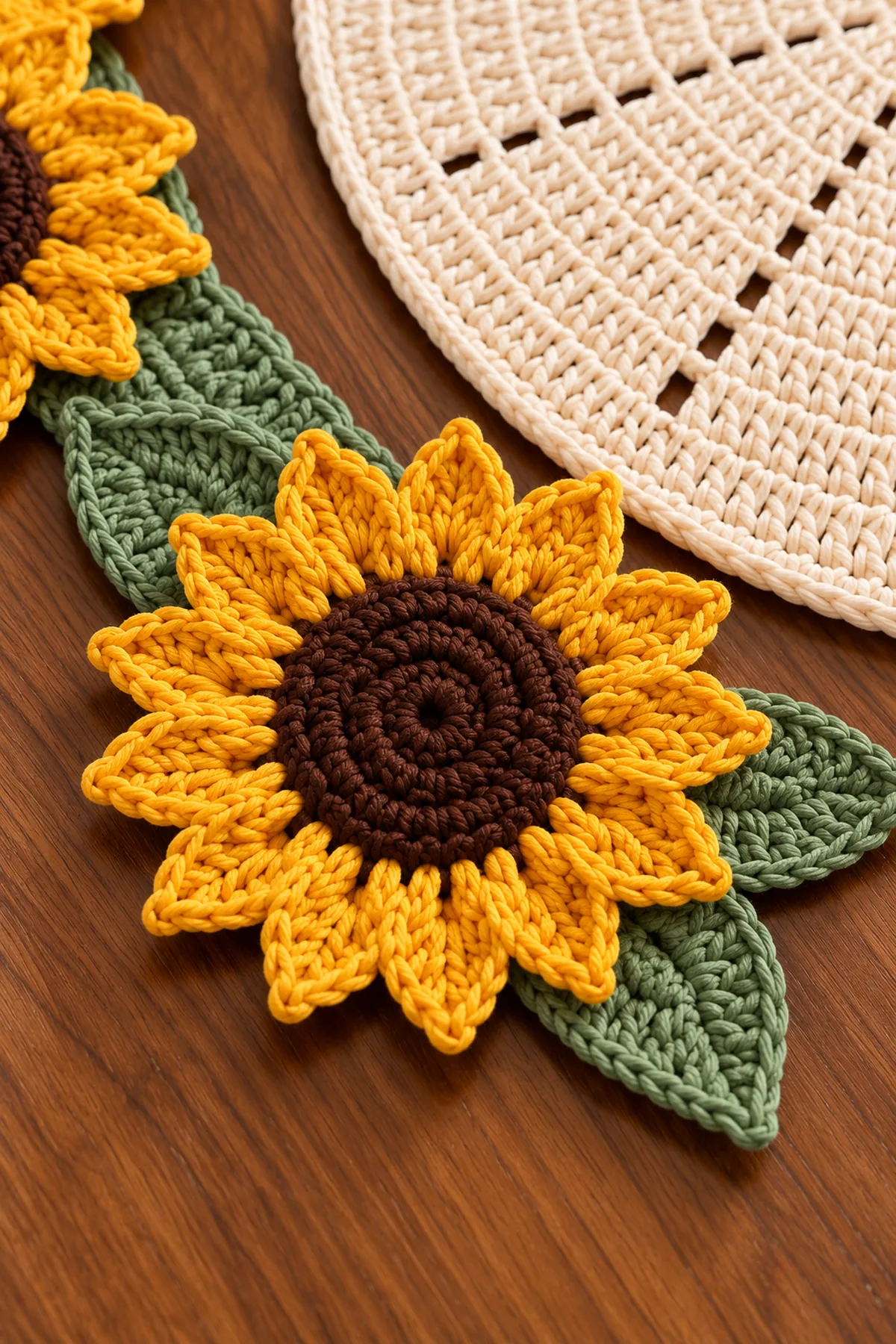
- Center each sunflower over its marked spine position. Pin through the brown center and both sage rows, then sew around the outer half of the brown circle in two complete passes. Catch the base of every petal in the second pass so petals do not lift; do not sew through the petal tips.
- Position two leaves at each flower, one on either side and slightly behind the center. Sew each leaf base across at least four spine stitches using its matching tail; secure the pointed tip with one light stitch so the leaf lies flat but retains its shape. Repeat at all 15 marks for 30 attached leaves.
- Lay the runner flat and check that every flower is centered on the spine and that the green strip is not twisted. The flower centers should follow a gentle tabletop curve when arranged, but the crocheted spine itself should block flat.
- Arrange the three placemats beside the runner as separate pieces, matching the photo. Wash and block cotton according to its label; pin each mat to the same diameter and open each of its 12 spoke eyelets evenly. Let every component dry fully before setting the table.
Assembly and Shaping
The runner spine has 270 stitches over three rows. Its 15 flower centers sit at stitches 9 through 261 in 18-stitch intervals; 30 leaves attach in pairs. Each flower has a 16-sc brown center and 16 golden petals. Each of the three mats grows from 12 center dc to 168 dc and has 12 marked chain-one spokes before a 180-sc edge.
Lay every component on a flat surface before joining. Match the marked centers first, then divide each remaining edge into equal sections. Work through both layers with consistent tension and pause after each section to check that the fabric lies flat. This measured approach prevents twisting and keeps decorative details facing the intended direction.
Finishing
- Weave tails through same-color stitches on the underside and reverse direction before trimming.
- Wash and dry the mats flat to the same measured diameter; shape each flower and leaf gently without stretching its seams.
- Inspect all 15 flower attachments, all 30 leaf bases and every mat join. Repair a loose point before setting the table.
- Follow the yarn care label and keep the cotton pieces away from open flame and hot cookware.
For a polished result, weave each tail through several same-color stitches, reverse direction once, and trim only after the fabric has been gently stretched. Block to the listed dimensions without flattening textured stitches. Inspect joins, borders, straps, and decorative pieces before the project is used or gifted.
Helpful Tips
- Mark all 12 mat wedges before beginning Round 3, then move markers at the same spoke boundaries each round.
- If a mat ripples, check that the increases are one per wedge; if it cups, check for a missed increase before changing the hook.
- Make one flower and wash-block it before producing the remaining fourteen; use that first bloom as the size guide.
- Pin all 15 flowers in place before sewing so the 18-stitch spacing remains even from end to end.
Good lighting and a contrasting stitch marker make counting much easier. If a section looks uneven, compare the current count with the previous checkpoint before continuing. Fixing one missed stitch early is faster than compensating later, and it preserves the measurements used by the assembly instructions.
Frequently Asked Questions
How many sunflower motifs are in the runner?
The written runner uses 15 flowers and 30 leaves, with two leaves framing each flower. The three round placemats are separate pieces.
Can I make the placemats larger?
Yes. Continue the 12-wedge sequence, adding one dc increase to each wedge and renewing its chain-one spoke on every additional round. Record the new stitch count and block all mats to the same diameter.
Are these placemats safe for hot dishes?
They are decorative cotton linens, not tested trivets. Do not place hot cookware or open flames on crochet fabric.
Has this set been physically tested?
No sample or tested yardage is claimed. The stitch arithmetic is specified for checking, while gauge, dimensions and materials remain planning estimates until you make and wash a sample.
Conclusion
Your finished set pairs a winding sage-backed chain of golden sunflowers with three independent ivory mats whose open spokes echo the radial flower shapes. Keep the flowers and mat components flat, record your washed measurements and enjoy the warm handmade table styling shown in the reference.
BabyYarnie Printable Crochet Pattern Card
BabyYarnie — easy-to-follow crochet for everyday makers.
Project: Rustic Sunflower Crochet Table Runner & Matching Placemats
Skill level: Intermediate Hook: 3.5 mm (E) starting point; adjust to the washed cotton gauge Yarn: DK-weight 100% cotton
Finished size: Planning target: three placemats about 12–13 in diameter; runner about 58–62 in long and 6–7 in wide including petals and leaves
Card Materials
- Planning allowance: 600–800 yd ivory DK 100% cotton for three mats, 250–350 yd golden-yellow, 100–150 yd dark brown, and 200–300 yd sage green, plus swatch allowance
- 3.5 mm (E) hook or size that meets the washed gauge, 4 locking markers, blunt tapestry needle, scissors and tape measure
- Blocking mat or clean towels and rustproof pins; optional removable contrasting thread for marking each 12-wedge spoke and flower center
Card Instructions
- Crochet the Three Radial Ivory Placemats: Make three matching mats: begin with 12 dc, increase to 168 dc over 14 rounds with 12 chain-one radial spokes, then sc around 168 stitches and 12 spaces for a 180-stitch edge.
- Make Fifteen Sunflower Centers and Pointed Petals: Make 15 centers: 8 brown sc in a ring, increase to 16 sc, then add one golden six-stitch pointed petal in each of 16 gaps.
- Crochet the Runner Spine and Thirty Sage Leaves: Work a 270-stitch sage strip for three rows, mark 15 flower centers 18 stitches apart, and make 30 17-stitch pointed leaves.
- Arrange, Sew and Block the Complete Table Set: Sew one flower and two leaves at each of 15 spine marks, block the runner flat, and keep the three round placemats separate.
Finish: Check every count, weave in all ends, block to measurement, and inspect each join.