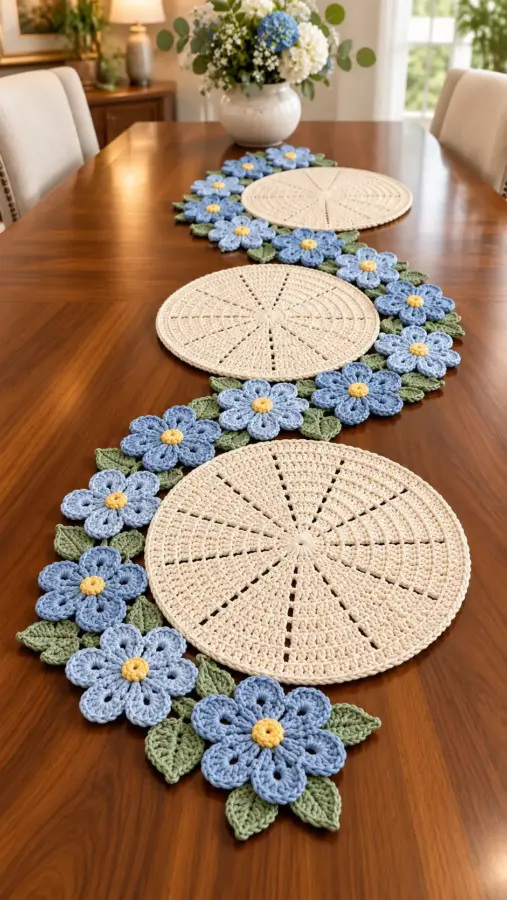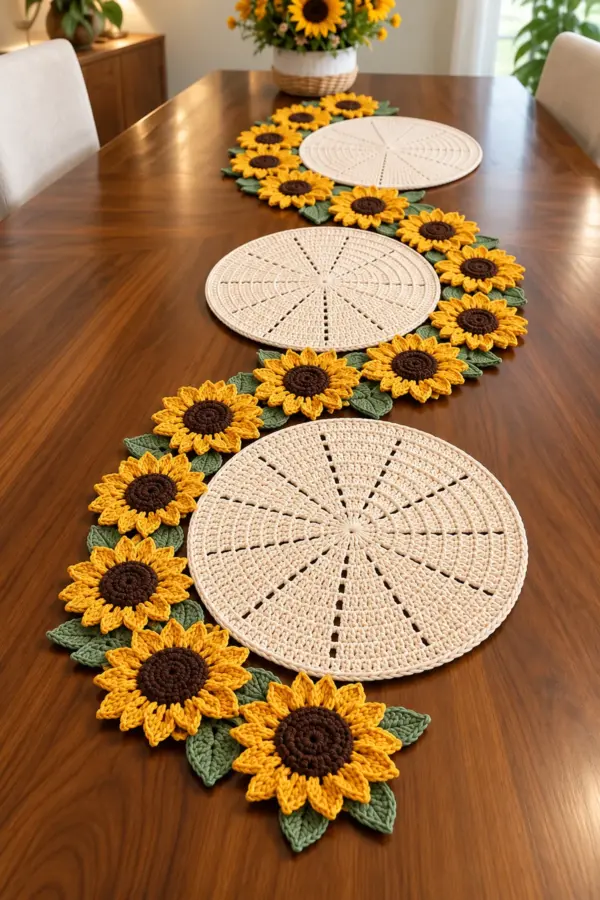
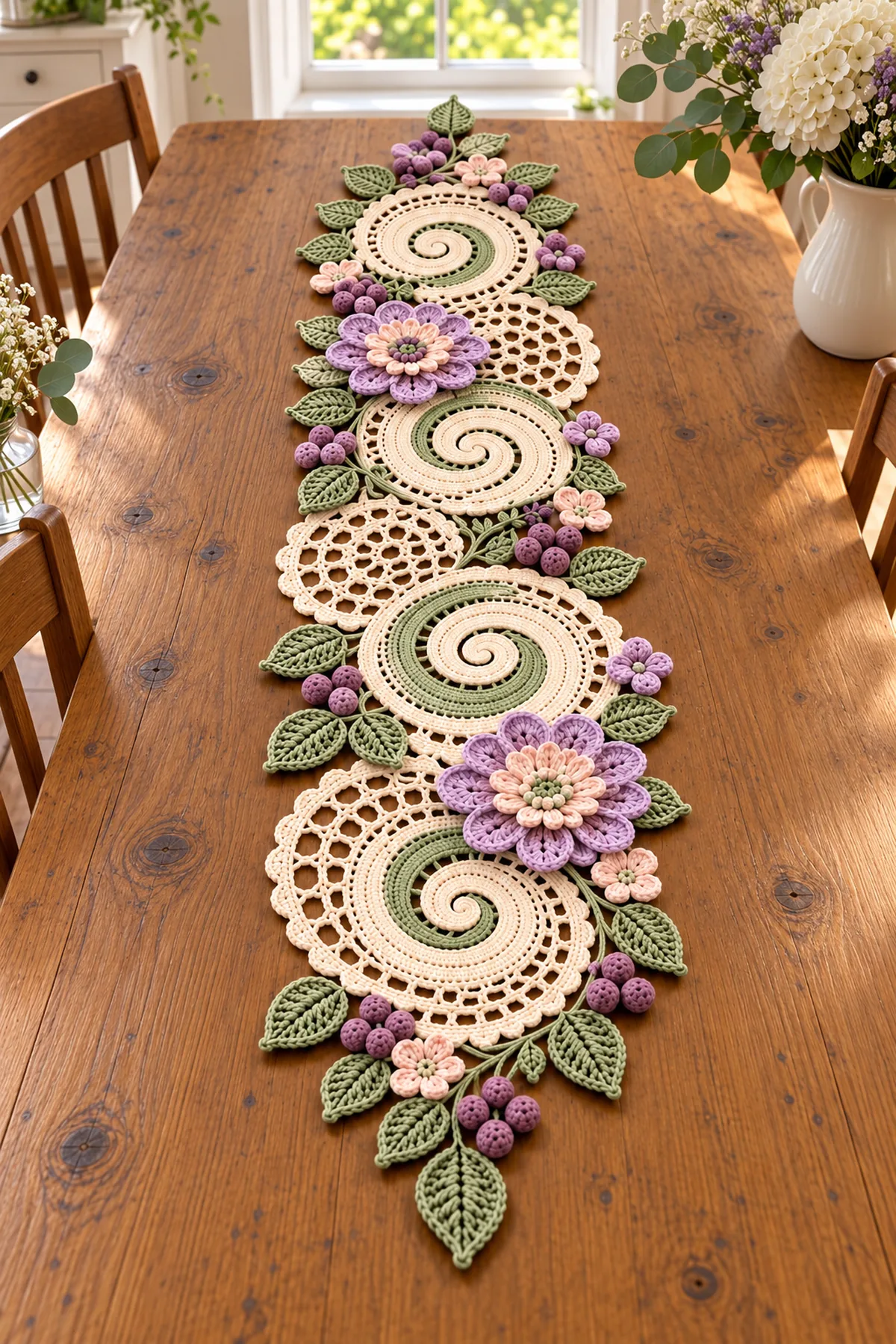
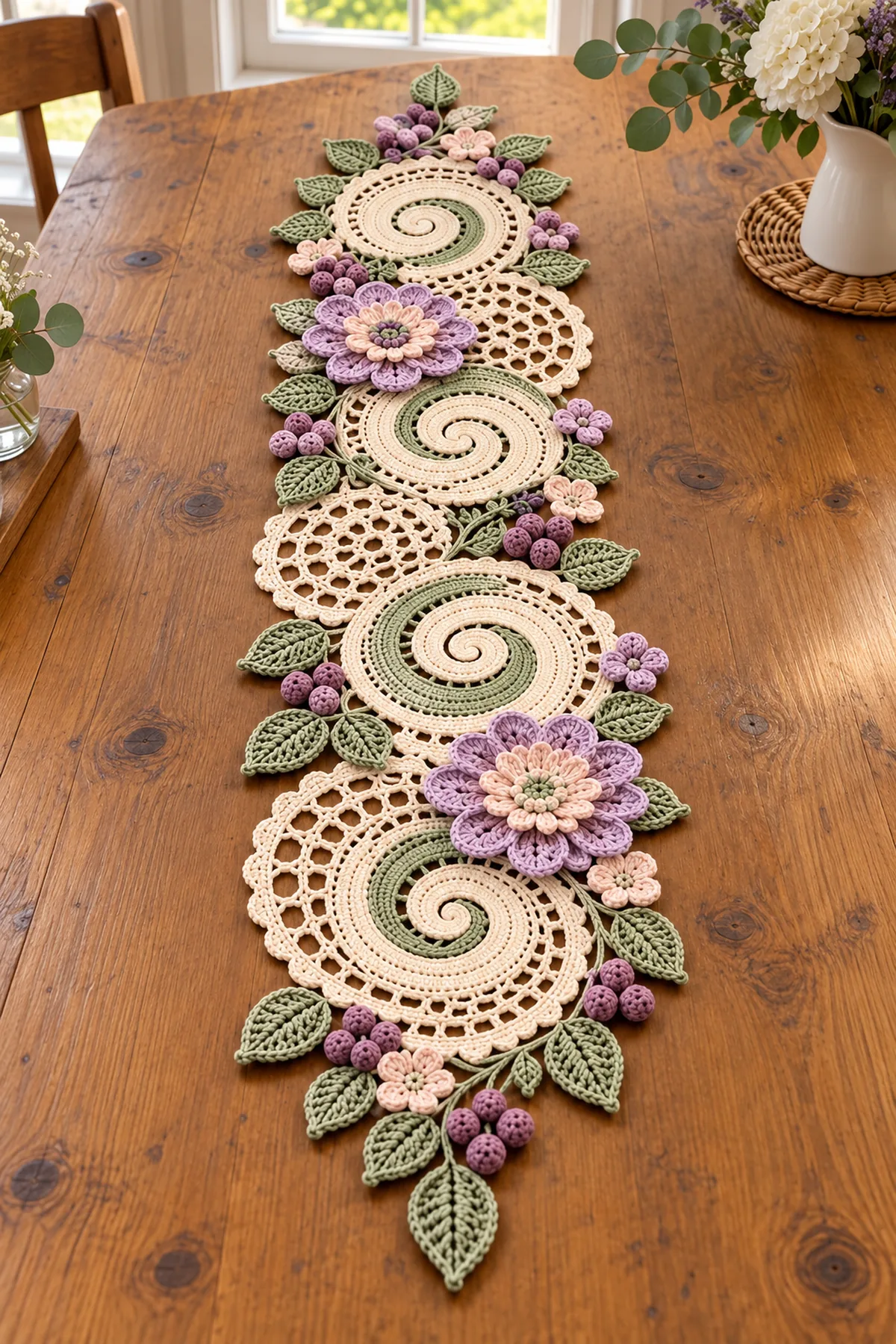
This Vintage Floral Lace Table Runner Pattern follows your reference photo’s long cream runner, sage spiral medallions, open lace bridges, soft lavender flowers, small berry clusters and leafy edges. The written construction is an original counted design: four joined-round circles, three mesh panels and securely sewn motifs. It is a decorative runner only, with no separate placemats or heat-protection claim.
Work four cream medallions in joined, marked rounds, then surface-sew a long sage crochet cord in a four-turn spiral over each one. Crochet three counted open-mesh panels and finish their short ends with 48-stitch joining edges. Join one panel to each semicircle of the medallions in sequence. Finish with the counted flowers, leaves and berry clusters along the outer edge.
Pattern Details
- Hook Size: 3.5 mm (E) for the runner; use 3.0 mm for small blossoms if needed
- Finished Size: Planning target: 46–50 in long and 8–9 in wide after blocking; four medallions about 8 in across
- Gauge: 16 dc and 8 rounds = 4 in in washed medallion fabric; 16 sc and 14 rows = 4 in in the mesh panel
- Terminology: US
- Estimated Time: Planning estimate 16–22 hours
- Construction: Four 8-round radial medallions; three 14-row mesh panels; four 195-sc spiral cords; 2 large flowers, 6 small blossoms, 16 leaves and 24 berries
- Skill level: Intermediate
Why You’ll Love This Project
The repeating circle-and-mesh sequence makes the long shape easy to plan in sections. The raised sage cords add the distinctive spiral look, while detachable motif stages let you arrange the flowers and leaves before sewing them down.
Materials
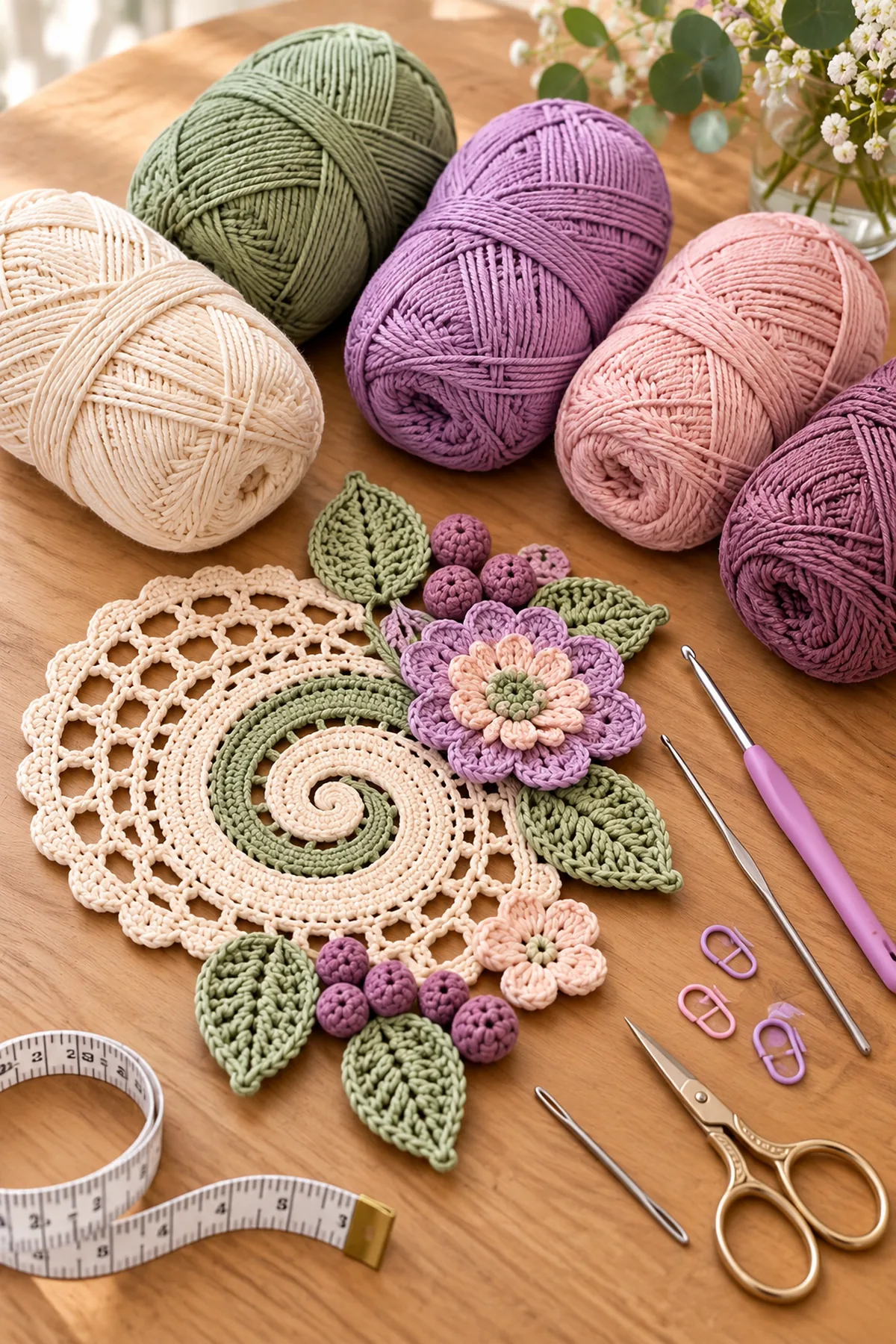
- DK 100% cotton: about 350–450 yd warm ivory, 180–240 yd sage, 100–140 yd lilac, 50–70 yd blush and 25–40 yd muted mauve for berries; allow extra for swatches
- 3.5 mm (E) hook, optional 3.0 mm hook, 10 locking stitch markers, tape measure, blunt yarn needle, scissors and rustproof blocking pins
- A small amount of washable fiberfill for the berry beads; optional removable thread for marking the 12 medallion wedges and panel centers
Gauge, Measurements, and Planning
Wash and dry a cotton swatch before starting. Aim for 16 dc across and 8 joined rounds outward to measure 4 inches in the medallion fabric. At that gauge, 8 rounds form an approximately 8-inch circle. For each mesh bridge, 16 sc anchors and 14 rows should measure about 4 inches high; the chain-two spaces should open evenly to make an 11–12-inch-wide panel. Check one complete medallion and one panel before making the rest. Dimensions, yarn use and time are estimates until a sample is made and washed.
Make and wash a gauge swatch before beginning. Measure only after the swatch is completely dry. If the stitch width differs, change hook size rather than pulling the working yarn tighter. Keep a written count at the end of every section so the finished edges remain balanced and the assembly points line up.
Abbreviations and Special Stitches
- ch: chain
- sc: single crochet
- hdc: half double crochet
- dc: double crochet
- tr: treble crochet
- sl st: slip stitch
- st(s): stitch(es)
- sp: space
- rnd: round
- sc2tog: single crochet two together
Special stitch guidance: Each medallion has 12 marked wedges. After Round 2, end each wedge with ch 1 and skip that spoke space on the next round; the spoke chain spaces do not count as dc. The mesh rows keep 16 sc anchors and 15 ch-2 spaces. For each short-edge joining border, work through all 16 sc anchors and both chains in each of the 15 spaces, then add one extra sc at each corner to make exactly 48 edge stitches.
Important Notes
- The supplied photo is the mandatory visual reference for the long cream-and-sage spiral runner, open lace bridges, soft lavender flowers, berry clusters and leaf placement. The written stitch counts and arrangement are original; no wording, instructions, watermark or image pixels are copied.
- The stitch arithmetic and component totals are checked, but no physically made sample, tested yardage or wash durability is claimed. Swatch, block one medallion and one mesh panel, and record actual dimensions before continuing.
- Beginning chains and joining slip stitches do not count as stitches. Mark the first stitch of every round and turn every flat mesh row.
- This is decorative crochet table linen, not a tested trivet. Keep it away from open flame and do not place hot cookware on it.
- Generated article images illustrate the intended construction. Follow written stitch counts if a visual differs from the tutorial.
Complete Instructions for Vintage Floral Lace Table Runner Pattern
Make Four Cream Spiral Medallions
Make four matching circles. Join rounds without turning; use a marker in the first dc and mark all 12 wedge boundaries. Beginning chains never count.
- Round 1: With ivory, make a magic ring, ch 2 and work 12 dc into the ring. Join to the first dc and tighten the ring. (12 sts) That is 12 dc.
- Round 2: Ch 2, work 2 dc in each old dc and join. Move the marker to the first new dc; each marked wedge now contains 2 dc. (24 sts) That is 24 dc.
- Round 3: In each wedge, dc in the first old dc, 2 dc in the next old dc, then ch 1 to mark the spoke. Repeat in all 12 wedges, skipping no old dc; join. (36 sts) That is 36 dc and 12 ch-1 spaces.
- Rounds 4–8: In each wedge, work 1 dc in the first (2, 3, 4, 5, 6) old dc positions for Rounds 4–8 respectively, 2 dc in the final old dc, then ch 1. Skip the prior round’s spoke space, join, and move markers. Counts: R4 (48 sts), R5 (60 sts), R6 (72 sts), R7 (84 sts) and R8 (96 sts), plus 12 spoke spaces each round.
- Round 9, firm edge: Ch 1, sc once in each of the 96 dc and skip each of the 12 ch-1 spoke spaces; join. (96 sts; 96 sc) Fasten off. Make three more medallions.
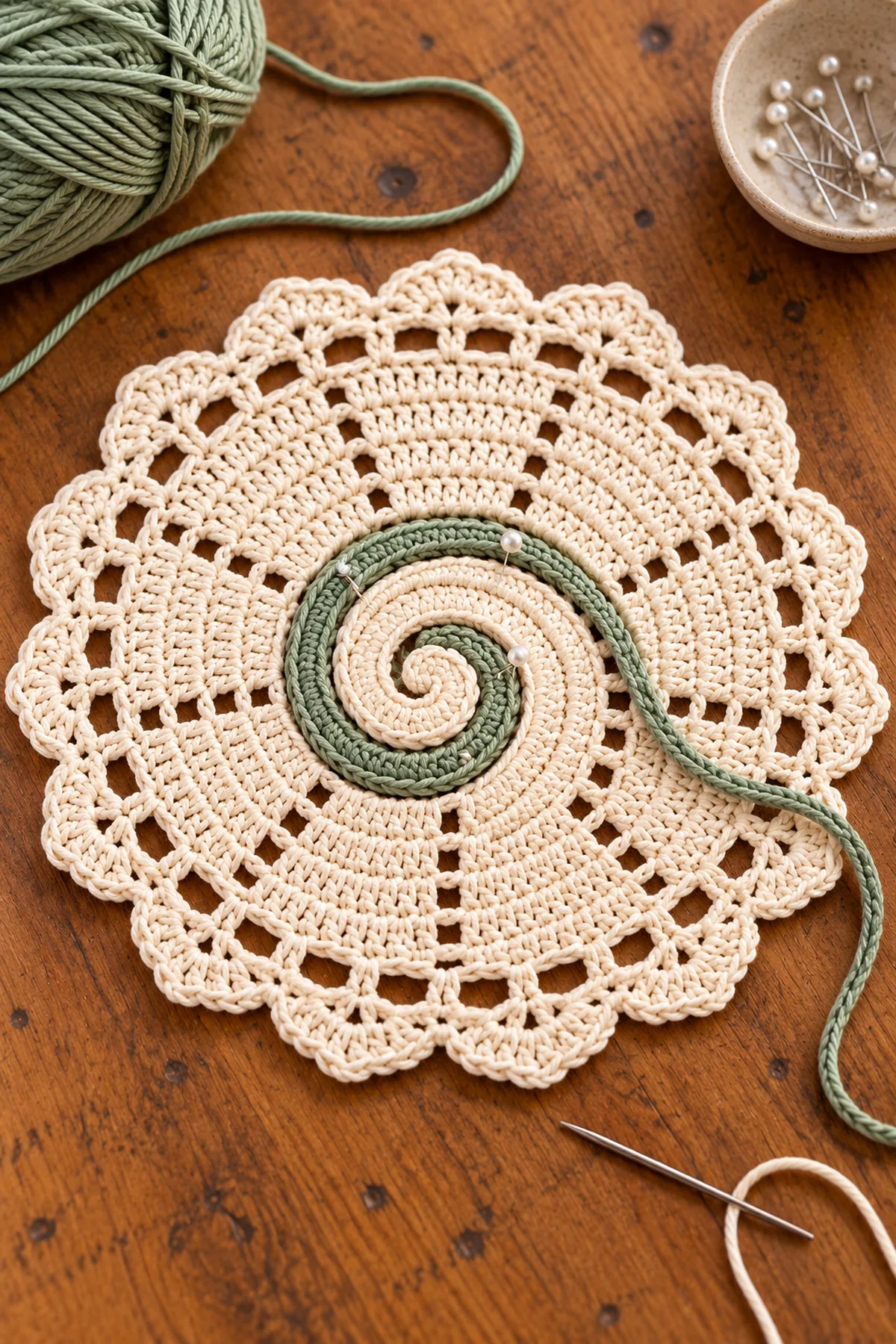
- Raised spiral cord, make 4: With sage, ch 196. Sc in the second chain from hook and each remaining chain. (195 sc) At 16 sc per 4 inches, the cord is about 49 inches. Coil one end at the center of a medallion and wind outward for four turns, spacing adjacent tracks about 1 inch apart until the tail reaches the outer edge. Pin, check that the circle stays flat, and sew the cord down at about every 2 sc with matching yarn.
Crochet Three Open-Lace Connector Panels
Make three identical rectangles. The 16 sc anchors set the panel width; the ch-2 spaces form the open mesh. Turn after every row.
- Foundation and Row 1: With ivory, ch 47. Sc in the second chain from hook; repeat (ch 2, skip 2 chains, sc in next chain) 15 times. Turn. (16 sts) This means 16 sc anchors and 15 ch-2 spaces.
- Rows 2–14: Ch 1, sc in the first sc, then repeat (ch 2, sc in the next sc) across to the final sc. Work into the old sc anchors, not into the chain spaces. Turn after each row. Every row has (16 sts), or 16 sc anchors, and 15 ch-2 spaces; fasten off after Row 14.
- Short-edge border, make both ends of each panel: At the foundation end, sc through the 16 worked sc and through both skipped chain loops in each of the 15 mesh gaps (46 sc), then add one extra sc at each corner (48 sc). At the Row 14 end, sc in each of the 16 anchor stitches and twice into each of the 15 ch-2 spaces (46 sc), then add one extra sc in each corner stitch (48 sc).
- Repeat for three panels. Block each rectangle to approximately 11–12 inches across by 3.5–4 inches long. If its 48-stitch ends do not lie flat, adjust the hook and swatch again rather than changing the joining counts.
Make the Flowers, Leaves and Berry Clusters
Use smooth cotton in the reference palette. Make all motifs before assembly and keep the backs flat for sewing.
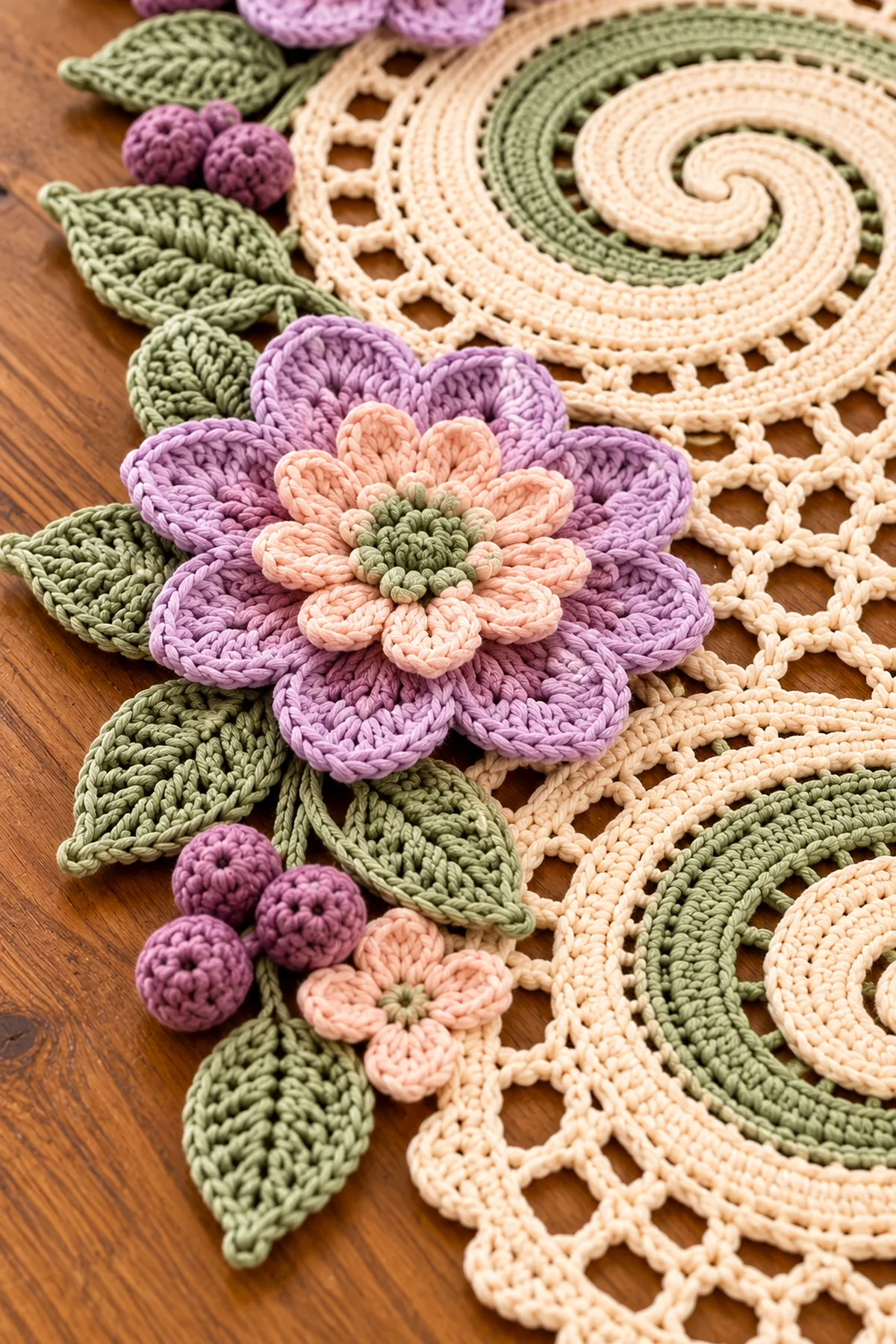
- Large layered flower, make 2: With muted mauve, make a ring and work 6 sc; join. Round 2: 2 sc in each stitch. (12 sc) For the inner layer, join blush to the six Round 1 stitches in front of the center and repeat (ch 4, sl st in the same stitch) 6 times. For the outer layer, join lilac to the 12 Round 2 stitches and repeat (ch 5, sl st in the same stitch) 12 times. These make 6 short inner loops and 12 longer outer loops. Fasten off and weave ends securely.
- Small blossom, make 6: With muted mauve, make a ring and work 6 sc; join. With lilac, repeat (ch 4, sl st in the next center stitch) 6 times for six even petals. Close the ring and fasten off.
- Pointed leaf, make 16: With sage, ch 10. On the first side, starting in the second chain, work sc, hdc, 2 dc, tr, 2 dc, hdc; work 3 sc in the last chain. Rotate to the unused underside and work hdc, 2 dc, tr, 2 dc, hdc, sc across the remaining chain bars. Sl st at the base and fasten off. (19 stitches: 8 + 3 + 8)
- Berry bead, make 24: With mauve, make a ring and work 6 sc; join. Round 2: 2 sc in each stitch. (12 sc) Round 3: sc around. Round 4: sc2tog 6 times. (6 sc) Add a pinch of fiberfill, draw the opening closed and fasten off with a long sewing tail. Make six groups of four berries.
Join and Arrange the Complete Table Runner
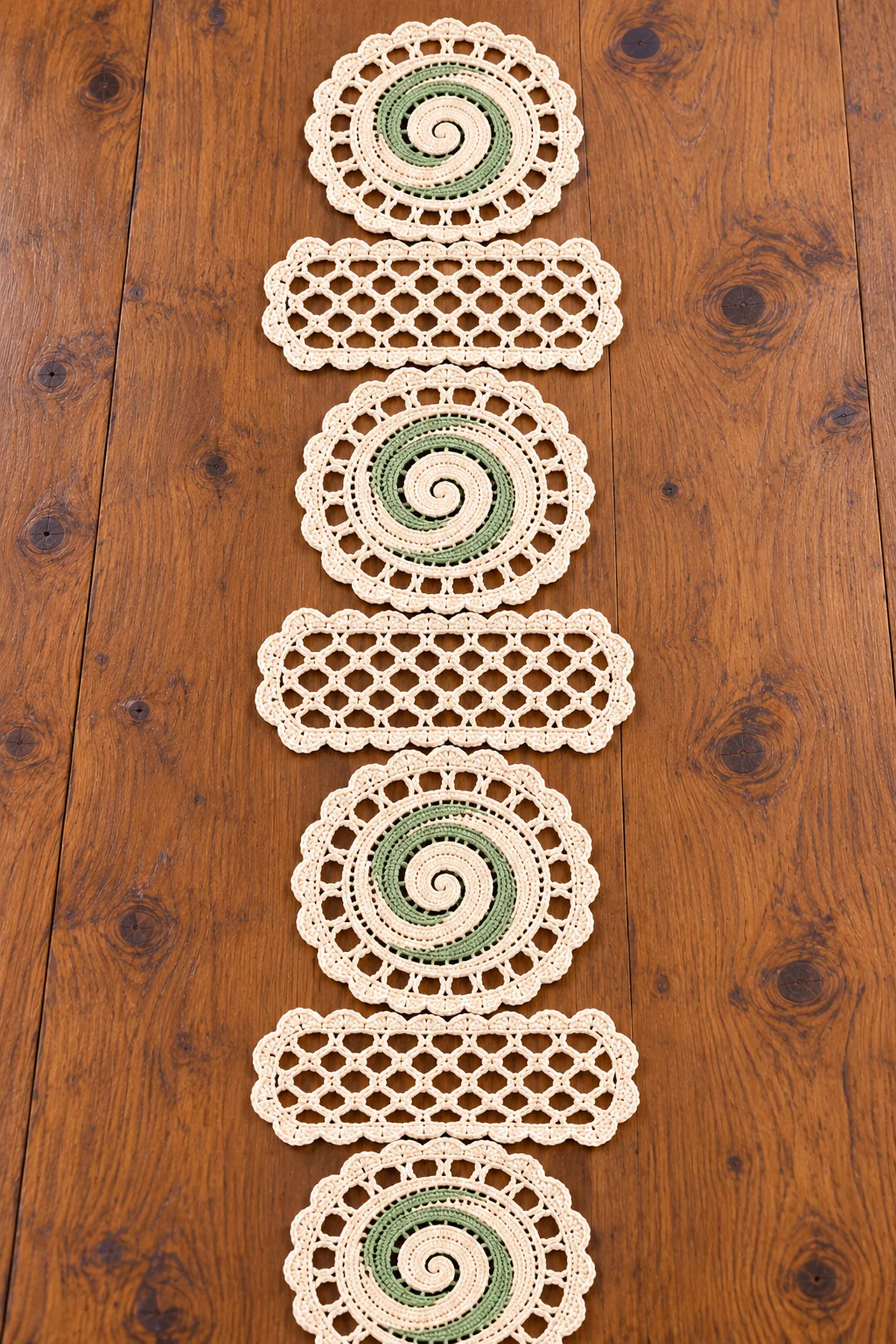
Lay the components in a straight sequence: circle, mesh panel, circle, mesh panel, circle, mesh panel, circle. The runner is one piece; it has no separate placemats.
- On each medallion, place markers after edge stitches 48 and 96 to divide the 96-sc edge into two semicircles. Join the first panel’s 48-sc end to the lower semicircle of Medallion 1 with a whipstitch through both loops. Join its other 48-sc end to the upper semicircle of Medallion 2. Repeat for Medallions 2–3 and 3–4, attaching each panel to opposite halves of its neighboring circles. Keep the spiral centers upright and the panels untwisted.
- Pin the two large flowers at opposite outer corners of the middle lace panels. Sew each center down through the mesh or medallion edge without closing the open spaces. Place two small blossoms on each panel, alternating sides for six total.
- Arrange the six groups of four berries along the connector edges and circle-to-panel joins. Sew each berry base twice through the fabric and secure its tail on the underside. Place 16 leaves in pairs around the flower groups, with points alternating outward and along the runner.
- Lay the runner flat and check the four circles, three mesh bridges, two large flowers, six small blossoms, 16 leaves and 24 berries. Block gently to the target length and width without stretching the spiral cords or closing the lace openings. Let dry completely.
Assembly and Shaping
The runner has four 96-stitch-edged medallions, three 14-row lace panels and six 48-stitch panel ends. Each circle is divided into two 48-stitch semicircles for its panel joins. The embellishment inventory is 2 layered flowers, 6 small blossoms, 16 leaves and 24 berries in 6 groups of 4.
Lay every component on a flat surface before joining. Match the marked centers first, then divide each remaining edge into equal sections. Work through both layers with consistent tension and pause after each section to check that the fabric lies flat. This measured approach prevents twisting and keeps decorative details facing the intended direction.
Finishing
- Weave each tail through several same-color stitches on the wrong side, reverse direction and trim only after a gentle tug test.
- Wash and block according to the cotton label. Pin the mesh panels square and the medallions to equal diameters without flattening the raised spirals.
- Inspect every join, flower center, leaf base and berry attachment from both sides; repair a loose stitch before using or gifting the runner.
- Keep the decorative cotton runner away from open flames and hot cookware; it is not a tested trivet.
For a polished result, weave each tail through several same-color stitches, reverse direction once, and trim only after the fabric has been gently stretched. Block to the listed dimensions without flattening textured stitches. Inspect joins, borders, straps, and decorative pieces before the project is used or gifted.
Helpful Tips
- Mark all 12 medallion wedges before Round 3 and move the same markers at each increase round.
- Count the 16 sc anchors and 15 chain spaces at the end of every mesh row; do not work into the chain spaces on Rows 2–14.
- Make one spiral cord and pin it loosely first. If the circle cups or ripples, check the cord length and spacing before sewing it permanently.
- Pin all three panels between the four circles in sequence before sewing, then check that all spiral centers and mesh rows face the same way.
Good lighting and a contrasting stitch marker make counting much easier. If a section looks uneven, compare the current count with the previous checkpoint before continuing. Fixing one missed stitch early is faster than compensating later, and it preserves the measurements used by the assembly instructions.
Frequently Asked Questions
How many spiral medallions are in this runner?
The original layout uses four cream 12-wedge circles, each with one raised four-turn sage cord, joined by three open-mesh panels.
Can I change the length?
Yes. Add or remove a connector panel and one circle to extend or shorten the repeat, then keep the flower, berry and leaf counts proportional. Recheck the 48-stitch joining edges and block all circles evenly.
Can I use this as a trivet?
No. It is decorative cotton lace and has not been tested for heat. Keep hot cookware and open flames off the runner.
Has the finished runner been physically tested?
No sample or tested yardage is claimed. Stitch counts and component totals are specified for checking; gauge, finished dimensions and yarn estimates remain planning targets until a sample is made and washed.
Conclusion
Your finished runner brings together four sage spiral medallions, airy cream lace bridges, layered lavender blooms, small blossoms, leafy sprigs and mauve berry clusters. Follow the reference palette, check every join and block the piece gently to keep the openwork clear.
BabyYarnie Printable Crochet Pattern Card
BabyYarnie — easy-to-follow crochet for everyday makers.
Project: Vintage Floral Lace Table Runner Pattern
Skill level: Intermediate Hook: 3.5 mm (E) for the runner; use 3.0 mm for small blossoms if needed Yarn: DK-weight 100% cotton
Finished size: Planning target: 46–50 in long and 8–9 in wide after blocking; four medallions about 8 in across
Card Materials
- DK 100% cotton: about 350–450 yd warm ivory, 180–240 yd sage, 100–140 yd lilac, 50–70 yd blush and 25–40 yd muted mauve for berries; allow extra for swatches
- 3.5 mm (E) hook, optional 3.0 mm hook, 10 locking stitch markers, tape measure, blunt yarn needle, scissors and rustproof blocking pins
- A small amount of washable fiberfill for the berry beads; optional removable thread for marking the 12 medallion wedges and panel centers
Card Instructions
- Make Four Cream Spiral Medallions: Make four 12-wedge circles from 12 to 96 dc over 8 rounds, add a 96-sc edge, and sew one 195-sc sage cord in a four-turn spiral onto each circle.
- Crochet Three Open-Lace Connector Panels: Make three 14-row panels, each row with 16 sc and 15 ch-2 spaces; border both short ends to exactly 48 sc for joining.
- Make the Flowers, Leaves and Berry Clusters: Make 2 layered flowers with 6 inner and 12 outer petals, 6 six-petal blossoms, 16 pointed 19-stitch leaves and 24 small berries arranged in six groups.
- Join and Arrange the Complete Table Runner: Join four spiral circles with three mesh panels using 48 stitches at each half-circle end, then sew on all counted flowers, leaves and berry clusters.
Finish: Check every count, weave in all ends, block to measurement, and inspect each join.