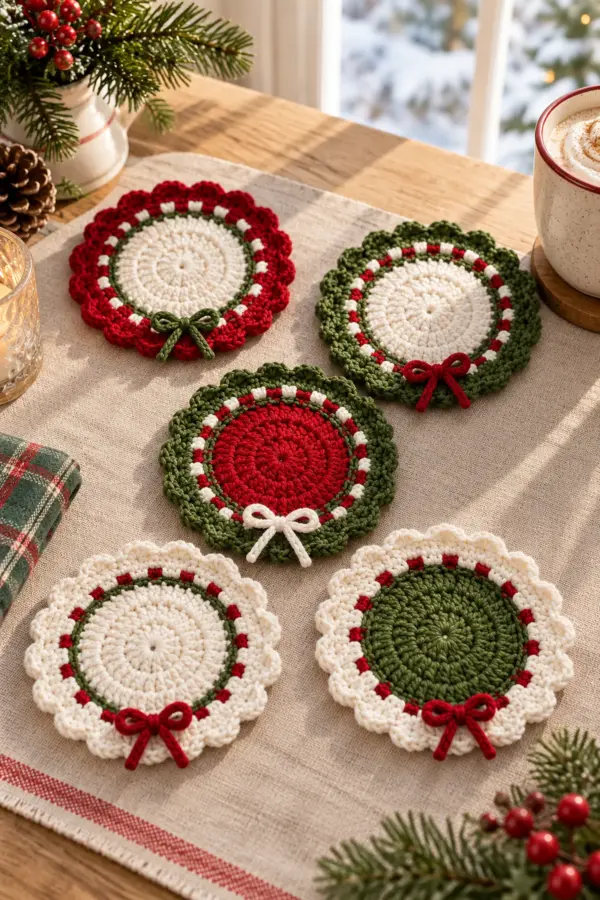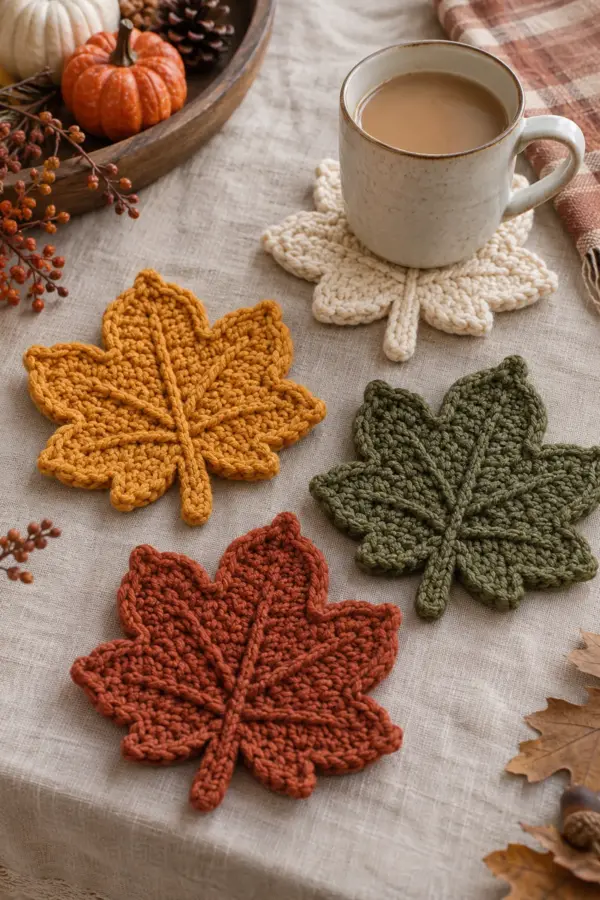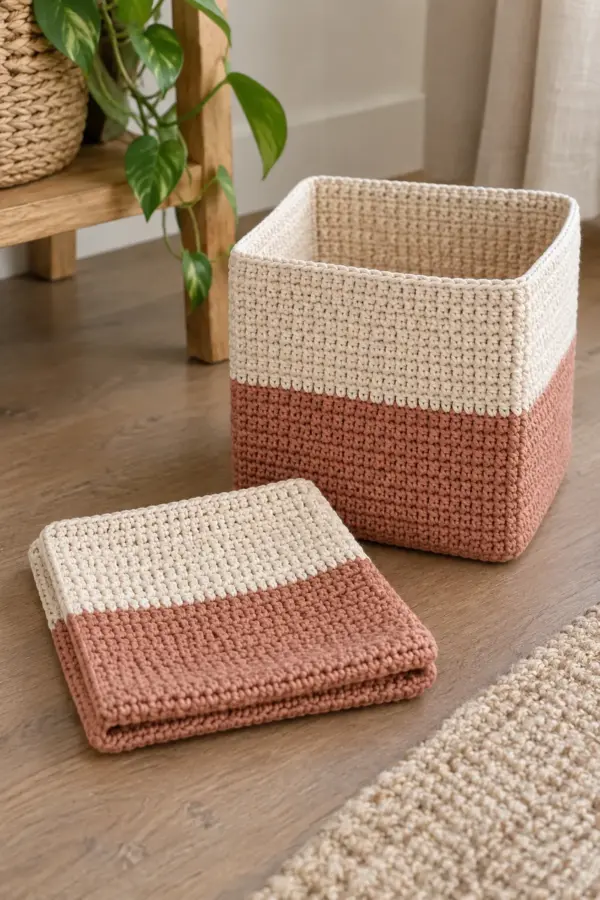
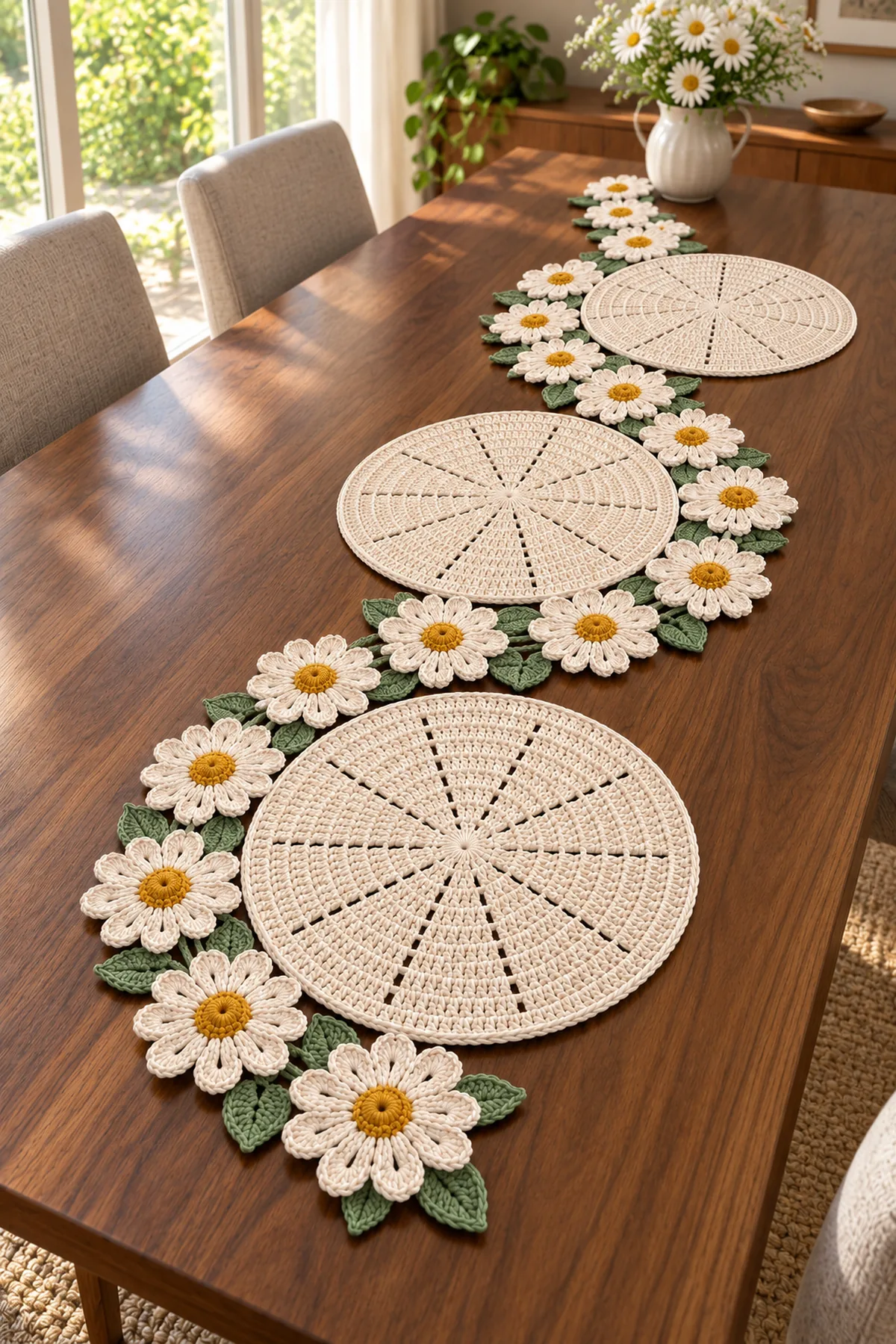
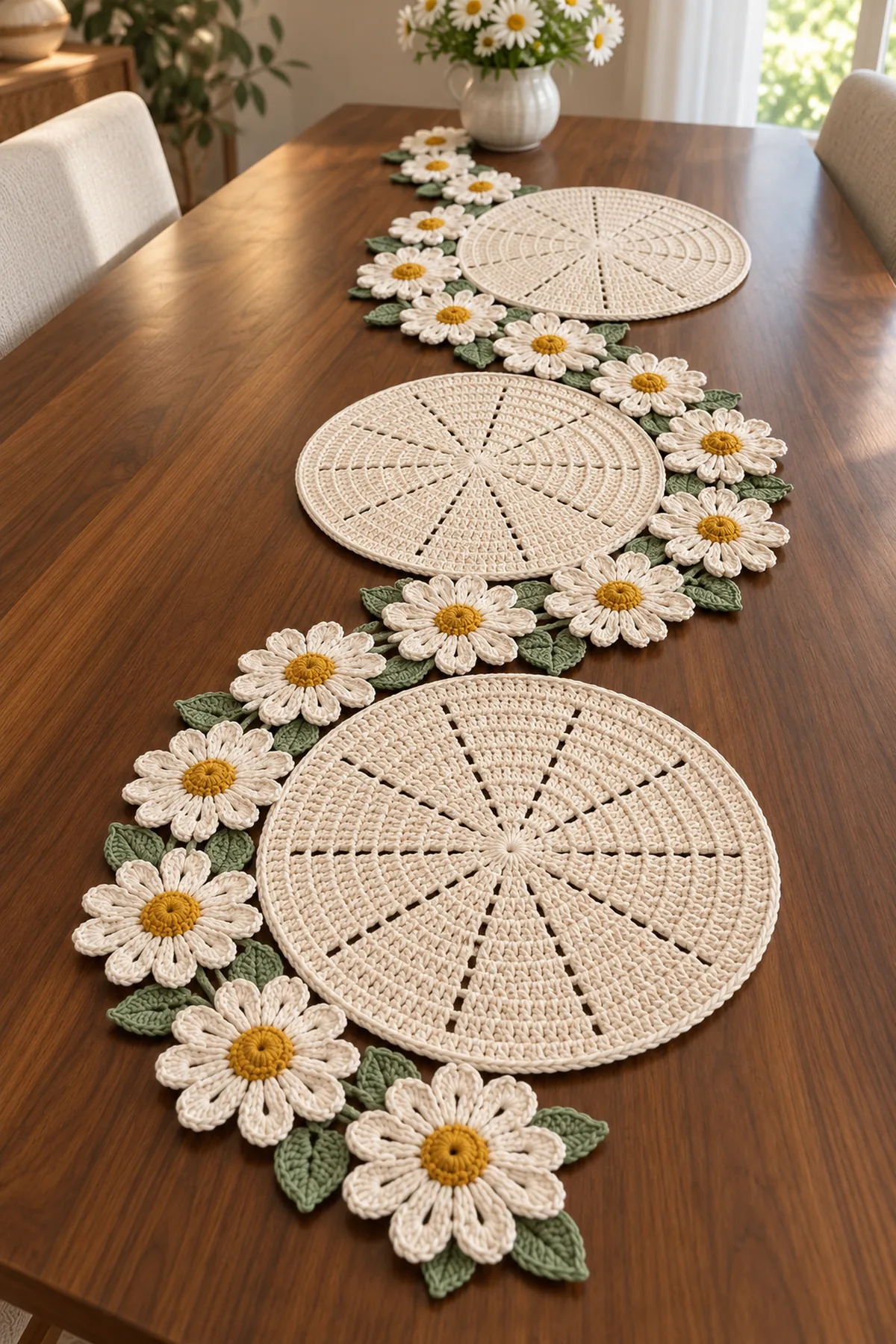
This elegant crochet daisy lace table runner and placemat set follows the visual language of your photograph: a long chain of white daisies with golden centers and sage leaves running along a wood table, with three independent ivory circular lace placemats beside it. The photograph is our mandatory shape and palette reference, not a source of stitch instructions. Below is a newly engineered BabyYarnie pattern with counted radial placemat rounds, complete two-sided petals, a measured flower spine and securely sewn leaves.
The set has four functional textiles: one narrow 15-daisy floral runner and three matching, independent round placemats. Each placemat has ten expanding lace spokes and a firm single-crochet edge. Each daisy has a 24-stitch yellow center and twelve ivory two-sided petals; each pair of sage leaves is sewn to a four-row runner spine. The placemats are never sewn to the runner, so they can be placed along either side as in the reference.
Pattern Details
- Hook Size: 3.5 mm (E) starting point; adjust for flat, even cotton fabric
- Finished Size: Planning: three placemats about 11–12 in diameter; daisy runner about 50–55 in long and 4–5 in wide including petals/leaves; measure a trial sample
- Gauge: Target 20 dc and 12 joined rounds per 4 in for placemats; about 24 sc per 4 in on runner spine; swatch and block
- Estimated Time: Planning 18–25 hours for the whole set, depending on experience
- Construction: Three 19-round, ten-spoke 180-position placemats; 15 daisies with 24-sc centers and 12 petals each; 30 tapered leaves; one 320-sc by 4-row spine
- Skill level: Intermediate
Why You’ll Love This Project
A neat circular lace disk keeps each place setting coherent, while the floral strip makes a long table feel festive without covering its wood surface. The construction is modular: finish one placemat and one daisy first to check gauge, then repeat exact counts. Separate mats are practical to wash and position independently.
Materials
- Planning allowance: 700–900 yd ivory DK 100% cotton, 200–300 yd sage green, and 40–60 yd golden-yellow, plus swatch allowance; actual use depends on gauge
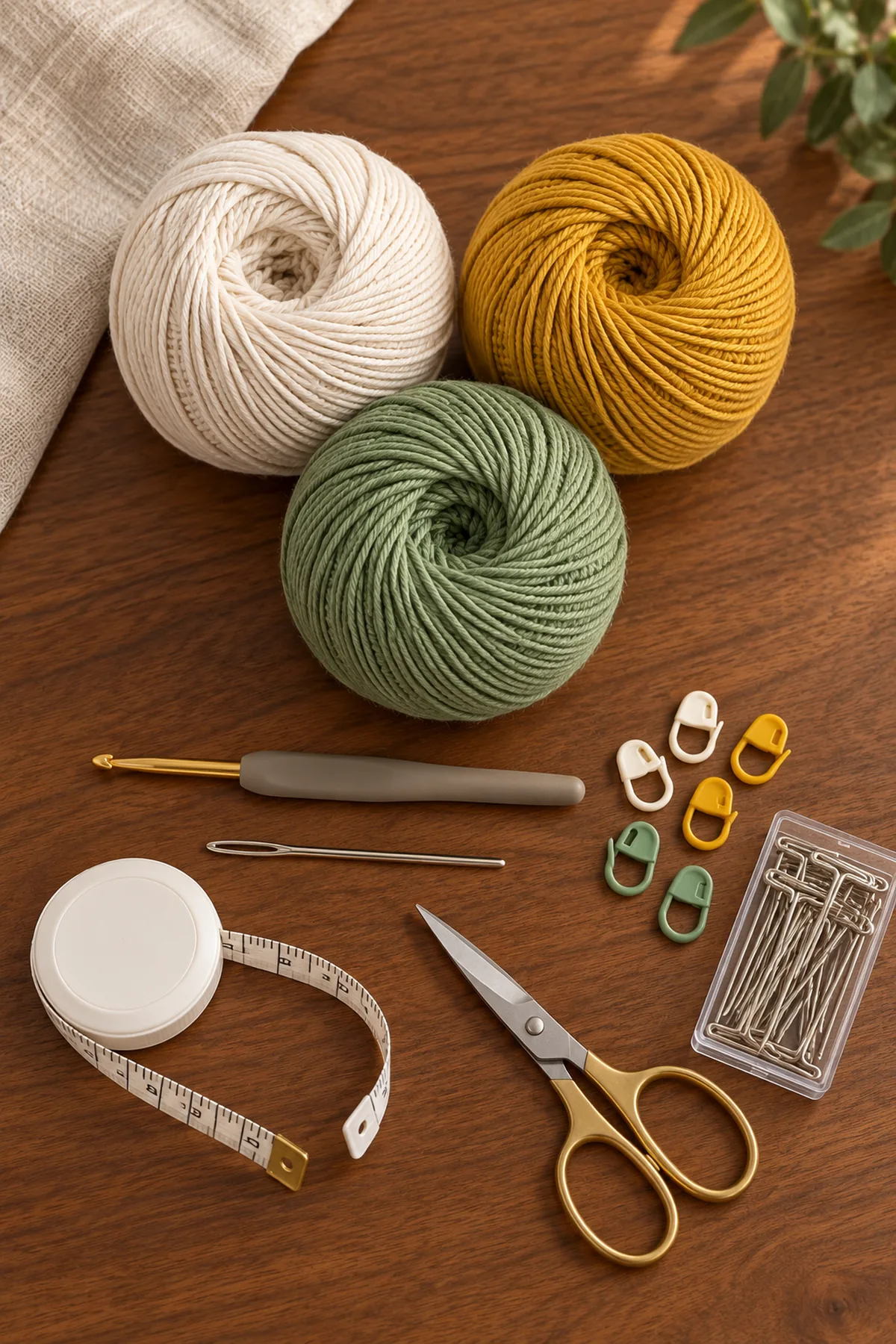
- 3.5 mm (E) hook or size giving flat fabric, blunt tapestry needle, removable stitch markers, scissors and tape measure
- Blocking mat or clean towels and rustproof pins; optional steam-free damp blocking according to yarn care label
Gauge, Measurements, and Planning
The 180-position final placemat circle is a planning circumference of roughly 36 in at 20 dc per 4 in, suggesting about 11.5 in diameter. That estimate is not a measured sample: dc width, eyelet spacing and blocking change it. If the circle bowls or ruffles before edging, adjust hook/tension and remake the trial disk rather than stretching it into shape. A 320-sc spine at 24 sc per 4 in projects about 53 in before end blooms; arrange all 15 flowers along it before permanent sewing.
Make and wash a gauge swatch before beginning. Measure only after the swatch is completely dry. If the stitch width differs, change hook size rather than pulling the working yarn tighter. Keep a written count at the end of every section so the finished edges remain balanced and the assembly points line up.
Abbreviations and Special Stitches
- ch: chain
- sc: single crochet
- hdc: half double crochet
- dc: double crochet
- sl st: slip stitch
- st(s): stitch(es)
- sp: space
- inc: two stitches in one old stitch
- sc2tog: single-crochet two stitches together
- sc3tog: single-crochet three stitches together
Special stitch guidance: Joined radial rounds: ch 2 to begin each dc round and join with an uncounted sl st to its first dc; the ch 2 does not count. For Round 19, ch 1 and join to first sc. An eyelet spoke is a ch-1 space renewed directly over the previous round’s space; it counts as one working position. Each narrow daisy petal is an attached nine-chain strip with graded sc, hdc and dc stitches worked back toward the center, anchored across exactly two center sc. On leaf rows, sc2tog consumes two old stitches and makes one new sc. For sc3tog, insert hook into each of three old stitches in turn, pull up a loop each time, then yarn over and draw through all four loops. A turning chain never counts.
Important Notes
- Development disclosure: the round/row arithmetic is checked, but no physical sample, tested dimensions, tested yarn usage or wash durability is claimed. Make and block one placemat, daisy and leaf before committing to the full set.
- The user-supplied photo is a mandatory visual reference for the three ivory circular mats and yellow-white-green daisy runner. This tutorial does not reuse source pixels, written instructions or logo.
- AI-generated article and Pin imagery illustrates the planned design, not a physically crocheted specimen or stitch chart. Follow the written counts if an image appears to show different stitches.
- The placemats are separate from the runner. Keep all pieces flat for table use, with no buttons, beads, wire, glue or raised center embellishments.
- Cotton table linens are decorative dining textiles, not certified hot-pan trivets. Do not put hot cookware or open flames on them. Follow the yarn label for laundering.
Complete Instructions for Elegant Crochet Daisy Lace Table Runner & Placemat Set
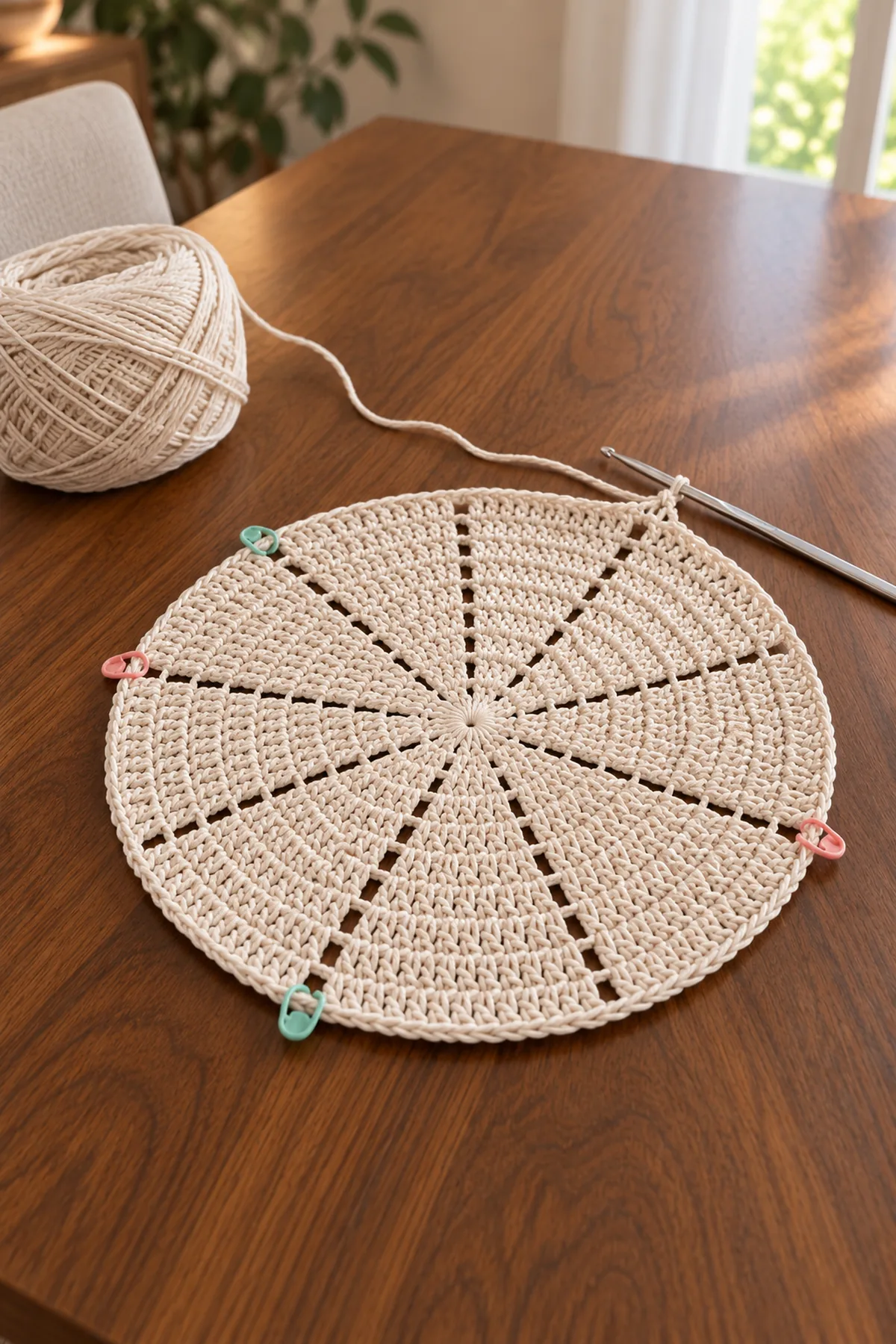
Make Three Ten-Spoke Lace Placemats
- Placemat Round 1: ch 2, work 10 dc into a magic ring; tighten, sl st to the first dc. (10 sts) Work joined rounds; opening ch 2 and joining sl st never count.
- Round 2: Ch 2, 2 dc in each old dc around; join to first dc. (20 sts)
- Round 3: Ch 2; [2 dc in next dc, ch 1, skip next dc] 10 times. Join to first dc. Count each ch-1 space as one position. (30 sts)
- Round 4: Ch 2; [dc in next 1 dc, 2 dc in next dc, ch 1 over the next ch-1 space] 10 times. Leave that old ch-space unworked beneath the new ch. Join to first dc. (40 sts)
- Round 5: Ch 2; [dc in next 2 dc, 2 dc in next dc, ch 1 over the next ch-1 space] 10 times. Leave that old ch-space unworked beneath the new ch. Join to first dc. (50 sts)
- Round 6: Ch 2; [dc in next 3 dc, 2 dc in next dc, ch 1 over the next ch-1 space] 10 times. Leave that old ch-space unworked beneath the new ch. Join to first dc. (60 sts)
- Round 7: Ch 2; [dc in next 4 dc, 2 dc in next dc, ch 1 over the next ch-1 space] 10 times. Leave that old ch-space unworked beneath the new ch. Join to first dc. (70 sts)
- Round 8: Ch 2; [dc in next 5 dc, 2 dc in next dc, ch 1 over the next ch-1 space] 10 times. Leave that old ch-space unworked beneath the new ch. Join to first dc. (80 sts)
- Round 9: Ch 2; [dc in next 6 dc, 2 dc in next dc, ch 1 over the next ch-1 space] 10 times. Leave that old ch-space unworked beneath the new ch. Join to first dc. (90 sts)
- Round 10: Ch 2; [dc in next 7 dc, 2 dc in next dc, ch 1 over the next ch-1 space] 10 times. Leave that old ch-space unworked beneath the new ch. Join to first dc. (100 sts)
- Round 11: Ch 2; [dc in next 8 dc, 2 dc in next dc, ch 1 over the next ch-1 space] 10 times. Leave that old ch-space unworked beneath the new ch. Join to first dc. (110 sts)
- Round 12: Ch 2; [dc in next 9 dc, 2 dc in next dc, ch 1 over the next ch-1 space] 10 times. Leave that old ch-space unworked beneath the new ch. Join to first dc. (120 sts)
- Round 13: Ch 2; [dc in next 10 dc, 2 dc in next dc, ch 1 over the next ch-1 space] 10 times. Leave that old ch-space unworked beneath the new ch. Join to first dc. (130 sts)
- Round 14: Ch 2; [dc in next 11 dc, 2 dc in next dc, ch 1 over the next ch-1 space] 10 times. Leave that old ch-space unworked beneath the new ch. Join to first dc. (140 sts)
- Round 15: Ch 2; [dc in next 12 dc, 2 dc in next dc, ch 1 over the next ch-1 space] 10 times. Leave that old ch-space unworked beneath the new ch. Join to first dc. (150 sts)
- Round 16: Ch 2; [dc in next 13 dc, 2 dc in next dc, ch 1 over the next ch-1 space] 10 times. Leave that old ch-space unworked beneath the new ch. Join to first dc. (160 sts)
- Round 17: Ch 2; [dc in next 14 dc, 2 dc in next dc, ch 1 over the next ch-1 space] 10 times. Leave that old ch-space unworked beneath the new ch. Join to first dc. (170 sts)
- Round 18: Ch 2; [dc in next 15 dc, 2 dc in next dc, ch 1 over the next ch-1 space] 10 times. Leave that old ch-space unworked beneath the new ch. Join to first dc. (180 sts)
- Round 19: Ch 1; sc in each of the 170 dc and once into each of the ten ch-1 spaces; join to first sc and fasten off. (180 sts)
- Make three identical placemats in ivory. At the end of Round 3 there are ten sectors of two dc plus one ch-1 space. From Round 4 onward each sector gains one dc per round while preserving exactly one ch-1 spoke space. In Round 18, each sector has 17 dc and one space, or 180 positions total.
- Round 19 works one sc in each of the 170 dc and each of the ten spaces for 180 sc. Keep the join slip stitch uncounted. Weave all tails through the back without drawing the spokes together. Damp-block one sample flat before repeating twice.
Crochet Fifteen Two-Sided Daisies
- Daisy center Round 1: 6 sc into a magic ring. (6 sts) Tighten the ring, mark the first sc, and work a continuous spiral without joining or turning.
- Round 2: inc in each stitch. (12 sts)
- Round 3: [sc in next 1 stitches, inc in next stitch] 6 times. (18 sts)
- Round 4: [sc in next 2 stitches, inc in next stitch] 6 times. (24 sts)
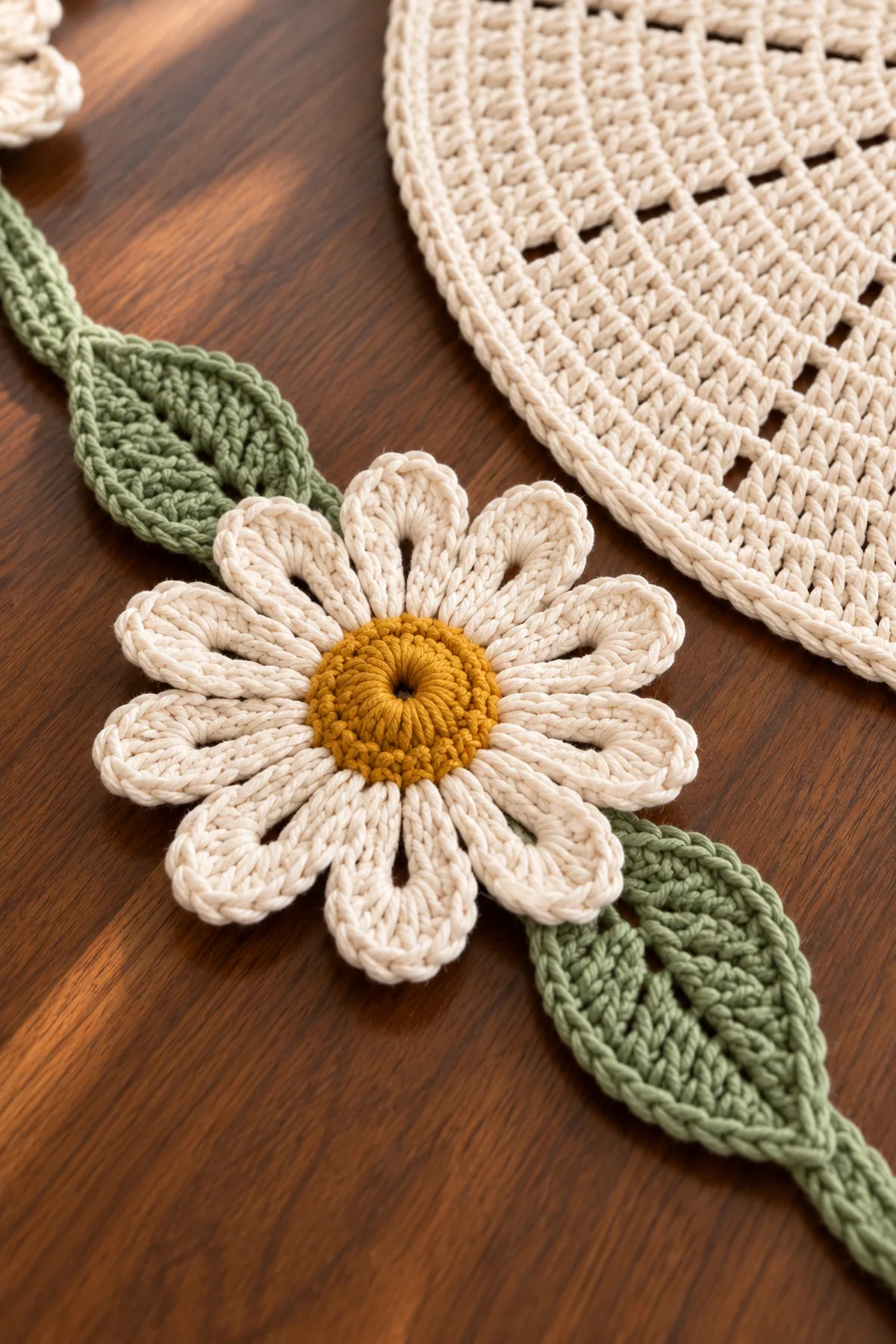
- Decorative petal round: Repeat 12 times around 24 center sc: sl st in first center sc, ch 9; starting in second ch from hook work sc, hdc in next ch, dc in next 4 ch, hdc in next ch, sc in last ch, returning to the center; sl st in the second center sc. Fasten off after petal 12. Count 12 complete graded-stitch petals, not 12 ordinary stitches. (12 sts)
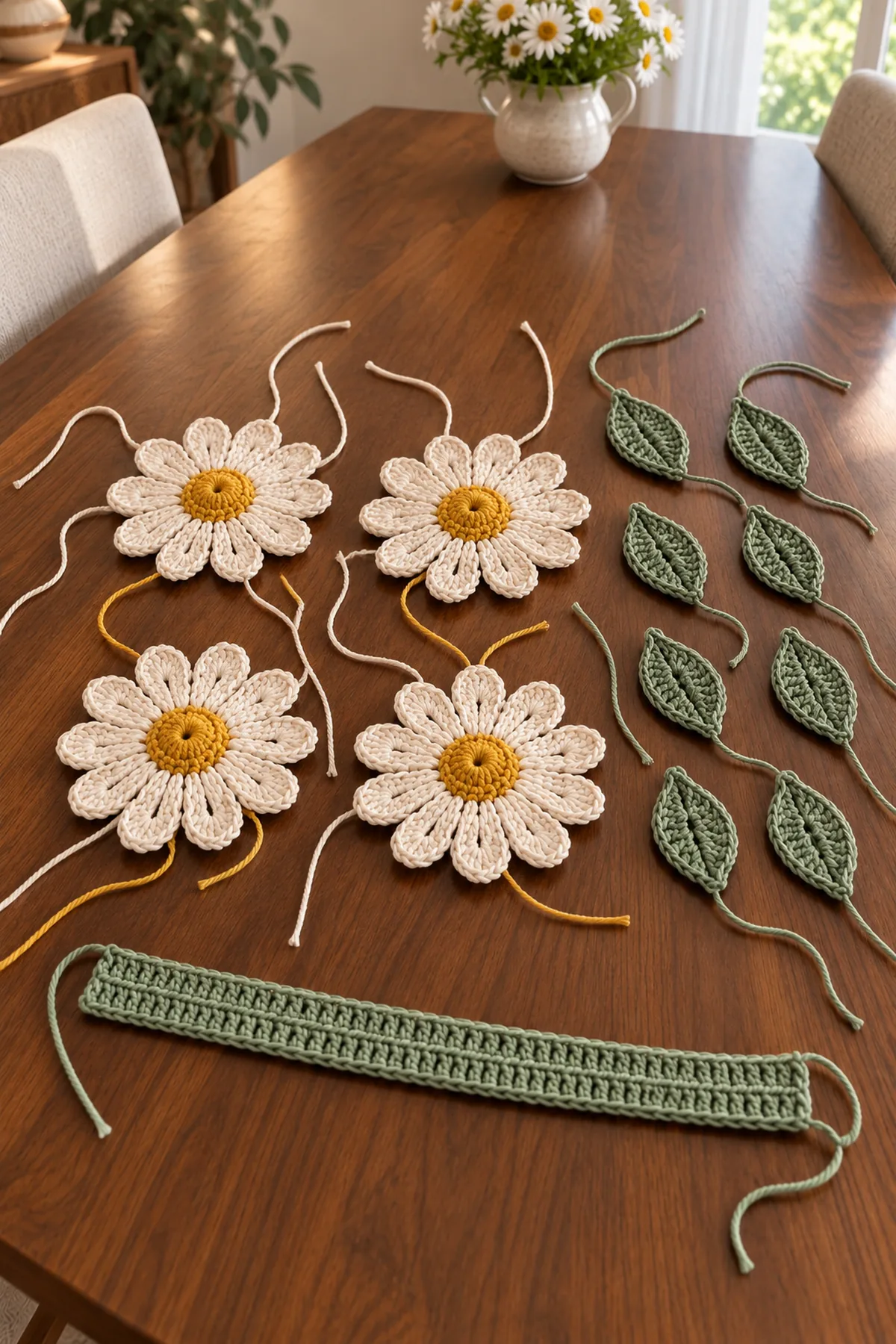
- Make 15 identical flowers. Work the golden center Rounds 1–4, then change to ivory before beginning the decorative petal round. Its 12 repeats each consume two of the 24 old center sc. Each nine-chain petal is worked back toward the center in graded sc, hdc and dc stitches so it forms a slender, softly rounded daisy ray rather than an unsupported chain loop.
- After every third petal, flatten the flower and check that the petals radiate without twisting. At the end, count 12 complete ivory petals. Weave color-change tails firmly into the back of the yellow center. Do not use a button for the center.
Crochet Thirty Tapered Sage Leaves
- Sage leaf Row 1: ch 10; sc in second chain from hook and in each remaining chain. (9 sts) Ch 1 and turn; this chain never counts.
- Row 2: Sc2tog, sc in next 5 stitches, sc2tog. Ch 1 and turn. (7 sts)
- Row 3: Sc2tog, sc in next 3 stitches, sc2tog. Ch 1 and turn. (5 sts)
- Row 4: Sc2tog, sc in next 1 stitches, sc2tog. Ch 1 and turn. (3 sts)
- Row 5: Sc3tog across all three old stitches. Fasten off with an 8-in tail. (1 sts)
- Make 30 leaves in sage. Each starts nine sc wide and narrows 9, 7, 5, 3, 1 over five rows. Leave an 8-in sewing tail at the wide base of each leaf. Run a short line of surface slip stitches from base toward tip if you want a center vein; these decorative stitches do not change row counts.
- Damp-block leaf points gently, keeping their nine-stitch bases flexible for sewing beneath flowers.
Work the Long Sage Runner Spine
- Runner spine Row 1: ch 321; sc in second chain from hook and in each remaining chain. (320 sts) Ch 1 and turn; this chain never counts.
- Row 2: Sc in each of the 320 stitches. Ch 1 and turn. (320 sts)
- Row 3: Sc in each of the 320 stitches. Ch 1 and turn. (320 sts)
- Row 4: Sc in each of the 320 stitches. Fasten off with a long sewing tail. (320 sts)
- The spine is one sage strip: foundation ch 321; Row 1 has 320 sc; Rows 2–4 each have 320 sc. Do not add to the ends while turning. If your row count differs, correct it before sewing any flowers.
- Lay the strip flat and mark center columns 13, 34, 55, 76, 97, 118, 139, 160, 181, 202, 223, 244, 265, 286 and 307 on Row 2. The 21-stitch spacing is a placement guide, not a new crochet row; it may be nudged after blocking if the actual flowers overlap excessively.
Attach Flowers and Leaves into a Flat Runner
- Arrange the 15 daisies along the spine in order of the marked columns. Alternate the flower center slightly to the left and right of the strip so the chain feels natural, but keep every center on a marked column. The first and last blooms may project beyond the strip ends.
- Sew the back of each yellow center to the full four-row spine over at least eight small anchor stitches. Make a second pass in the reverse direction. Do not rely on petal tips as the only connection. Where adjacent petals touch, tack two tips together once without bunching.
- Place two sage leaves under each bloom, one pointing from each long side. Sew each leaf’s entire nine-stitch base to the spine and hide it beneath the adjacent ivory petals. Tack each leaf tip once if it lifts. No loose petals or leaves should catch a place setting.
- Check that all 15 flower centers and 30 leaf bases are secured. The completed runner stays long and narrow; the three placemats stay separate and can sit beside or partly over its floral edges as in the photo.
Block and Use the Four-Piece Table Set
- Lightly damp-block the runner lengthwise and the three placemats separately. Shape every mat into a true circle and spread the daisy petals evenly; let all pieces dry fully.
- Lay the flower runner along the middle of a table. Place the three independent mats for place settings. Move any petal or leaf that would sit beneath a plate base; the dinnerware should rest on the flat ivory disks.
- Inspect every seam and trim any escaping tail. Wash according to the cotton label, reshape flat and recheck flower and leaf attachments before using again.
Assembly and Shaping
Join fifteen separate daisies to the four-row sage spine by their complete centers at columns 13 + 21n (n=0..14), then attach two tapered leaves under each bloom. The three ten-spoke ivory placemats are independent circles, not stitched to the runner. The construction is floral appliqué on a narrow strip, not a hexagon-motif runner.
Lay every component on a flat surface before joining. Match the marked centers first, then divide each remaining edge into equal sections. Work through both layers with consistent tension and pause after each section to check that the fabric lies flat. This measured approach prevents twisting and keeps decorative details facing the intended direction.
Finishing
- Weave ends through three or more back-side stitch paths; do not cinch lace eyelets or leaf points.
- Damp-block one mat and one bloom before repeating the complete set, then block all four finished textiles flat.
- Reinforce every daisy center and full nine-stitch leaf base with a second sewing pass; tack any raised tip.
- Wash and dry according to the yarn label. Reinspect stitches and sewn components; do not use as a hot-pan trivet.
For a polished result, weave each tail through several same-color stitches, reverse direction once, and trim only after the fabric has been gently stretched. Block to the listed dimensions without flattening textured stitches. Inspect joins, borders, straps, and decorative pieces before the project is used or gifted.
Helpful Tips
- Place removable markers after every ten placemat sectors; each sector should have one eyelet.
- Keep the uncounted starting chains and joining slip stitches out of every placemat count.
- Arrange all fifteen blooms before sewing; actual gauge may require slight spacing adjustment.
- Block the graded-stitch petals into even narrow rays before sewing the flowers.
Good lighting and a contrasting stitch marker make counting much easier. If a section looks uneven, compare the current count with the previous checkpoint before continuing. Fixing one missed stitch early is faster than compensating later, and it preserves the measurements used by the assembly instructions.
Frequently Asked Questions
Are the placemats attached to the runner?
No. They are three independent round textiles. Only the daisies and leaves are sewn to the long sage runner spine.
How is this different from the modular daisy hexagon runner?
This set has a narrow four-row floral chain plus three separate radial-lace mats. The earlier runner is made of joined cream hexagons with daisy centers; neither its geometry nor its component construction is reused.
Can I make fewer flowers or a shorter runner?
Yes. Make a shorter spine with a multiple of 21 sc between marked center columns, leaving about 13 sc at each end, then attach one bloom and two leaves per marked column. Check actual flower spacing before sewing.
Has the set been physically sample-tested?
No physical sample is claimed. Counts have been numerically checked, but size, drape and yarn allowance are estimates. Swatch and block a trial mat, flower and leaf.
Conclusion
The finished design is a flexible four-piece table set: a long white-and-gold daisy vine with sage leaves and three separate ivory lace circles. Record your actual gauge and finished measurements after a trial piece, then repeat the counted components and secure every appliqué seam before the set goes on the table.
BabyYarnie Printable Crochet Pattern Card
BabyYarnie — easy-to-follow crochet for everyday makers.
Project: Elegant Crochet Daisy Lace Table Runner & Placemat Set
Skill level: Intermediate Hook: 3.5 mm (E) starting point; adjust for flat, even cotton fabric Yarn: DK-weight 100% cotton
Finished size: Planning: three placemats about 11–12 in diameter; daisy runner about 50–55 in long and 4–5 in wide including petals/leaves; measure a trial sample
Card Materials
- Planning allowance: 700–900 yd ivory DK 100% cotton, 200–300 yd sage green, and 40–60 yd golden-yellow, plus swatch allowance; actual use depends on gauge
- 3.5 mm (E) hook or size giving flat fabric, blunt tapestry needle, removable stitch markers, scissors and tape measure
- Blocking mat or clean towels and rustproof pins; optional steam-free damp blocking according to yarn care label
Card Instructions
- Make Three Ten-Spoke Lace Placemats: Three separate round mats: 10 to 180 positions in 18 radial rounds, then a 180-sc firm edge.
- Crochet Fifteen Two-Sided Daisies: 15 golden 24-sc disks, each edged by 12 complete ivory petals.
- Crochet Thirty Tapered Sage Leaves: Two small five-row leaves for each of 15 flowers; 30 leaves total.
- Work the Long Sage Runner Spine: One four-row, 320-sc foundation strip with 15 evenly spaced flower centers.
- Attach Flowers and Leaves into a Flat Runner: A 15-bloom chain over a four-row spine, with 30 sewn sage leaves; three mats remain independent.
- Block and Use the Four-Piece Table Set: Block flat, keep dinnerware on the mats, and inspect all sewn floral parts after washing.
Finish: Check every count, weave in all ends, block to measurement, and inspect each join.