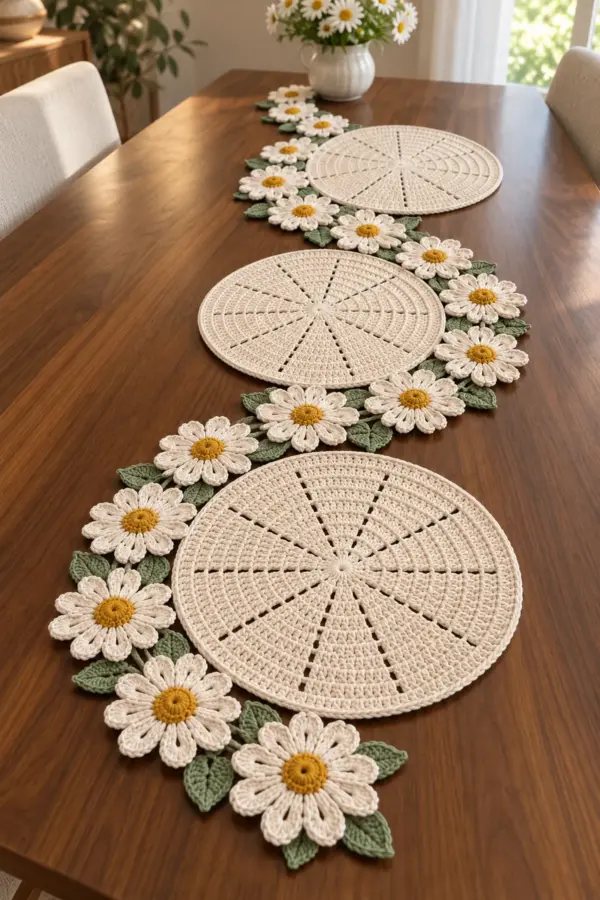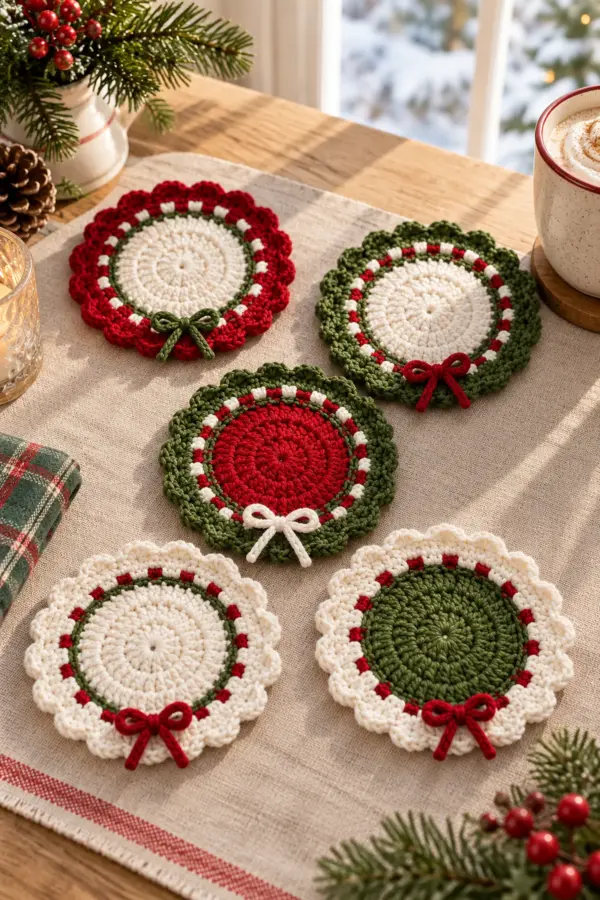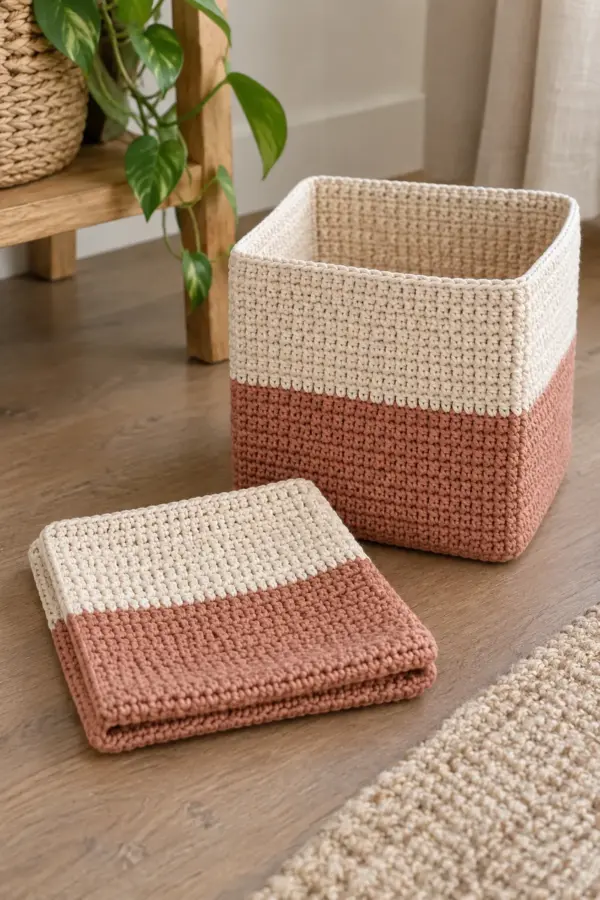
This original BabyYarnie crochet maple leaf coasters tutorial follows the silhouette and palette of the supplied reference as a visual brief. The stitch instructions, component engineering and wording are newly authored. Make every part in the order shown, then perform the fit and seam checks before display or gifting.
The reference is visual inspiration, not a source of usable written instructions. This complete US-terms tutorial gives countable stages for every structural component and explains how the pieces are joined.
Pattern Details
- Hook Size: 4 mm for firm washable cotton
- Finished Size: Planning 6–7 in across each five-lobed leaf, plus a 2-in stem
- Gauge: Target 17 sc and 19 rows per 4 in; make one blocked sample pair first
- Estimated Time: 2–3 hours per coaster; 8–12 hours for four
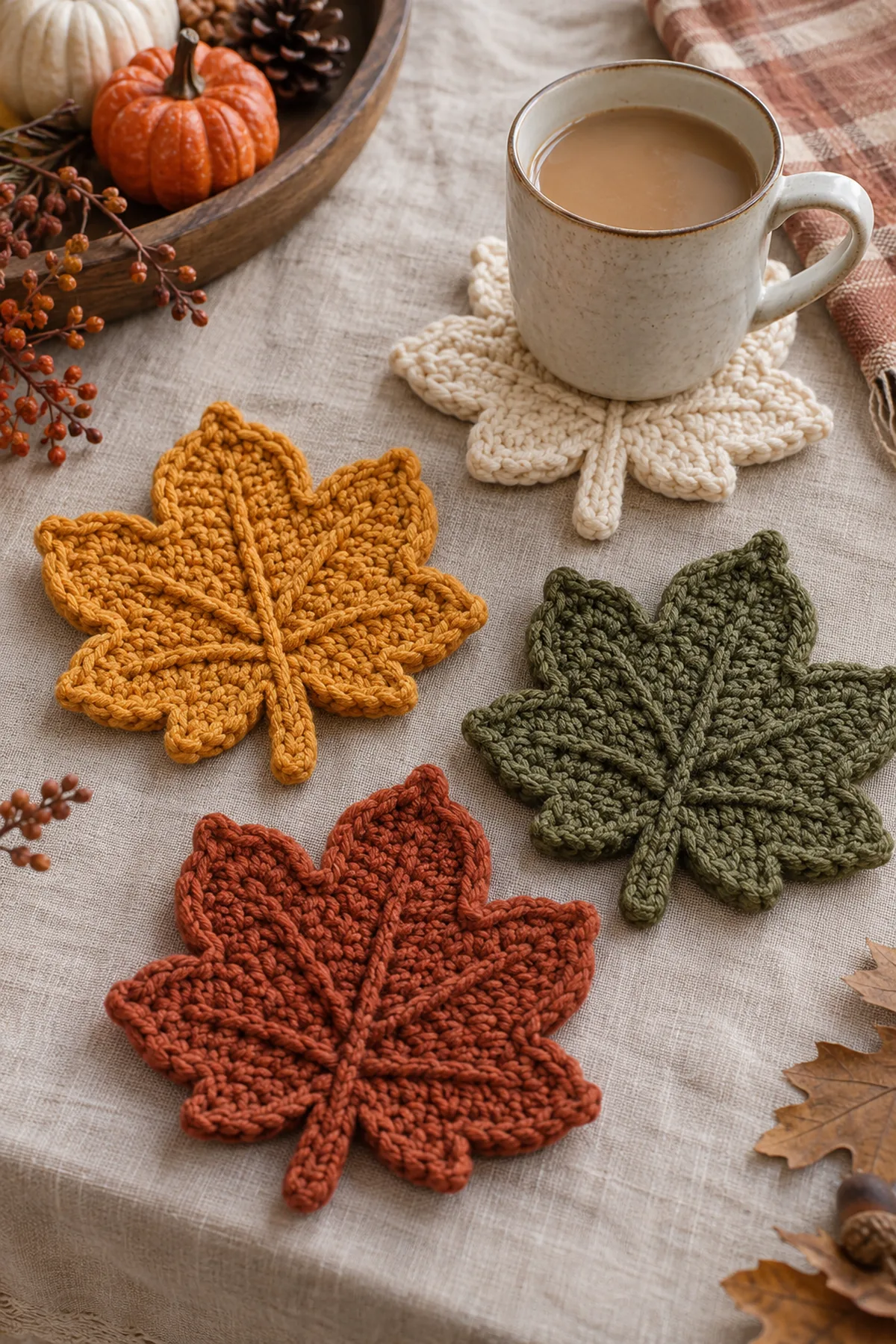
- Construction: Eight identical five-lobed leaf panels paired into four double-layer coasters, each with one short stem and optional top-side raised vein
- Skill level: Intermediate
Why You’ll Love This Project
A distinctive silhouette makes the finished project recognizable in one glance. Clear component counts make it possible to catch a shaping error before a seam is closed, and the finishing notes cover the details that a photo cannot teach.
Materials
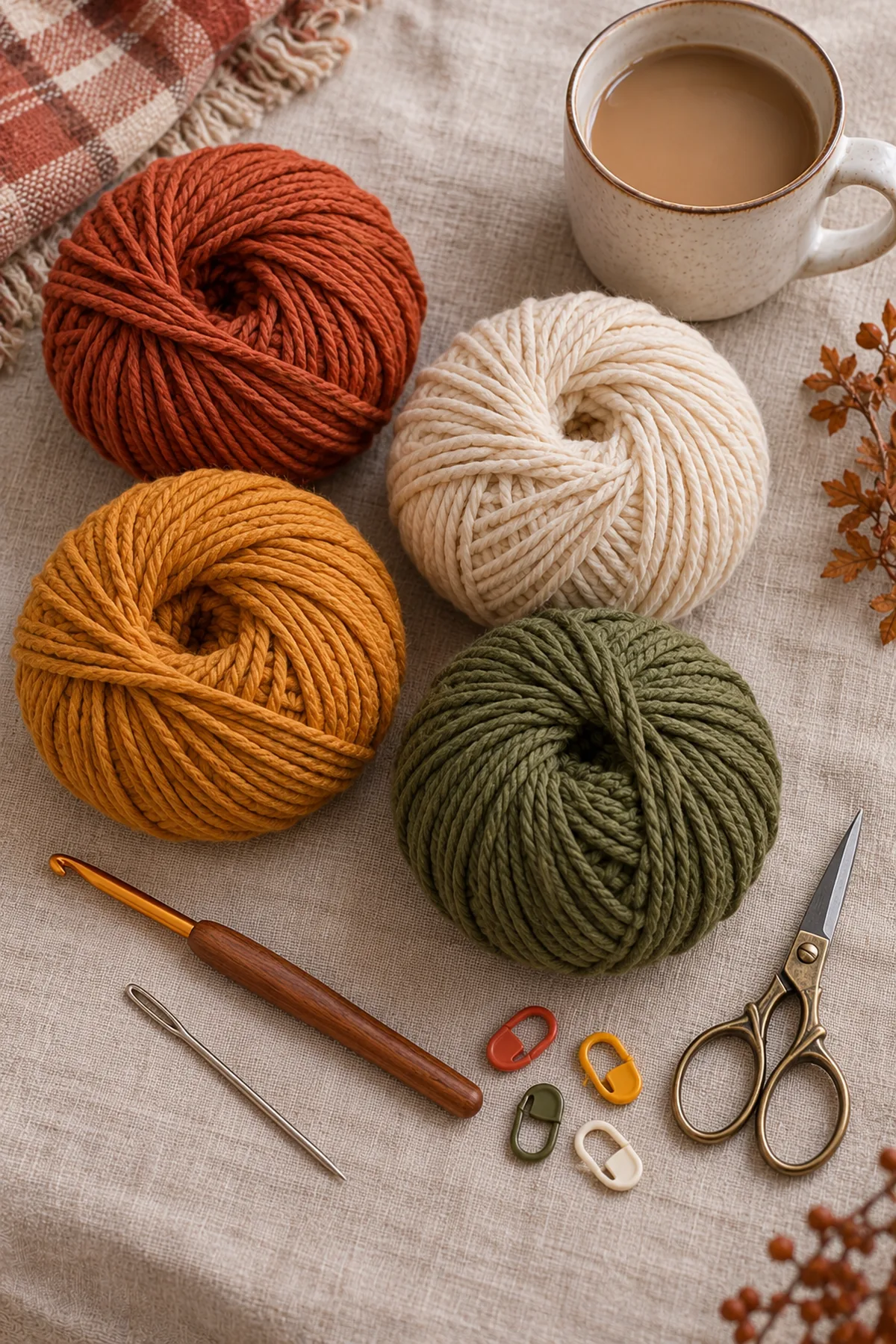
- Planning allowance: about 85 yd per coaster in rust, mustard, olive or cream worsted 100% cotton, 340 yd total plus swatch allowance
- 4 mm hook, blunt needle, removable markers and scissors
- Blocking mat, rustproof pins and ruler; no batting, glue or synthetic heat-sensitive filling
Gauge, Measurements, and Planning
The 20-stitch central circle divides into five disjoint groups of four stitches. Each group grows one eight-row lobe. Make two equal panels for each coaster and check that every lobe tip aligns before joining. The mug belongs on the flat center; this is a coaster, not a hot-pan trivet or potholder.
Make and wash a gauge swatch before beginning. Measure only after the swatch is completely dry. If the stitch width differs, change hook size rather than pulling the working yarn tighter. Keep a written count at the end of every section so the finished edges remain balanced and the assembly points line up.
Abbreviations and Special Stitches
- ch: chain
- sc: single crochet
- dc: double crochet
- sl st: slip stitch
- st(s): stitch(es)
- inc: two single crochets in one stitch
- dec: single-crochet two stitches together
- BLO: back loop only
- hdc: half double crochet
Special stitch guidance: Invisible decrease in a spiral: insert through the front loops of the next two stitches, yarn over and pull through both front loops, yarn over and pull through the remaining two loops. For flat rows use a regular sc2tog through both loops. A turning chain and a finishing slip stitch are never counted. Unless a joined round is explicitly stated, work spirals without joining or turning.
Important Notes
- Development disclosure: stitch arithmetic and the written component sequence are checked, but no physically crocheted sample or measured gauge is claimed. Yarn amounts, sizes and times are estimates; swatch and test the fit before gifting.
- AI-generated pictures illustrate the intended appearance; they are not photographs of a tested specimen or stitch charts. Use the written counts as the construction authority.
- The supplied image is a mandatory visual design reference only. This is not the source creator’s pattern; do not copy its text, instructions, layout, logo or image pixels.
- Use 100% cotton and keep the item away from open flames and hot cookware. This is not a potholder or heat-rated trivet. Do not put loose decorations near infants.
- Mark the first counted stitch of each spiral round. For every flat row, ch 1 and turn, then place the first sc in the last stitch of the previous row. Remove temporary markers before use.
Complete Instructions for Crochet Layered Maple Leaf Coasters
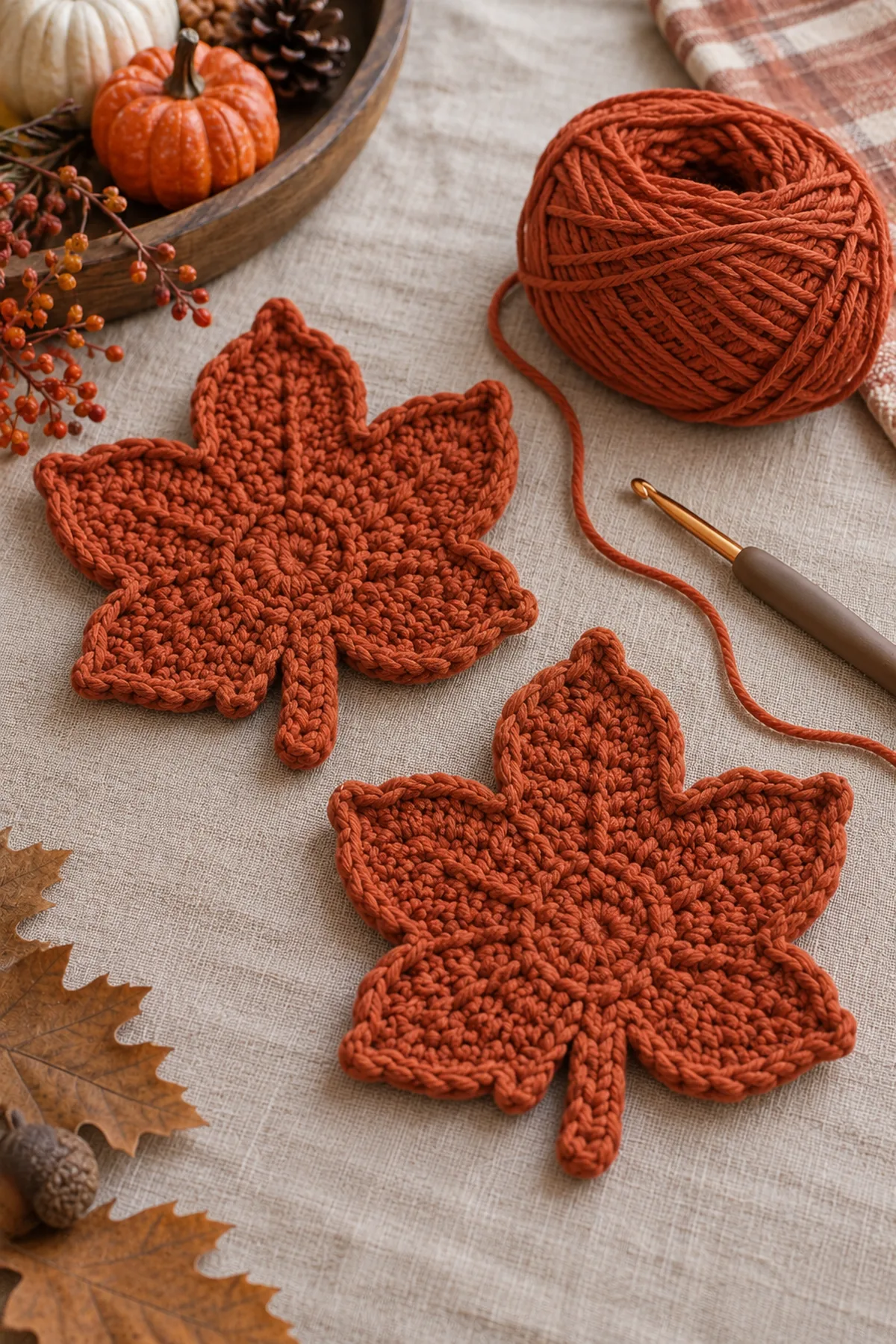
Crochet the First Five-Lobed Leaf Panel
- Maple center Round 1: 5 sc into a magic ring. (5 sts) Tighten the ring, mark the first sc, and work a continuous spiral without joining or turning.
- Round 2: inc in each stitch. (10 sts)
- Round 3: [sc in next 1 stitches, inc in next stitch] 5 times. (15 sts)
- Round 4: [sc in next 2 stitches, inc in next stitch] 5 times. (20 sts)
- Mark five consecutive non-overlapping four-stitch groups around the 20-stitch Round 4 edge. Do not share an old stitch between neighboring lobes.
- For lobe 1, join yarn into the first stitch of group 1, sc across its four old center stitches, ch 1 and turn. (4 sts) This is Lobe Row 1; the separately counted foundation chain in the audit represents these four picked-up stitches.
- Row 2: Inc, sc in next 2 stitches, inc; ch 1 and turn. (6 sts)
- Row 3: Inc, sc in next 4 stitches, inc; ch 1 and turn. (8 sts)
- Row 4: Sc in each stitch. (8 sts)
- Row 5: Sc2tog, sc in next 4 stitches, sc2tog; ch 1 and turn. (6 sts)
- Row 6: Sc2tog, sc in next 2 stitches, sc2tog; ch 1 and turn. (4 sts)
- Row 7: Sc2tog twice; ch 1 and turn. (2 sts)
- Row 8: Sc2tog; fasten off. (1 sts)
- Repeat all eight lobe rows in each of the remaining four groups. There are exactly five pointed lobes around the center and no separate side-chain increases. Weave the working tail into the wrong side.
Make the Matching Back and Short Stem
- Crochet a second panel exactly as above in the same cotton color; use the first blocked panel as a physical outline rather than changing stitch counts.
- Maple stem Row 1: ch 9; sc in second chain from hook and in each remaining chain. (8 sts) Ch 1 and turn; this chain never counts.
- Row 2: Sc in each stitch. (8 sts)
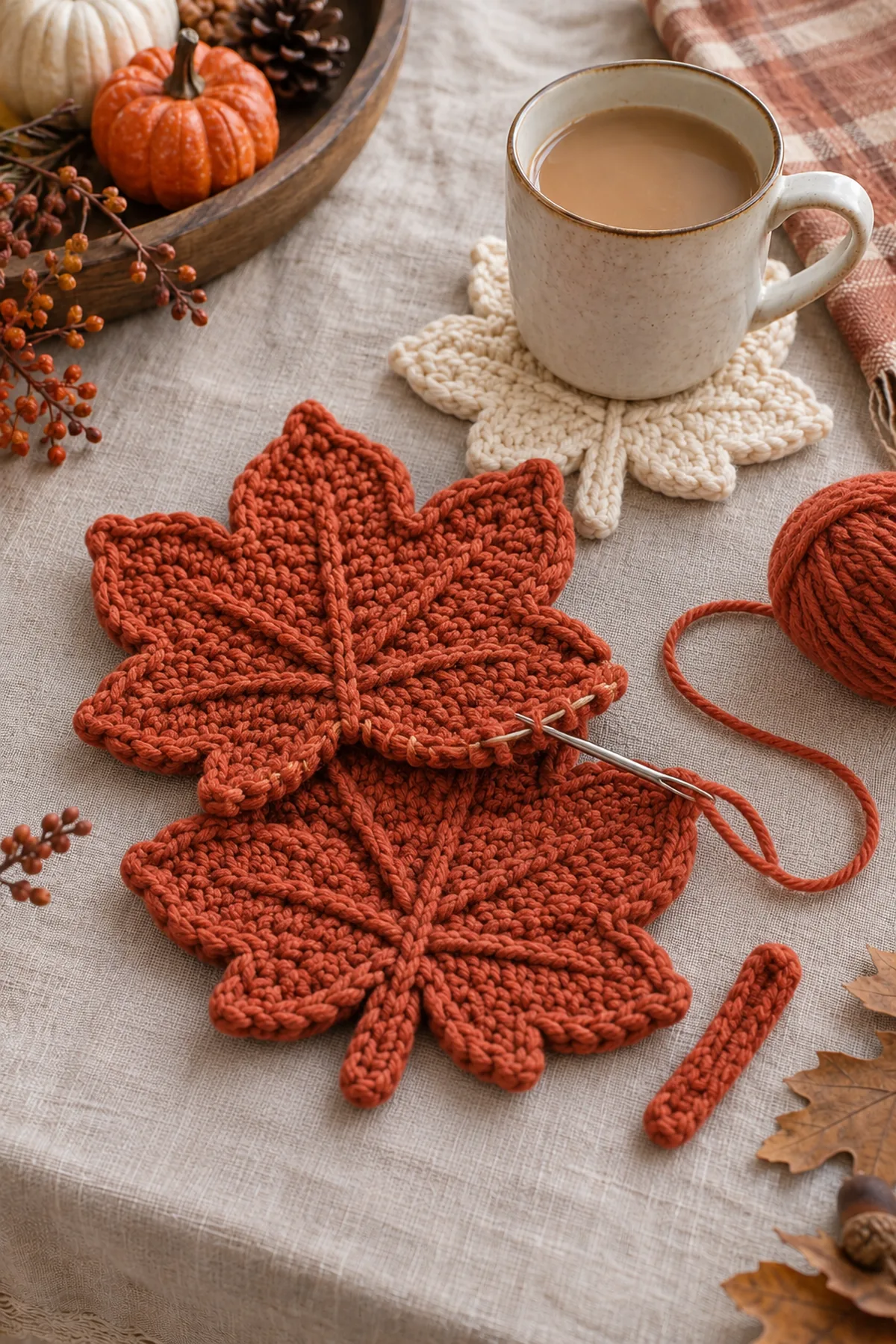
- Fold the eight-stitch stem strip lengthwise, sew its two long edges together, and sew one complete eight-stitch short end to a valley between two neighboring lobes of the front panel. Tack the other end only if you prefer a very short stem; no loose cord should dangle.
Join the Two Layers and Add Veins
- With wrong sides together, match both center rings and all five lobe tips. Whipstitch around the complete outer contour through corresponding edge loops of both panels, inserting one extra securing pass at each deep valley; do not pull the edge inward. Leave no stuffing between the layers.
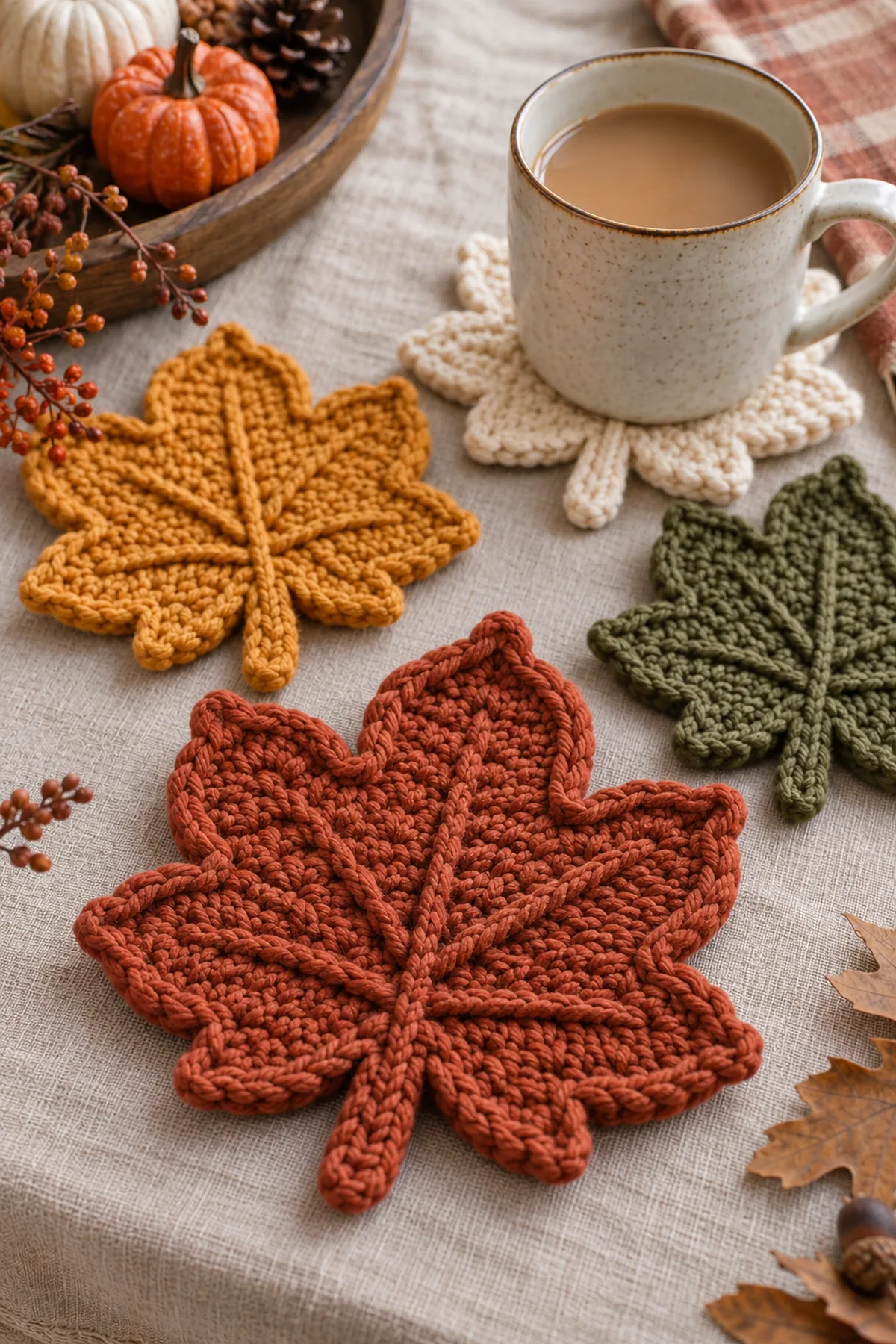
- On the top only, work a relaxed surface slip-stitch from the central ring toward each of the five tips, ending two rows before each point. Add two short side branches per lobe if desired. These overlays are decorative and do not change structural stitch counts.
- Lay a mug on the central area. If the surface veins make it wobble, shorten the veins near the center or turn the plain back upward for use.
Repeat for a Four-Coaster Autumn Set
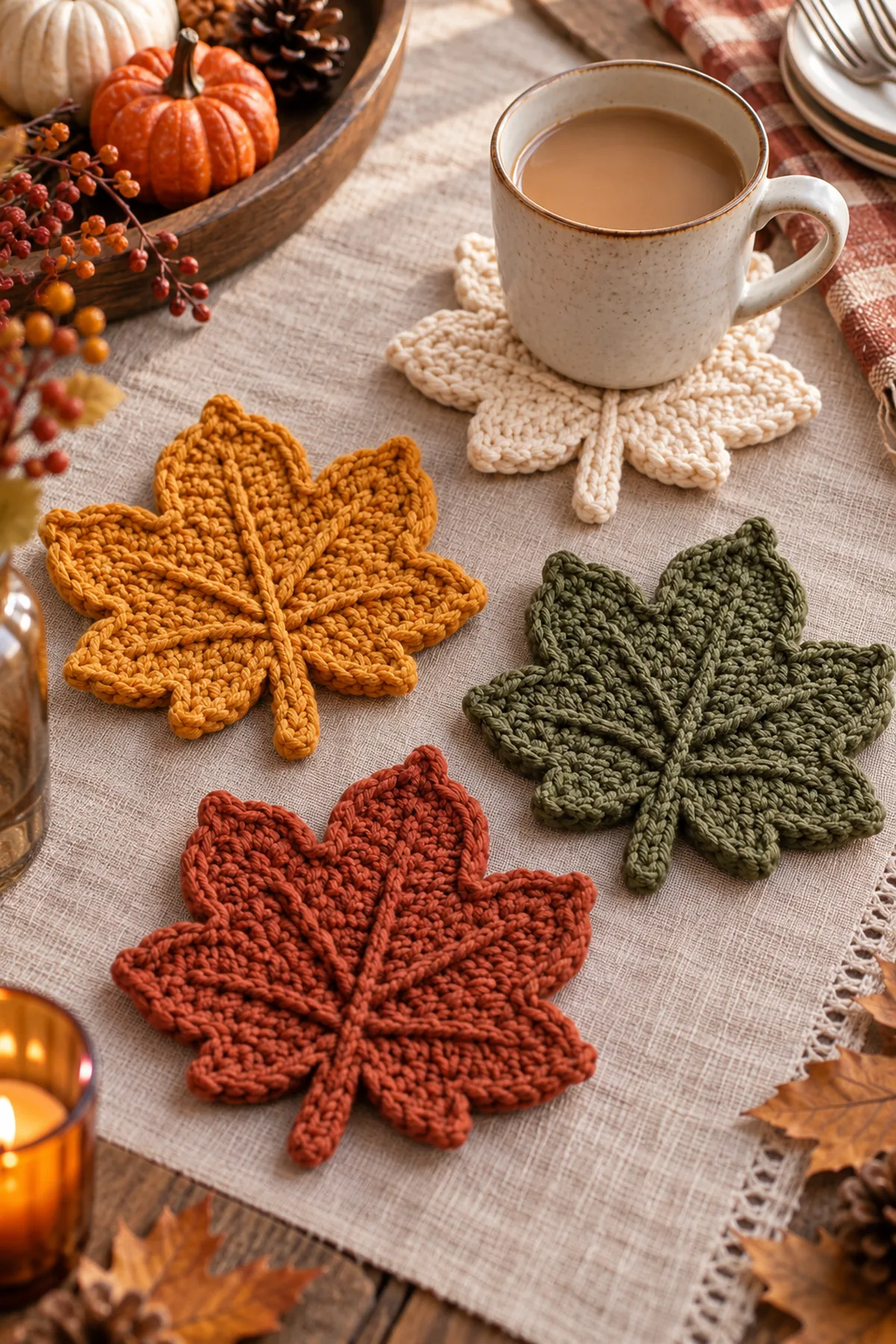
- Make a total of four coasters, using two identical panels and one stem per color: rust, mustard, olive and cream. Eight panels and four stems are required for the full set.
- Wet-block according to the cotton label and pin each of the five tips symmetrically. Dry completely and inspect the perimeter seam, stem ends and level center.
- These are drink coasters for warm or cold cups, not heat-rated trivets. Do not place hot cookware, flames or lit candles on the cotton.
Assembly and Shaping
Each coaster joins two identical five-lobed maple panels with wrong sides inward; a doubled short stem sits at one valley. Four colors make a set. The decorative top veins are optional and leave a flat center for a mug.
Lay every component on a flat surface before joining. Match the marked centers first, then divide each remaining edge into equal sections. Work through both layers with consistent tension and pause after each section to check that the fabric lies flat. This measured approach prevents twisting and keeps decorative details facing the intended direction.
Finishing
- Before closure, check every part against its stated last-round count and place a small amount of washable filling where directed.
- Sew full contact edges, then make a second reinforcing pass. Secure and bury ends through at least three fabric paths.
- Remove pins and markers. Pull-test all attachments, check for exposed filling, and inspect again after washing according to the yarn label.
For a polished result, weave each tail through several same-color stitches, reverse direction once, and trim only after the fabric has been gently stretched. Block to the listed dimensions without flattening textured stitches. Inspect joins, borders, straps, and decorative pieces before the project is used or gifted.
Helpful Tips
- A marker at each repeat boundary makes increases and decreases easier to count.
- Make paired pieces together and compare before sewing.
- If stuffing shows through, redo the affected section with a smaller hook rather than covering gaps with embroidery.
Good lighting and a contrasting stitch marker make counting much easier. If a section looks uneven, compare the current count with the previous checkpoint before continuing. Fixing one missed stitch early is faster than compensating later, and it preserves the measurements used by the assembly instructions.
Frequently Asked Questions
Is this copied from the reference image?
No. The reference controls the visual brief only. The instructions and counts here are an independent BabyYarnie construction.
Was a physical sample tested?
No physical sample is claimed. Numerical stitch validation does not establish actual fit, fabric drape, yarn quantity or child safety; make a swatch and trial assembly.
Can I use hard safety eyes?
For the safest gift presentation, use securely embroidered eyes and avoid hard or detachable small parts.
Conclusion
Record your actual yarn, hook and finished measurement. Compare the completed silhouette with the design brief, then inspect every seam and embroidered feature before gifting or display.
BabyYarnie Printable Crochet Pattern Card
BabyYarnie — easy-to-follow crochet for everyday makers.
Project: Crochet Layered Maple Leaf Coasters
Skill level: Intermediate Hook: 4 mm for firm washable cotton Yarn: Worsted 100% cotton
Finished size: Planning 6–7 in across each five-lobed leaf, plus a 2-in stem
Card Materials
- Planning allowance: about 85 yd per coaster in rust, mustard, olive or cream worsted 100% cotton, 340 yd total plus swatch allowance
- 4 mm hook, blunt needle, removable markers and scissors
- Blocking mat, rustproof pins and ruler; no batting, glue or synthetic heat-sensitive filling
Card Instructions
- Crochet the First Five-Lobed Leaf Panel: Center grows 5,10,15,20; five exclusive 4-to-8-to-1 lobes complete one panel.
- Make the Matching Back and Short Stem: Second matching five-lobed panel and one doubled eight-stitch stem.
- Join the Two Layers and Add Veins: Matched double-layer edge, secured short stem and top-only optional surface veins.
- Repeat for a Four-Coaster Autumn Set: Four independently finished thick maple coasters; use only beneath drinking cups.
Finish: Check every count, weave in all ends, block to measurement, and inspect each join.