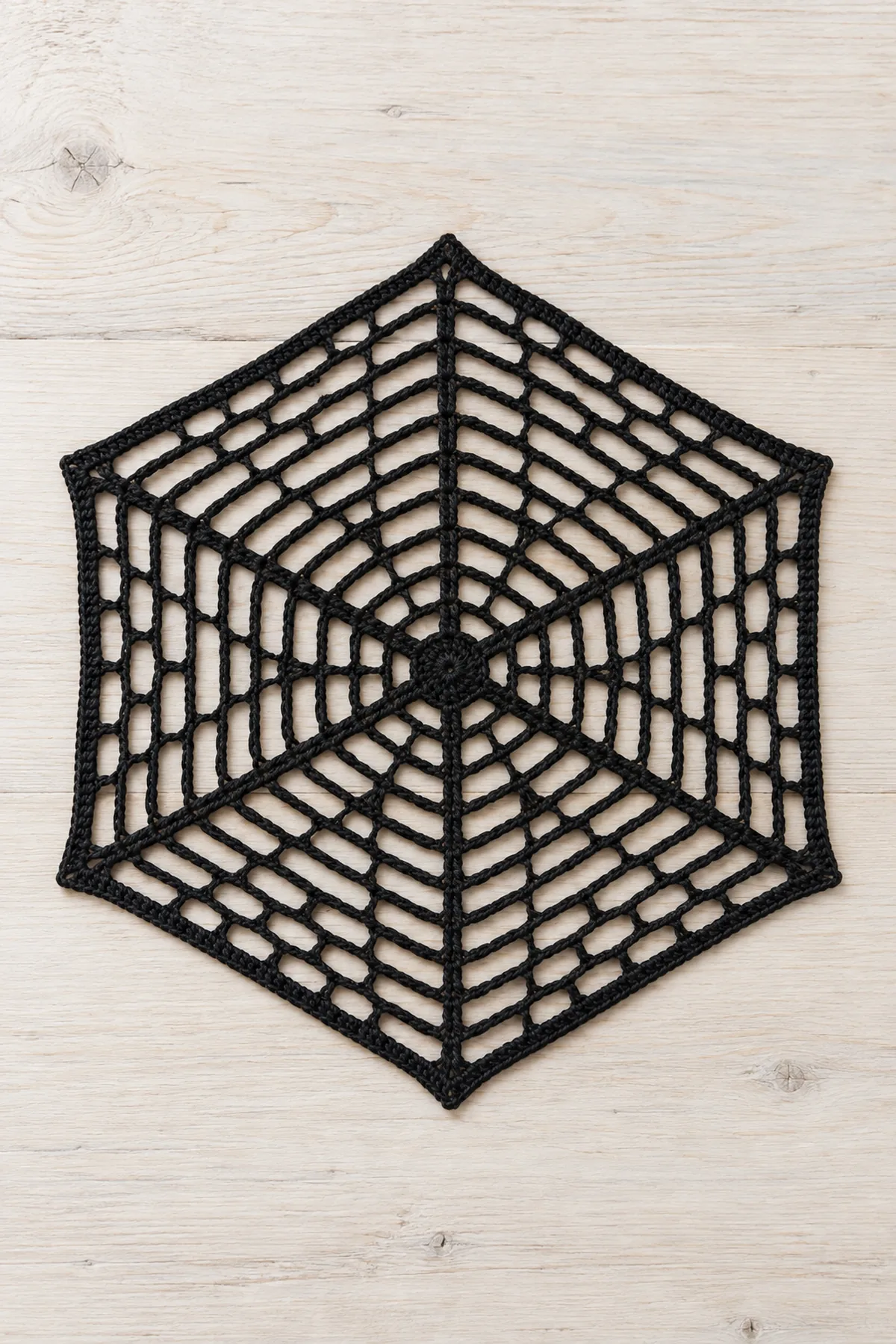
This crochet spiderweb table mat brings a practical handmade detail to Halloween. Large flat black cotton six-spoke mesh hexagon, twelve open concentric chain-arc rounds, solid single-crochet perimeter; no attached spider, center plate or heat protection claim. The instructions below describe the construction in US crochet terms. Choose yarn for the fabric structure rather than color alone, and compare each checkpoint with your own swatch before continuing.
Six marked anchor stitches form six straight rays. Between those rays, twelve concentric rounds of growing chain arcs make an open hexagonal web. A single-crochet perimeter defines the edge. This is decorative table lace, not a potholder or a heatproof trivet.
Pattern Details
- Hook Size: 3.5 mm starting point for relaxed lace, adjust after a small test
- Finished Size: Planning target approximately 10-12 inches point to opposite point after gentle blocking; gauge determines actual size
- Gauge: Lace target approximately 5 chain stitches per inch and 2.5 radial dc rounds per inch; check both together
- Estimated Time: 3-5 hours
- Construction: Six-sc center, twelve joined dc-anchor/chain-arc mesh rounds, one sc perimeter
- Skill level: Intermediate
Why You’ll Love This Project
The airy black mesh is readable against pale wood, and a six-marker system keeps every corner visible. There are no sewn appliques or charts to decode: a round table gives all twelve chain lengths and resulting position counts. The shape comes from the mesh itself.
Materials
- Planning allowance: 130 yards smooth black DK cotton, plus swatch allowance if needed
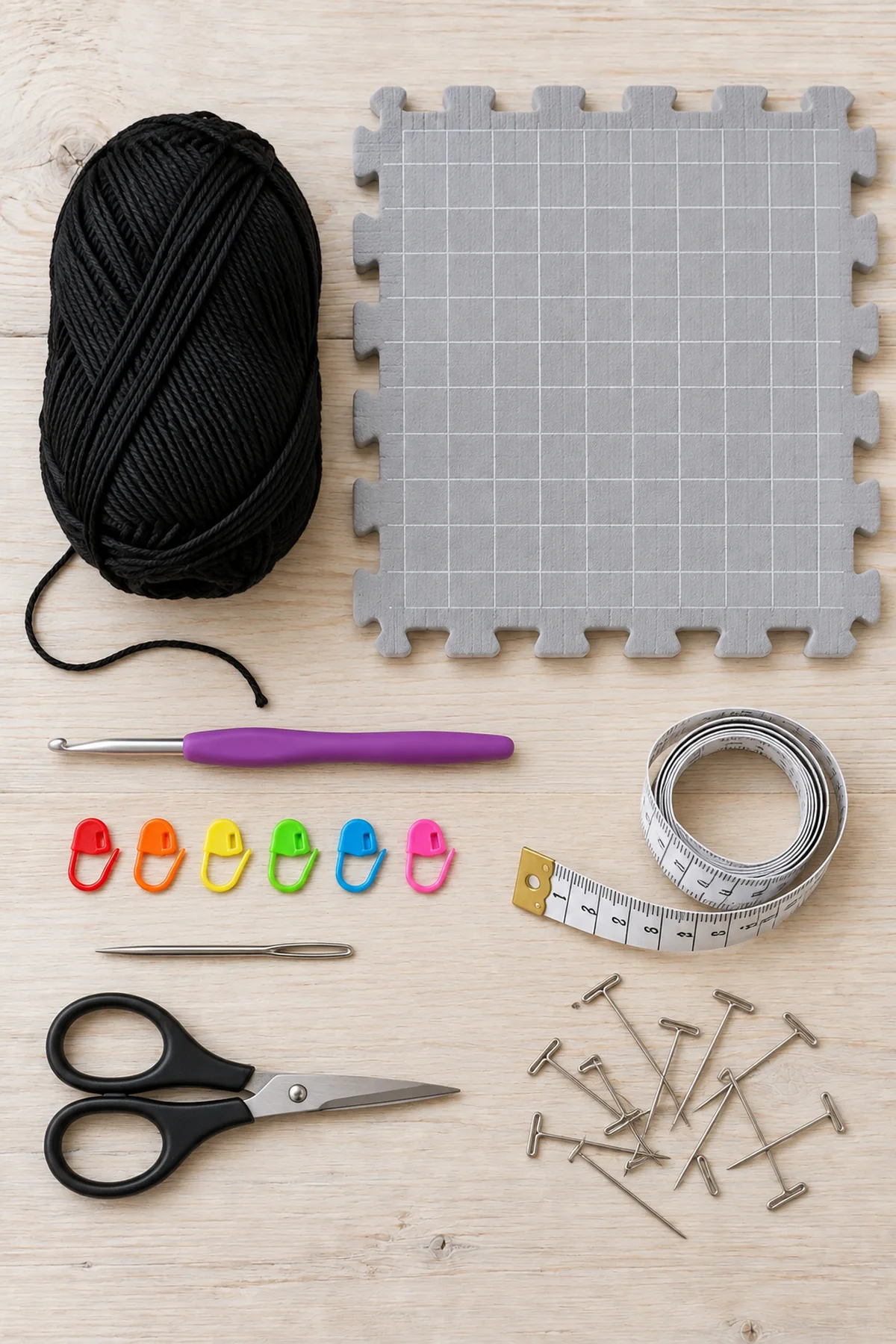
- 3.5 mm hook, six contrasting removable markers, tapestry needle, scissors, measuring tape and rustproof blocking pins/mat
Gauge, Measurements, and Planning
Work the center and first four mesh rounds as the shape test. At round 4, each side has eight chains and one anchor. Lay it flat: the six arcs should reach between evenly spaced rays without pulling or waving strongly. Target chain gauge is approximately five chains per inch; target radial height is about 2.5 dc rounds per inch. Twelve rounds then give a radius near 4.8 inches, while a 24-chain side is also about 4.8 inches, compatible with a regular hexagon near ten inches point-to-point. The center and border add a little. This is a planning relationship, not a physically measured sample. If your dc height and chain length disagree, practise more relaxed chains or adjust the hook before proceeding. Blocking cannot cure large structural differences. Do not force the mat to twelve inches if the natural fabric is smaller.
Make and wash a gauge swatch before beginning. Measure only after the swatch is completely dry. If the stitch width differs, change hook size rather than pulling the working yarn tighter. Keep a written count at the end of every section so the finished edges remain balanced and the assembly points line up.
Abbreviations and Special Stitches
- ch: chain
- sc: single crochet
- hdc: half double crochet
- dc: double crochet
- sl st: slip stitch
- st(s): stitch(es)
- rnd: round
- BLO: back loop only
- inc: 2 stitches in one stitch
- sc2tog: single crochet two stitches together
- RS: right side
- WS: wrong side
- sp: space
Special stitch guidance: Anchor = the counted dc at one of the six rays. Each new dc goes into the previous anchor, never into a chain arc. Work six anchor-and-arc repeats per round, including the final arc returning to the first anchor. The beginning ch 2 substitutes height only and does not count. For the count tables, every chain is one position; joining slip stitches are excluded. There are always six counted dc anchors, not seven.
Important Notes
- Pattern development note: stitch arithmetic and written construction have been reviewed computationally; this design has not been physically sample-tested. Gauge, yardage and finished measurements are planning targets, not a tested guarantee. Swatch and check fit before making a gift.
- Beginning ch 1 or ch 2 and joining slip stitches never count as stitches. Mark the first counted stitch of each round and move the marker after completing the round.
- On flat rows, turn after each row and work the first stitch into the last stitch of the previous row. On joined rounds, join to the first counted stitch and do not turn unless specifically instructed.
- Change color on the final yarn-over of the stitch before the new color is needed. Leave a 6-inch tail and weave it back and forth through same-color stitches after construction.
- Use the written stitch counts for structure and your washed gauge for dimensions. Do not silently add shaping increases to correct a measurement; make a fresh swatch with a different hook first.
- Images are AI-generated design illustrations, not stitch charts or photographs of a physically tested sample. Follow the written counts and your measured gauge.
Complete Instructions for Crochet Spiderweb Hexagon Table Mat
Make the Six-Anchor Center and First Mesh
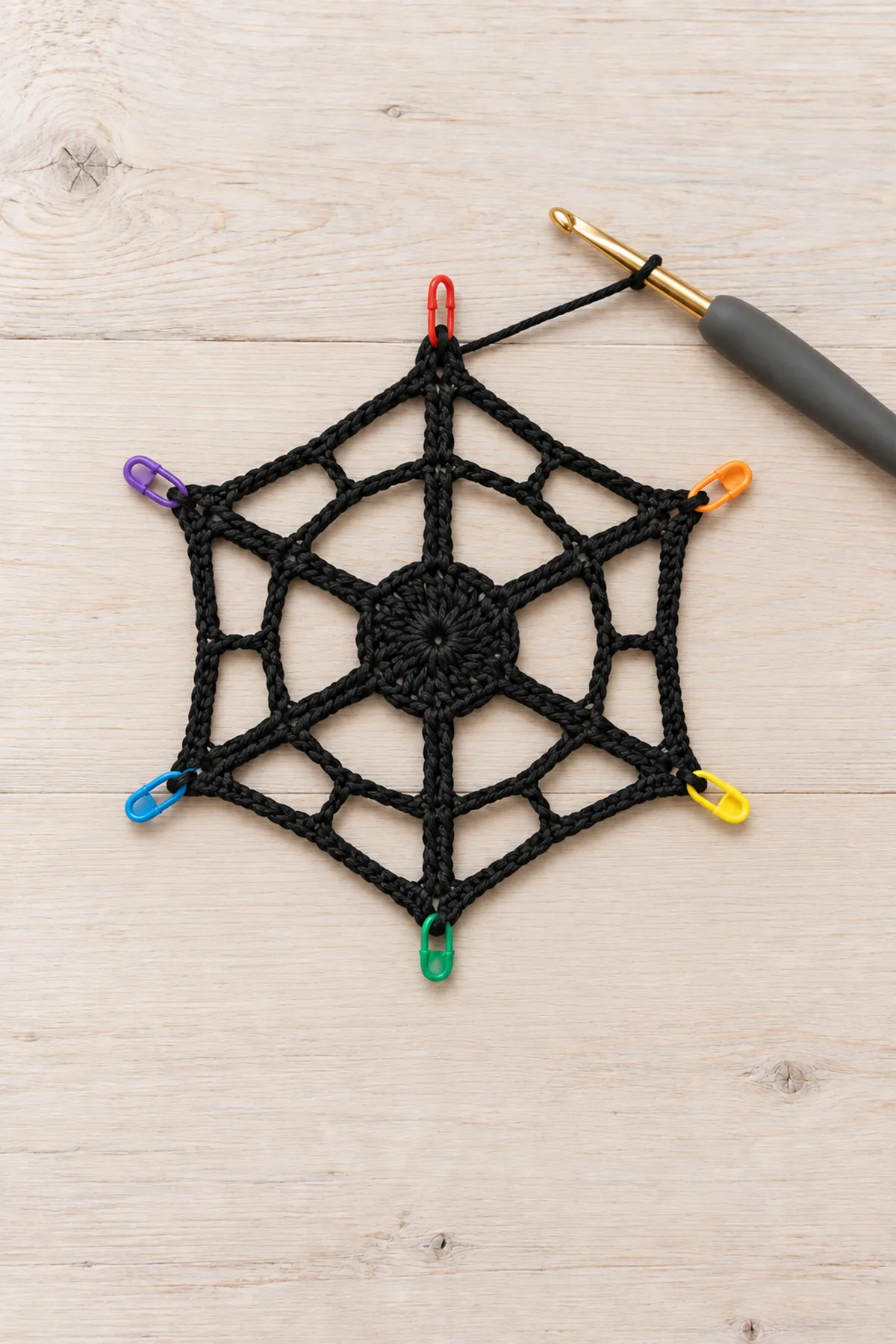
- With black, make a magic ring. Center round: 6 sc in ring, join first sc and tighten. (6 sts) Put a marker into each sc; these are the six original anchors.
- Mesh Round 1: ch 2; [dc in next marked sc, ch 2] six times. Join to first counted dc, not the beginning chain. (18 sts) counting six dc and twelve chains. Move each marker to its new dc.
- Mesh Round 2: ch 2; [dc in next marked dc, ch 4, skip the old ch-2 arc] six times. Join to first dc. (30 sts) There are six dc and six new ch-4 arcs. The final ch-4 crosses the sixth side before the join. Do not turn.
Grow Twelve Open Mesh Rounds
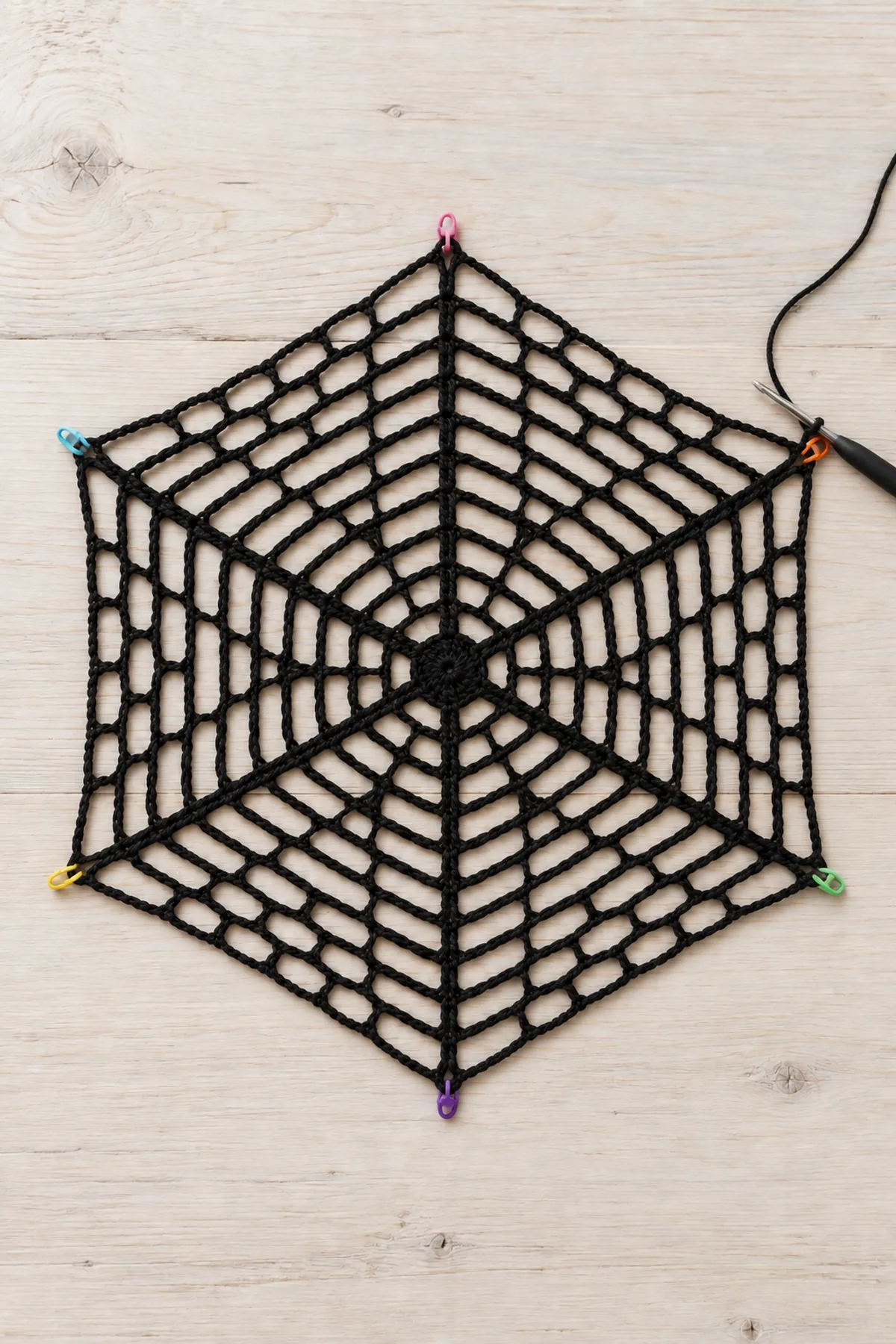
- For each next round ch 2, then [dc in next marked dc, chain the number listed, skip the entire old arc] six times. Join to the first dc. Move the six markers. The first dc is worked into the same anchor where the preceding join sits; do not advance to the second marker to start.
-
Mesh round Chains in EACH of 6 arcs Dc anchors Total positions 1 2 6 18 2 4 6 30 3 6 6 42 4 8 6 54 5 10 6 66 6 12 6 78 7 14 6 90 8 16 6 102 9 18 6 114 10 20 6 126 11 22 6 138 12 24 6 150 - Mesh Round 3: six repeats of dc in anchor, ch 6, skip old ch-4 arc; join. (42 sts)
- Mesh Round 4: six repeats of dc in anchor, ch 8, skip old ch-6 arc; join. (54 sts)
- Mesh Round 5: six repeats of dc in anchor, ch 10, skip old ch-8 arc; join. (66 sts)
- Mesh Round 6: six repeats of dc in anchor, ch 12, skip old ch-10 arc; join. (78 sts)
- Mesh Round 7: six repeats of dc in anchor, ch 14, skip old ch-12 arc; join. (90 sts)
- Mesh Round 8: six repeats of dc in anchor, ch 16, skip old ch-14 arc; join. (102 sts)
- Mesh Round 9: six repeats of dc in anchor, ch 18, skip old ch-16 arc; join. (114 sts)
- Mesh Round 10: six repeats of dc in anchor, ch 20, skip old ch-18 arc; join. (126 sts)
- Mesh Round 11: six repeats of dc in anchor, ch 22, skip old ch-20 arc; join. (138 sts)
- Mesh Round 12: six repeats of dc in anchor, ch 24, skip old ch-22 arc; join. (150 sts)
- Spread the work after Rounds 4, 8 and 12. Check six rays, equal chain lengths on all six sides, and a sixth return arc. If one side is short, undo that round and correct it; do not hide a missing arc in the border.
Finish the Solid Hexagon Perimeter
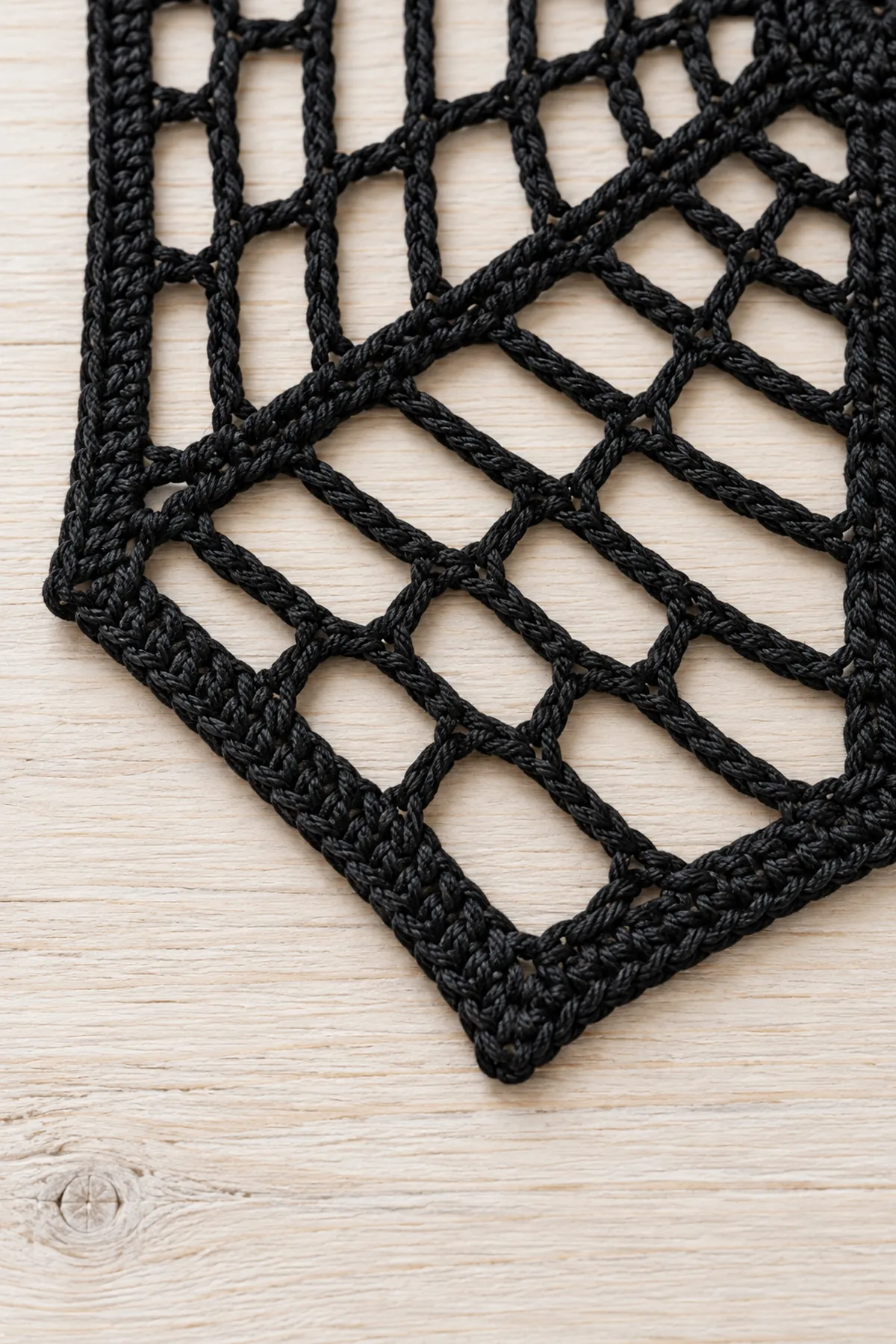
- After Mesh Round 12, ch 1. [Work 3 sc into the next marked dc anchor, then work 24 sc around the following ch-24 arc] six times. Join to first sc and fasten off. (162 sts) Work around each whole arc, spacing its 24 sc evenly, rather than into each chain. The three sc at each anchor form a corner.
- Move each marker to the middle sc of its three-sc corner. Count 24 side sc between each group of three corner sc. You must have six corners, 144 side sc and 18 corner sc. Do not crochet a second perimeter round.
- Weave the center and outer tails securely. Soak or dampen according to the cotton label, blot in a towel, then pin six corners at equal distance from the center. Adjust side arcs gently, keeping the same tension on all sides. Let dry fully, remove pins and markers, and measure.
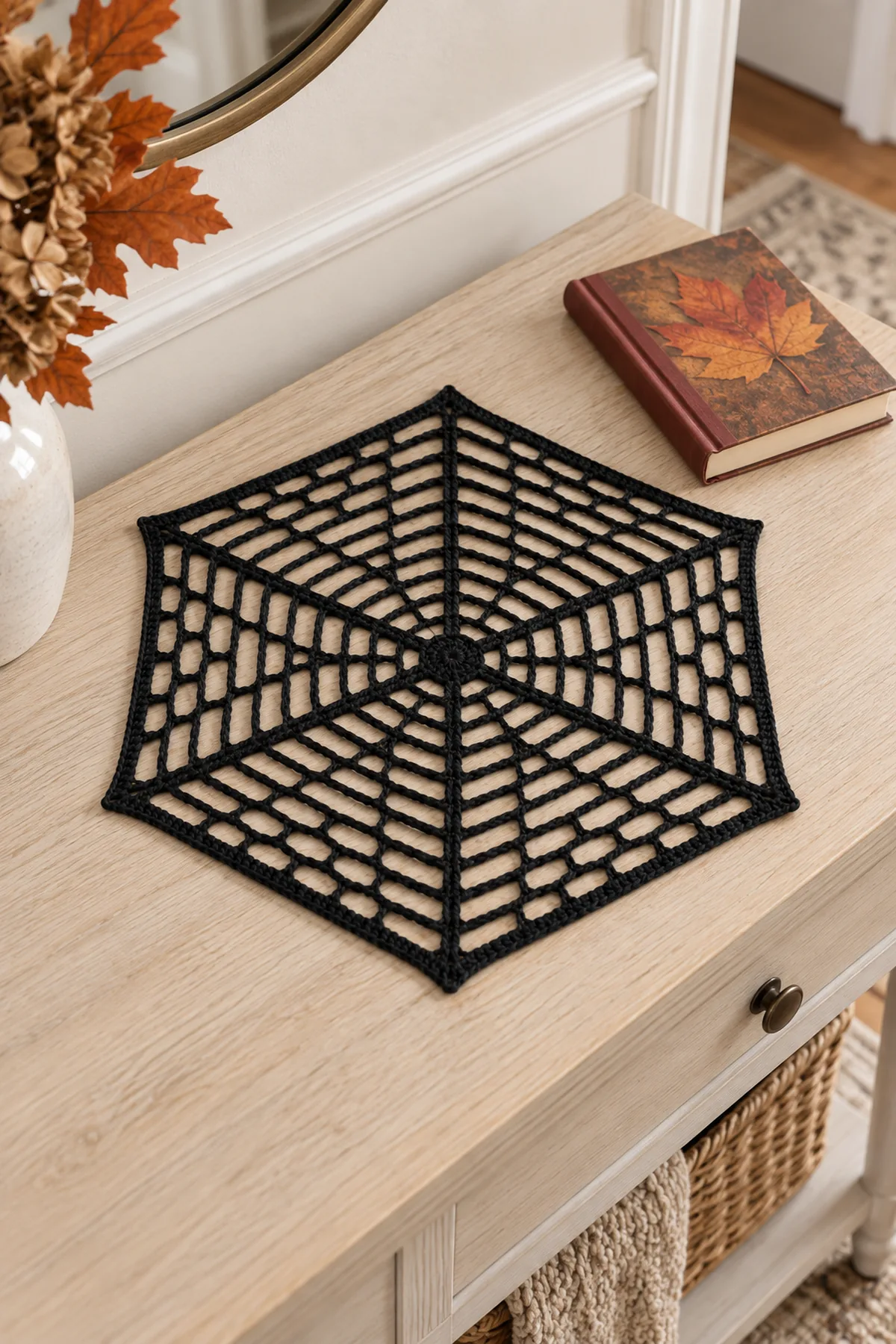
- Use on a cool dry decorative table. This open mesh is not heat insulation, a potholder, a fire barrier or child-proof decor. Keep it away from candles, hot serving dishes and flame. Store flat and reblock gently after washing.
Assembly and Shaping
No pieces are sewn together. Secure the center tail through several center stitches, block the six outer corners evenly with the center flat, and remove every blocking pin when fully dry. The complete mat has six rays and twelve open arc rounds, with no attached spider.
Follow the specific assembly for this project above. Do not sew closed an opening that is meant to remain open, and do not add attachments absent from the written construction.
Finishing
- Fasten off with a 6-inch tail; weave through three separate groups of stitches, changing direction twice.
- Damp-block gently according to the fiber label, check the intended shape, and dry fully before assembly or use.
- Inspect both sides, all joins, and every decorative attachment; resecure a loose stitch before gifting.
- Include the fiber content and washing instructions with the finished item. Keep the item away from candles and other heat sources.
For a polished result, weave each tail through several same-color stitches, reverse direction once, and trim only after the fabric has been gently stretched. Block to the listed dimensions without flattening textured stitches. Inspect joins, borders, straps, and decorative pieces before the project is used or gifted.
Helpful Tips
- Count in small marked sections instead of counting an entire dark-colored edge repeatedly.
- Use a pale working surface behind black yarn so both loops of the stitch remain visible.
- Keep a row tally and record your swatch measurements beside the size you selected.
- If shaping ripples or pulls, stop at that checkpoint and compare counts and gauge before progressing.
Good lighting and a contrasting stitch marker make counting much easier. If a section looks uneven, compare the current count with the previous checkpoint before continuing. Fixing one missed stitch early is faster than compensating later, and it preserves the measurements used by the assembly instructions.
Frequently Asked Questions
Can I change the colors?
Yes. Keep the yarn weight and fiber behavior consistent and use enough contrast for the decorative detail. Make a washed swatch with every major yarn substitution.
Is this pattern physically tested?
No physical sample test is claimed. The stitch counts are computationally checked and the written construction is reviewed. Make a gauge swatch, use the measurement checkpoints, and test fit or assembly before gifting.
Can I use this as a hot pad?
No. The large mesh openings do not protect a table or hands from heat. This mat is decorative only; keep it clear of candles, flame and hot cookware.
Conclusion
Keep the completed measurements and your yarn details with your pattern notes. The finished piece should match the described construction before it is styled or gifted. If a checkpoint does not match, correct the underlying count or gauge instead of concealing the difference during finishing.
BabyYarnie Printable Crochet Pattern Card
BabyYarnie — easy-to-follow crochet for everyday makers.
Project: Crochet Spiderweb Hexagon Table Mat
Skill level: Intermediate Hook: 3.5 mm starting point for relaxed lace, adjust after a small test Yarn: DK
Finished size: Planning target approximately 10-12 inches point to opposite point after gentle blocking; gauge determines actual size
Card Materials
- Planning allowance: 130 yards smooth black DK cotton, plus swatch allowance if needed
- 3.5 mm hook, six contrasting removable markers, tapestry needle, scissors, measuring tape and rustproof blocking pins/mat
Card Instructions
- Make the Six-Anchor Center and First Mesh: Six-sc center; Mesh Rounds 1-2 have 6 anchors with ch-2 then ch-4 arcs.
- Grow Twelve Open Mesh Rounds: Mesh Round n has 6 dc plus six ch-(2n) arcs; Round 12 ends with 150 positions.
- Finish the Solid Hexagon Perimeter: Perimeter: 3 sc in each anchor and 24 around each arc = 162 sc; block six equal corners.
Finish: Check every count, weave in all ends, block to measurement, and inspect each join.