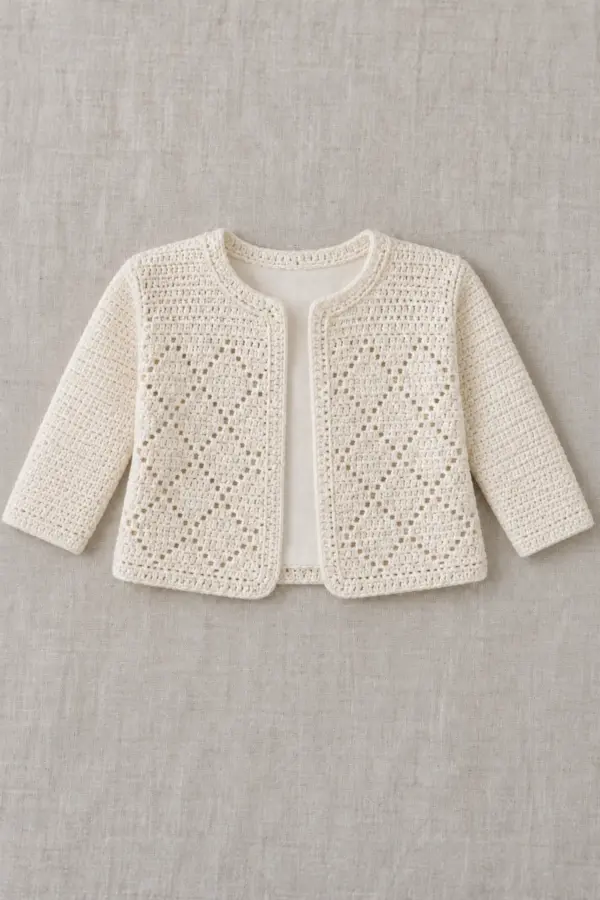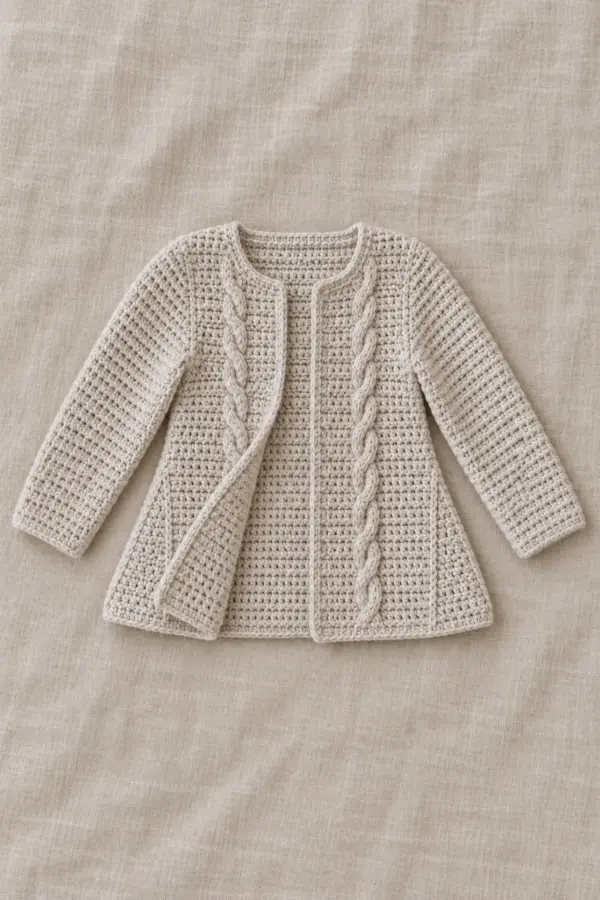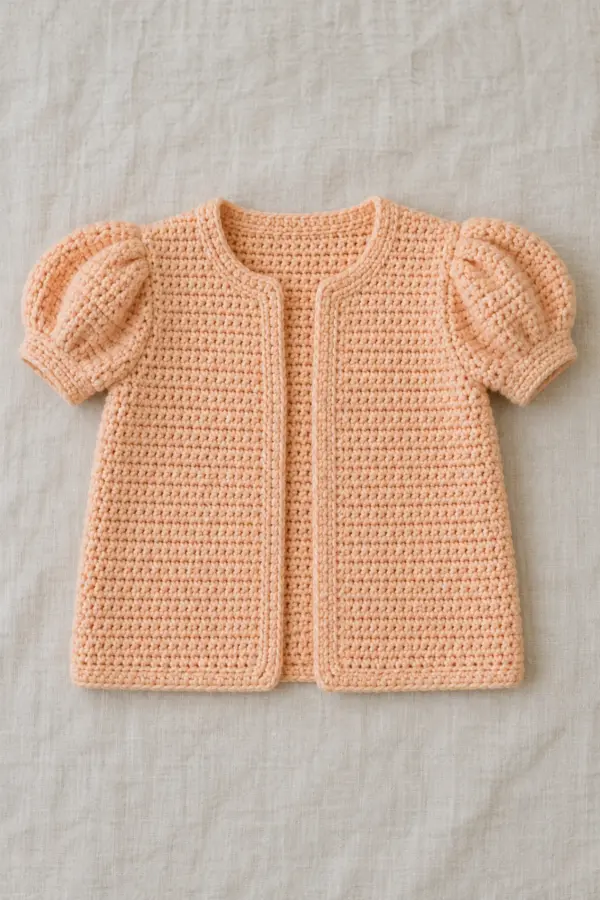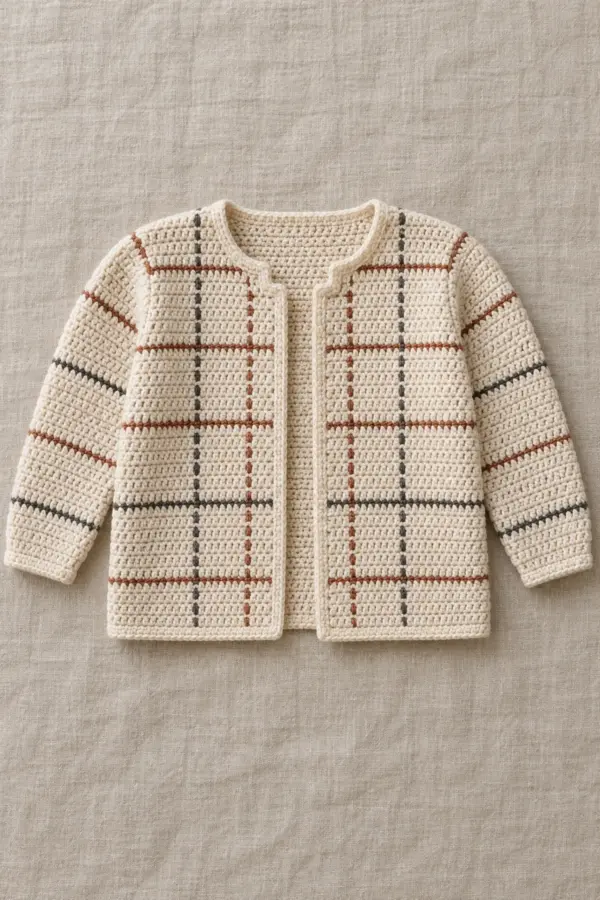
This original crochet v-neck baby cardigan with contrast placket targets easy crochet v neck baby cardigan and is a complete free beginner baby cardigan pattern. The garment is built from the specific pieces described below, with stitch counts and measured checkpoints before each join. The written arithmetic has been checked, but gauge and fit require a washed swatch and a trial fitting over a suitable layer.
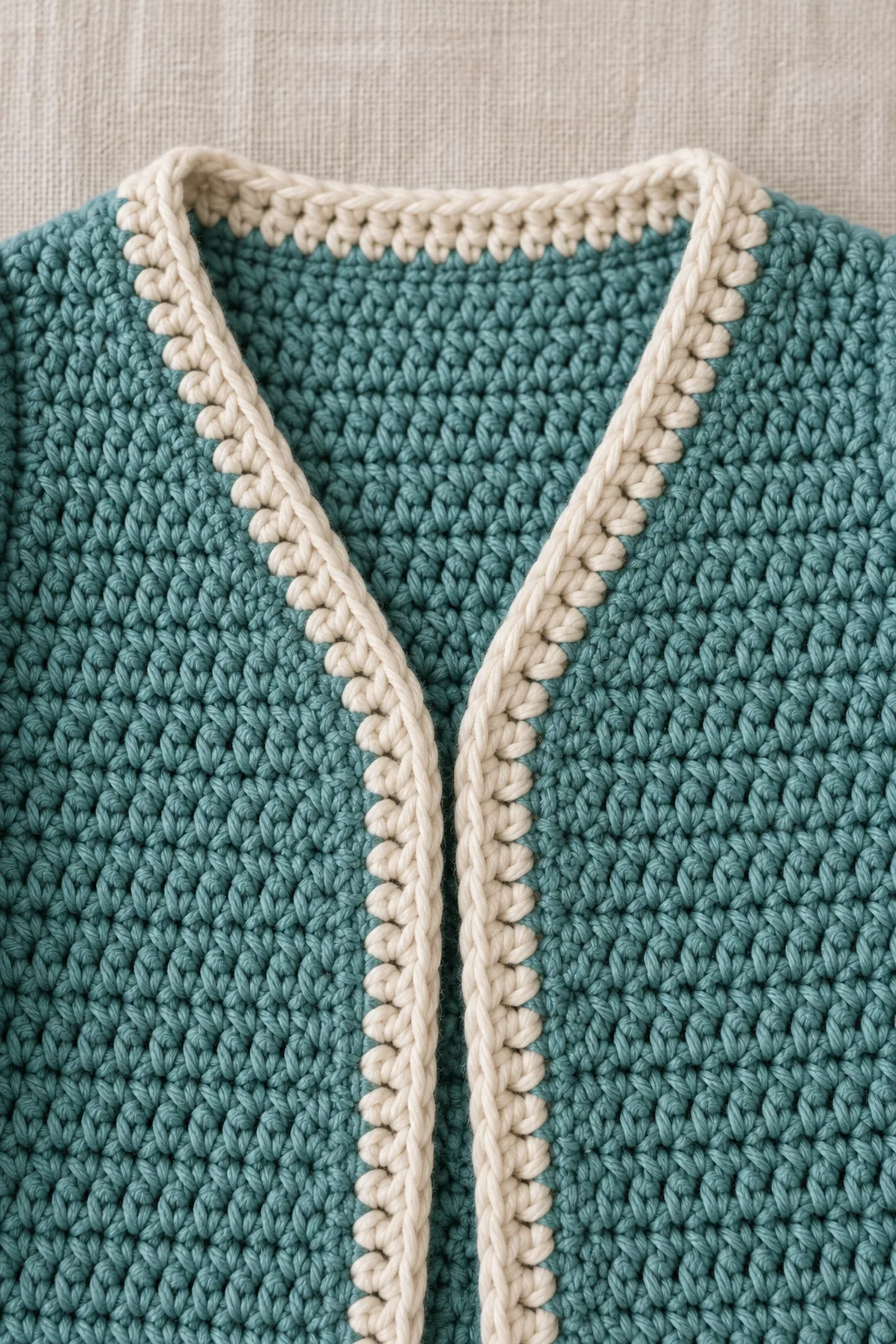
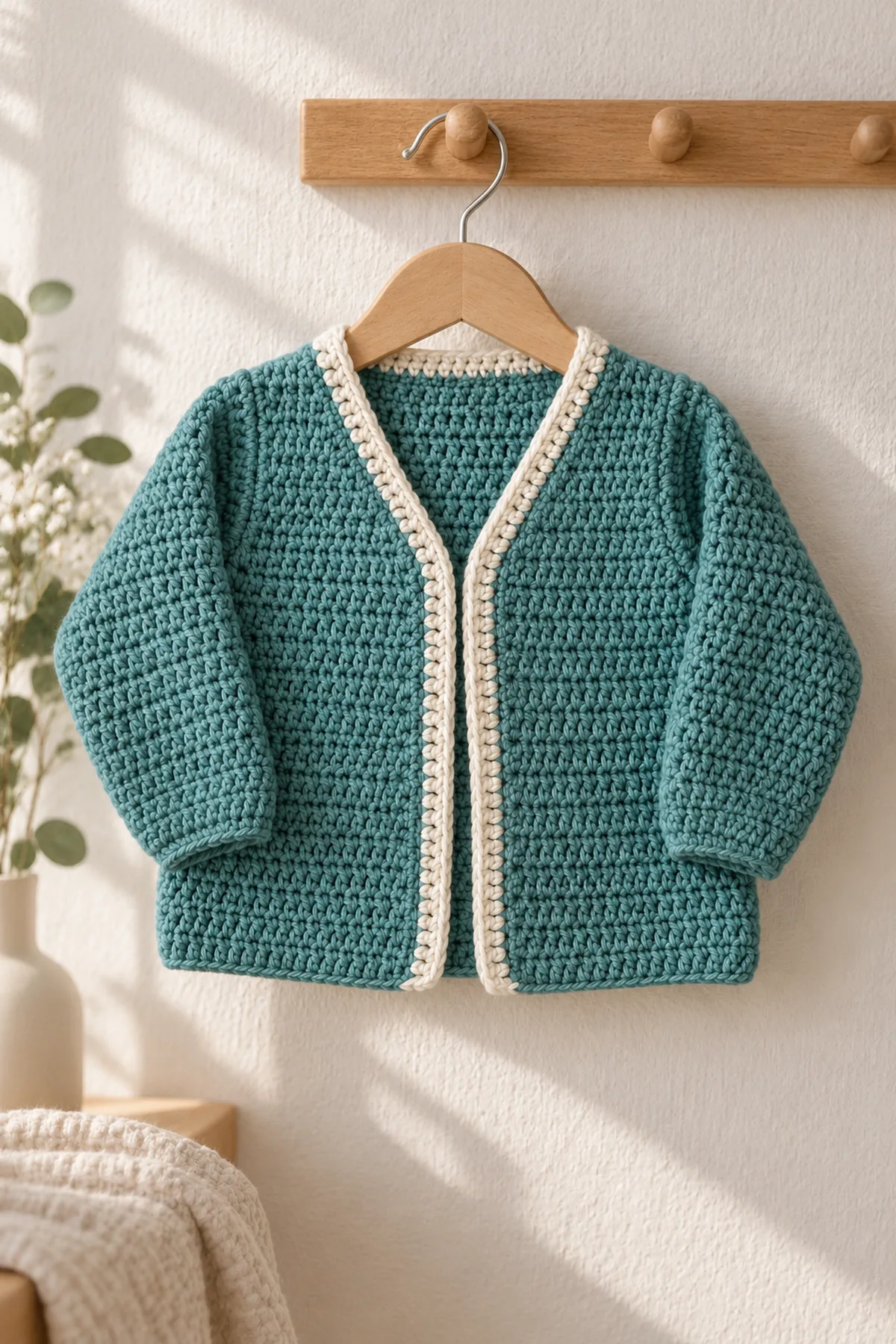
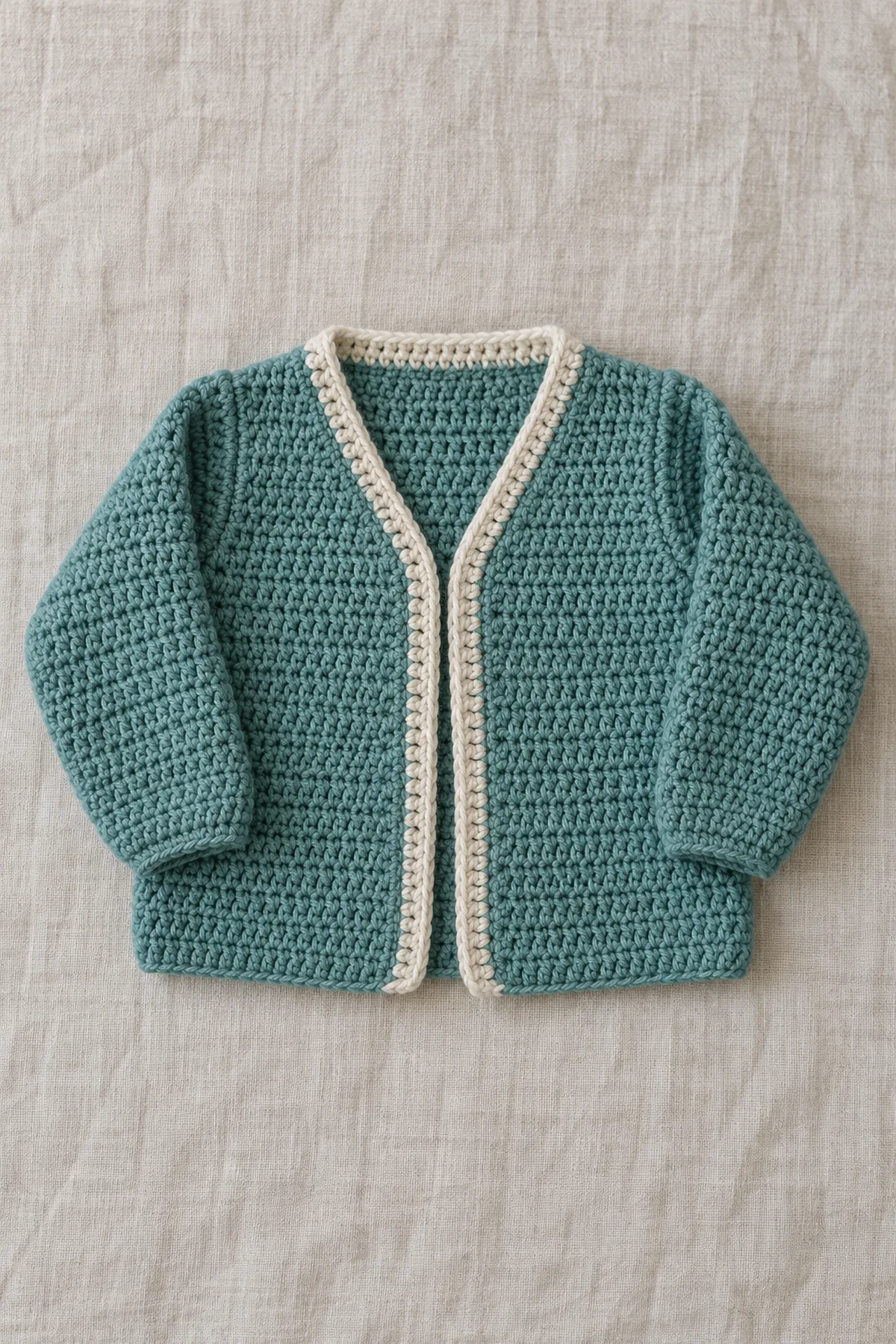
A plain teal back and two symmetrically tapered fronts create a clean open V-neck without buttons. Two short rows of ecru single crochet travel continuously up one front, around the back neck and down the other, making a visible contrast placket. Separate tapered sleeves are inserted after counted shoulder and side seams.
Pattern Details
- Hook Size: 4 mm, adjusted to washed hdc gauge
- Finished Size: 6–12 months planning target; approximately20.7-inch lower open chest and11-inch body length
- Gauge: 18 hdc and12 rows =4 inches after washing
- Estimated Time: 7–9 hours
- Construction: 45-stitch back, two 24-to-14-stitch V fronts, two 42-to-30-stitch sleeves and one continuous 83-stitch contrast placket
- Skill level: Easy
Why You’ll Love This Project
Each stitch repeat is short enough to count without a chart. The changing silhouette comes from how the pieces are assembled, and each seam has a named edge and count. The project can be stopped at every stage for a measurement before yarn is cut.
Materials
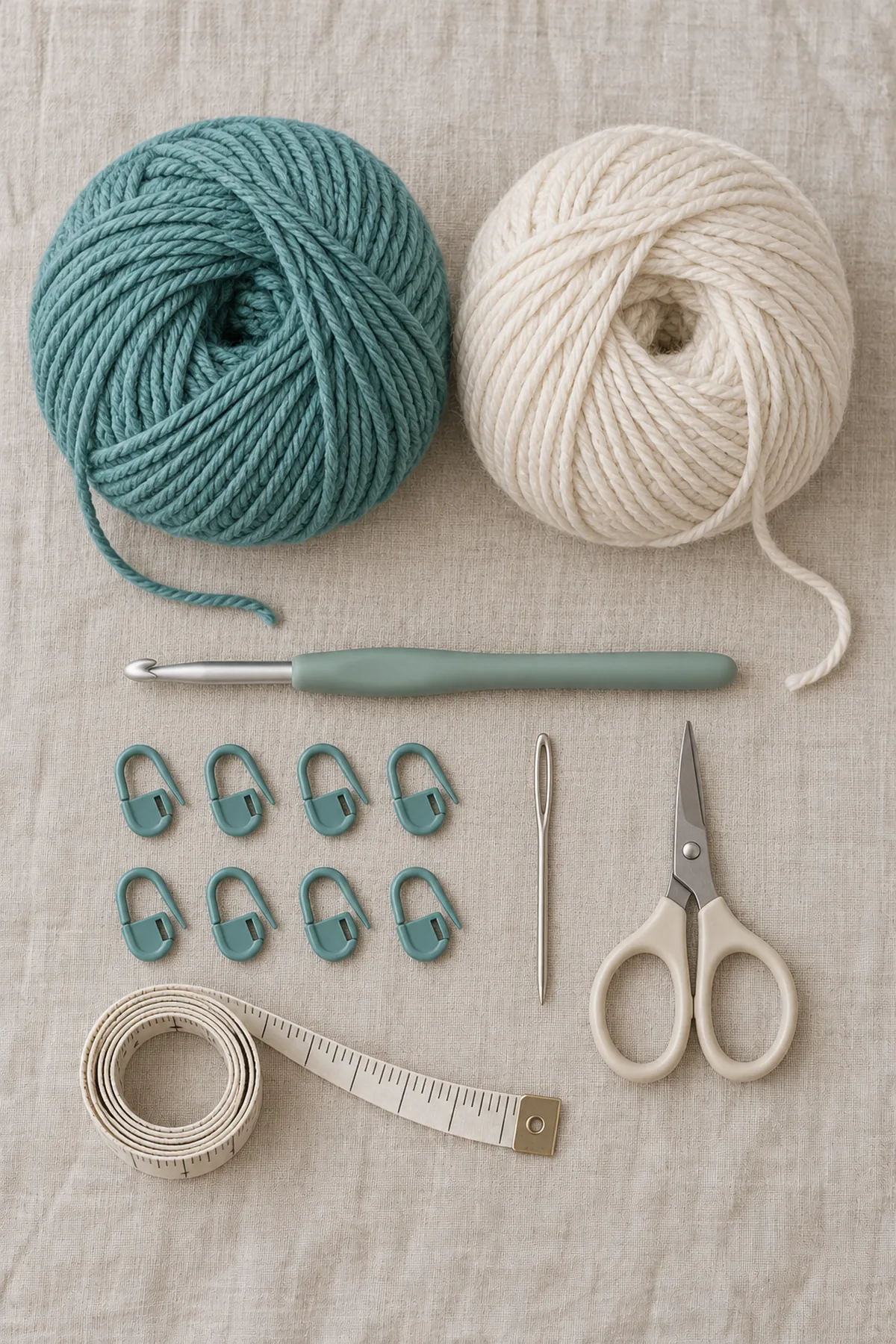
- Approximately 380 yards washable muted teal DK yarn and55 yards matching ecru DK yarn
- 4 mm hook, eight removable markers, yarn needle, scissors and measuring tape
Gauge, Measurements, and Planning
At eighteen hdc per four inches, the45-stitch back is10 inches and two24-stitch lower fronts add10.7 inches; the open lower chest is about20.7 inches before seams. Thirty-three rows at12 per four inches give11 inches. A14-row armhole on each front and back side is about9.3 inches around, matching a42-stitch upper sleeve edge at the target hdc gauge. The V removes one inner front stitch at each of ten named rows per side. Measure a washed sample and trial-fit over a layer; the age range is only a planning target.
Make and wash a gauge swatch before beginning. Measure only after the swatch is completely dry. If the stitch width differs, change hook size rather than pulling the working yarn tighter. Keep a written count at the end of every section so the finished edges remain balanced and the assembly points line up.
Abbreviations and Special Stitches
- ch: chain
- sc: single crochet
- hdc: half double crochet
- dc: double crochet
- sl st: slip stitch
- BLO: back loop only
- st(s): stitch(es)
- rnd: round
Special stitch guidance: Hdc2tog: yarn over and draw up a loop in each of the next two old stitches, yarn over and draw through all five loops. It consumes two positions and leaves one, reducing the row by one. On a V decrease row work hdc2tog over the two old stitches at the marked inner opening edge only; work ordinary hdc elsewhere. Turn with ch2, which does not count.
Important Notes
- Images are AI-generated illustrations of the intended construction, not photographs of a physically tested sample. Follow the written counts rather than counting image stitches.
- Development note: stitch arithmetic has been checked computationally. This garment has not been physically sample-tested. Sizes, gauge and yardage are planning targets; swatch, measure and trial-fit before gifting.
- Beginning turning chains and joining slip stitches do not count unless specifically stated. Work into the first real stitch and mark it.
- Use smooth, washable baby-suitable yarn. Avoid loose appliques, long loops and removable trim. Check every edge and attachment before supervised wear.
- A cardigan is supervised daytime clothing, not sleepwear or a safe-sleep item. Remove it before sleep and check seams, yarn tails and markers each time.
Complete Instructions for Crochet V-Neck Baby Cardigan with Contrast Placket
Make a Straight Back and Matching V Fronts
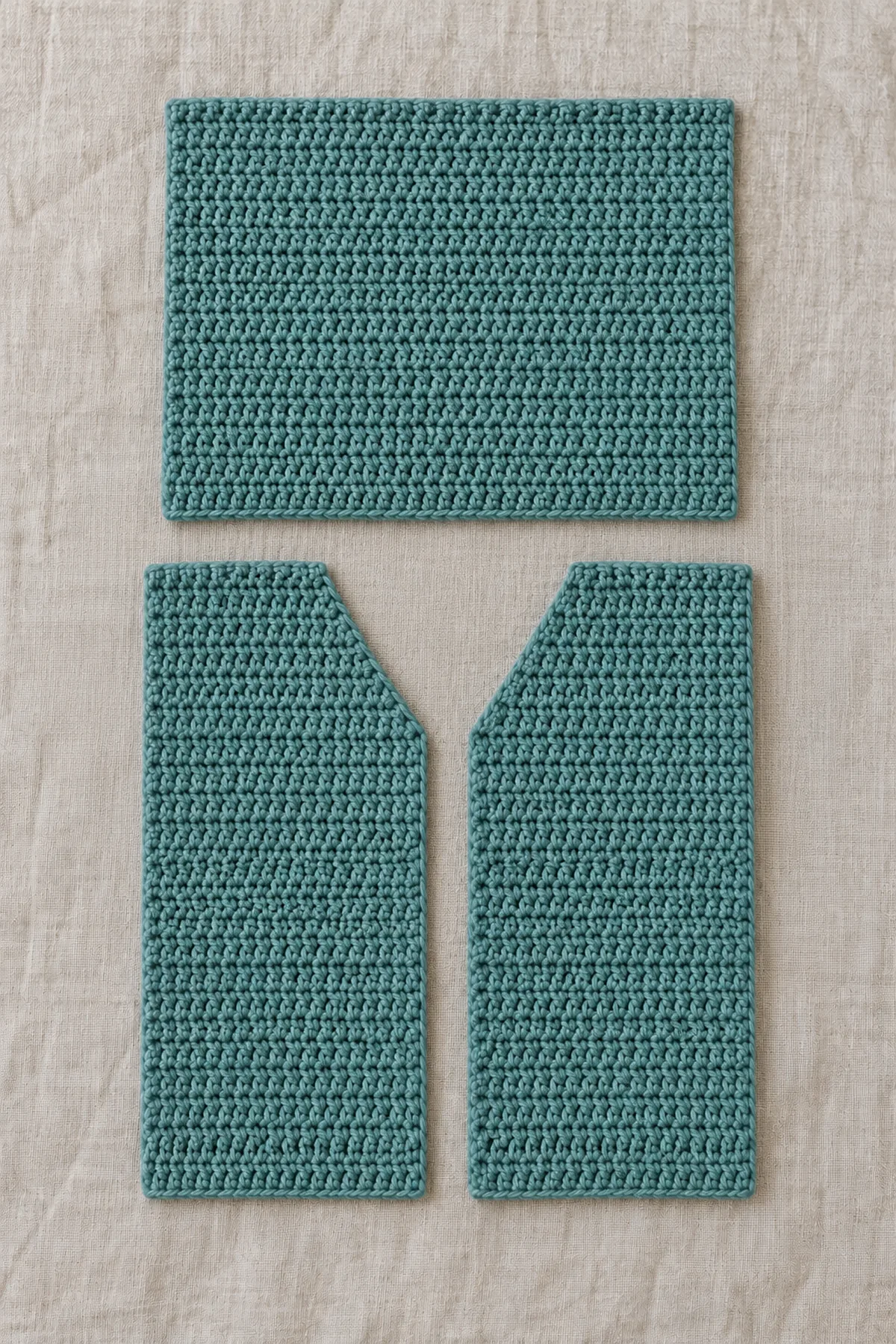
- Back: ch46 in teal. Row1: hdc in second chain and across. (45 sts) Ch2 and turn. Rows2–33: hdc in each of45 old stitches, ch2 and turn except after33. Mark Rows19 and33 at both side edges.
- For each front ch25 and hdc in second chain across. (24 sts) Rows2–12: hdc in all24; ch2 and turn. Mark the inner opening edge. Make two fronts with their inner edges facing one another; on right-side and wrong-side rows alike, the decrease is always at that marked inner edge, not both edges.
- Row13: at the marked inner edge hdc2tog over its two old stitches; hdc once in every other old stitch. (23 sts) Ch2 and turn. Row14: hdc once into every one of the 23 stitches. (23 sts) Ch2 and turn, except after Row32.
- Row15: at the marked inner edge hdc2tog over its two old stitches; hdc once in every other old stitch. (22 sts) Ch2 and turn. Row16: hdc once into every one of the 22 stitches. (22 sts) Ch2 and turn, except after Row32.
- Row17: at the marked inner edge hdc2tog over its two old stitches; hdc once in every other old stitch. (21 sts) Ch2 and turn. Row18: hdc once into every one of the 21 stitches. (21 sts) Ch2 and turn, except after Row32.
- Row19: at the marked inner edge hdc2tog over its two old stitches; hdc once in every other old stitch. (20 sts) Ch2 and turn. Row20: hdc once into every one of the 20 stitches. (20 sts) Ch2 and turn, except after Row32.
- Row21: at the marked inner edge hdc2tog over its two old stitches; hdc once in every other old stitch. (19 sts) Ch2 and turn. Row22: hdc once into every one of the 19 stitches. (19 sts) Ch2 and turn, except after Row32.
- Row23: at the marked inner edge hdc2tog over its two old stitches; hdc once in every other old stitch. (18 sts) Ch2 and turn. Row24: hdc once into every one of the 18 stitches. (18 sts) Ch2 and turn, except after Row32.
- Row25: at the marked inner edge hdc2tog over its two old stitches; hdc once in every other old stitch. (17 sts) Ch2 and turn. Row26: hdc once into every one of the 17 stitches. (17 sts) Ch2 and turn, except after Row32.
- Row27: at the marked inner edge hdc2tog over its two old stitches; hdc once in every other old stitch. (16 sts) Ch2 and turn. Row28: hdc once into every one of the 16 stitches. (16 sts) Ch2 and turn, except after Row32.
- Row29: at the marked inner edge hdc2tog over its two old stitches; hdc once in every other old stitch. (15 sts) Ch2 and turn. Row30: hdc once into every one of the 15 stitches. (15 sts) Ch2 and turn, except after Row32.
- Row31: at the marked inner edge hdc2tog over its two old stitches; hdc once in every other old stitch. (14 sts) Ch2 and turn. Row32: hdc once into every one of the 14 stitches. (14 sts) Ch2 and turn, except after Row32.
- Row33: hdc once in each of14 positions; fasten off. Both fronts end in14 upper shoulder stitches. Their inner edges slope symmetrically from Row13 to Row31. Block the two fronts side by side; rework if one V slope is longer or the top count is not14.
Crochet Two Tapered Sleeves
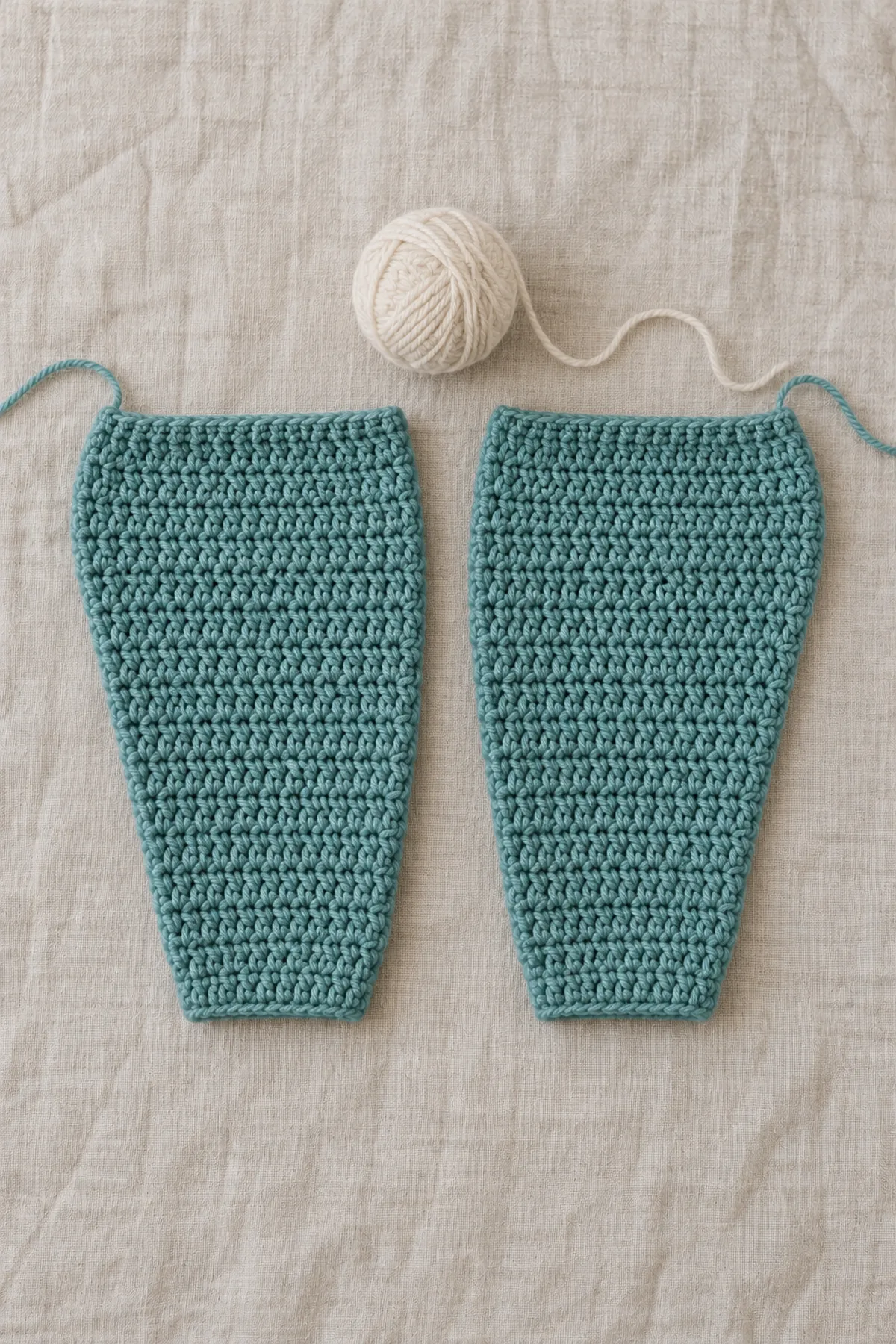
- For each sleeve ch43 in teal. Row1: hdc in second chain and across. (42 sts) Ch2 and turn. Work hdc in each old stitch on every row not named as a decrease row.
- On Rows4,8,12,16,20 and24, hdc2tog over the first two old stitches, hdc across the middle, then hdc2tog over the final two. Counts after those rows are40,38,36,34,32 and30. Work plain30-stitch Rows25–28, then fasten off. Make a second identical sleeve; the foundation edge is the wide upper arm and Row28 the cuff.
- Compare the washed42-stitch upper edges and30-stitch cuffs on both pieces. Do not stretch a narrower sleeve to fit the body opening.
Sew and Add the Contrast Placket
- Sew each fourteen-stitch front top edge to the corresponding outer fourteen stitches of the back top edge, right sides together. Leave the central seventeen back stitches free; the tapered front edges meet the outer back-neck corners without overlap.
- Sew each body side through Row19, leaving Rows20–33, fourteen front plus fourteen back row ends, open for the sleeve. Center a sleeve’s42-stitch foundation at the shoulder and its ends at the underarm; compare the washed upper edge with the28 row-end opening and ease evenly. Sew through full loops, then sew its28-row long edges from underarm to cuff. Repeat on the other side.
- Join ecru at one lower front corner. Sc once in each of its33 front row ends, once in each of the17 free back-neck stitches, then once in each of the other33 front row ends. (83 sc) Ch1, turn and sc in each of83 stitches for a second continuous placket row. Fasten off and check that the V and back neck lie flat; change hook if the border puckers rather than adding unplanned stitches.
- The V remains open below the neck. Do not add a button, tie, dangling tab or separate collar.
Measure and Use
- Wash, dry and measure lower chest, V depth, back neck, sleeve cuff and body length. Trial-fit over an intended layer while awake, checking that the V never pulls behind the neck and that cuffs do not restrict movement.
- Inspect all seams and yarn ends before each wear. This open garment is supervised daytime clothing, not sleepwear; remove before sleep.
Assembly and Shaping
The45-stitch back remains straight. Each front begins with24 stitches and loses one at the inner opening edge on ten named rows, finishing with14 upper shoulder stitches. Join those14 front stitches to the outer14 back stitches, leaving17 free central back-neck stitches. Side seams through Row19 leave fourteen row ends on each side of an armhole; each42-stitch sleeve upper edge matches the 28-row-end measured perimeter. A continuous83-sc ecru placket uses33 right front row ends,17 back neck stitches and33 left front row ends.
Lay every component on a flat surface before joining. Match the marked centers first, then divide each remaining edge into equal sections. Work through both layers with consistent tension and pause after each section to check that the fabric lies flat. This measured approach prevents twisting and keeps decorative details facing the intended direction.
Finishing
- Weave every tail through three changing stitch paths on the wrong side. Gently stretch each seam; repair any moving end.
- Wash according to the yarn label, reshape without stretching and dry fully. Check the washed chest, neck, sleeve circumference and overall length.
- Remove all markers. Inspect sleeves, neck, hem, closures if present, and yarn ends; stop using the garment if anything loosens or catches.
- Give the caregiver the fiber, care method, measured size and advice to use the garment only while the baby is supervised and awake.
For a polished result, weave each tail through several same-color stitches, reverse direction once, and trim only after the fabric has been gently stretched. Block to the listed dimensions without flattening textured stitches. Inspect joins, borders, straps, and decorative pieces before the project is used or gifted.
Helpful Tips
- Make a practice swatch in the actual stitch pattern, then wash and dry it before measuring four central inches.
- Label right and wrong sides of panels with removable markers so both fronts are mirror images.
- Count the first and final stitch at every row. Mark the armhole start before sewing side seams.
- If the written count is right but your measurement differs, change hook size and swatch again before making all the pieces.
Good lighting and a contrasting stitch marker make counting much easier. If a section looks uneven, compare the current count with the previous checkpoint before continuing. Fixing one missed stitch early is faster than compensating later, and it preserves the measurements used by the assembly instructions.
Frequently Asked Questions
Is this cardigan physically size tested?
No physical sample test is claimed. The stitch counts were checked computationally. Measure the washed panels and do a supervised fit check over a layer before use.
Can I change yarn?
Use another smooth washable yarn only after a washed swatch matches both stitch and row gauge. Recheck sleeve and neck openings.
Are buttons or cords needed?
No. This written version has an open front without buttons, drawstrings or long ties. Do not add small detachable trim to an infant garment.
Conclusion
Keep the measured dimensions and yarn details with your pattern notes. Check the construction and safety guidance before styling or gifting the finished crochet project.
BabyYarnie Printable Crochet Pattern Card
BabyYarnie — easy-to-follow crochet for everyday makers.
Project: Crochet V-Neck Baby Cardigan with Contrast Placket
Skill level: Easy Hook: 4 mm, adjusted to washed hdc gauge Yarn: DK
Finished size: 6–12 months planning target; approximately20.7-inch lower open chest and11-inch body length
Card Materials
- Approximately 380 yards washable muted teal DK yarn and55 yards matching ecru DK yarn
- 4 mm hook, eight removable markers, yarn needle, scissors and measuring tape
Card Instructions
- Make a Straight Back and Matching V Fronts: Back45 by33 rows; two fronts each decrease24 to14 at the inner edge over ten named rows.
- Crochet Two Tapered Sleeves: Sleeves taper42 to30 over28 rows.
- Sew and Add the Contrast Placket: Shoulders14 each, back neck17, armholes14+14 row ends, 42-stitch sleeves and83-sc contrast placket.
- Measure and Use: Symmetrical open V and flat contrast placket after washing.
Finish: Check every count, weave in all ends, block to measurement, and inspect each join.