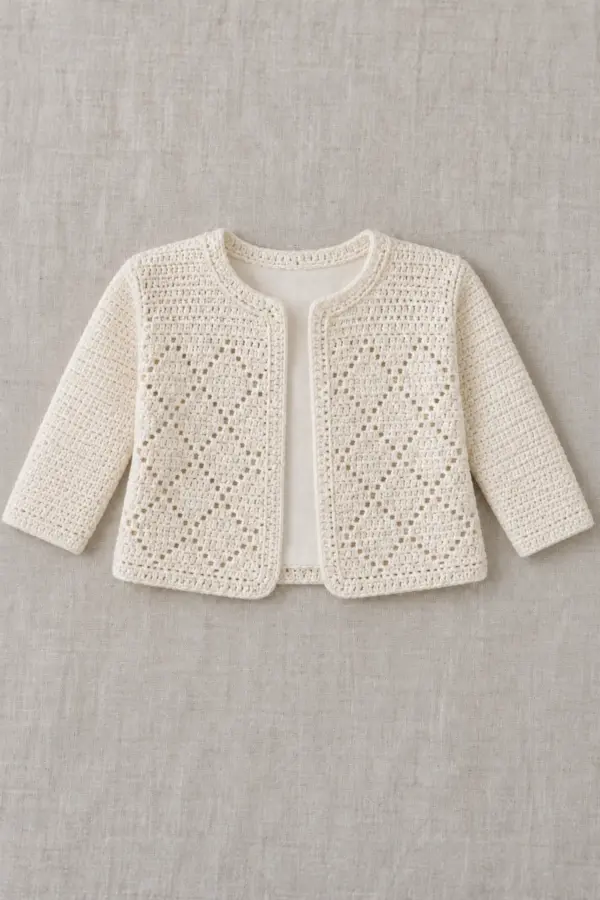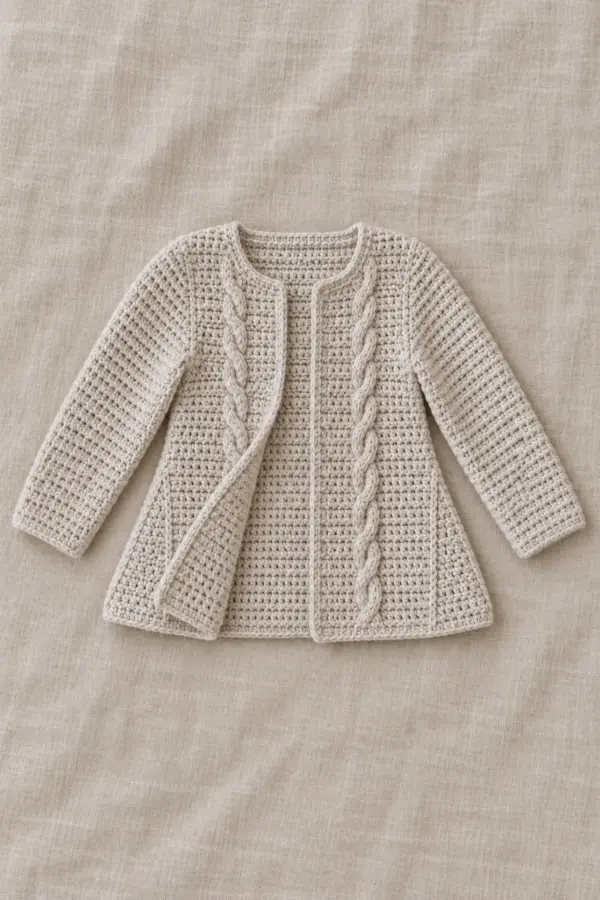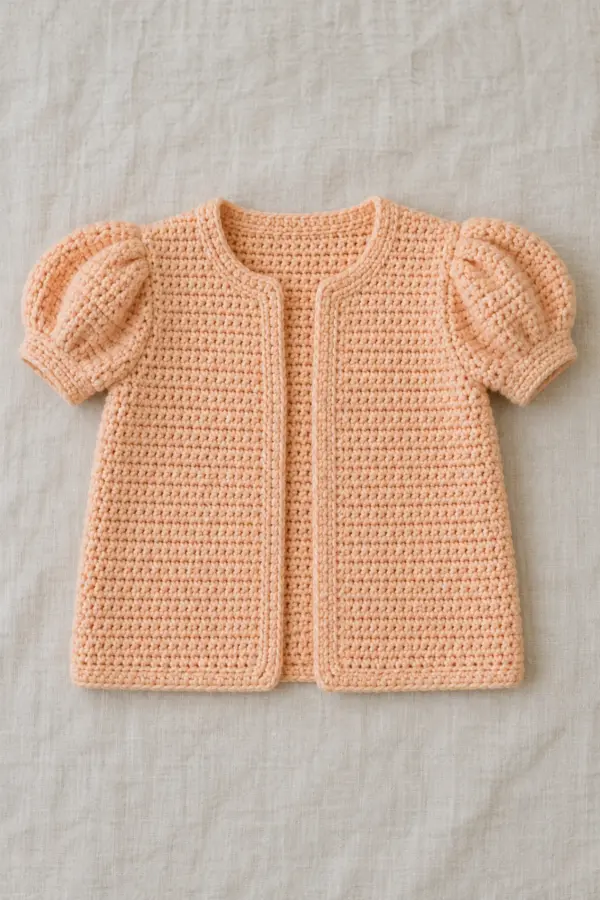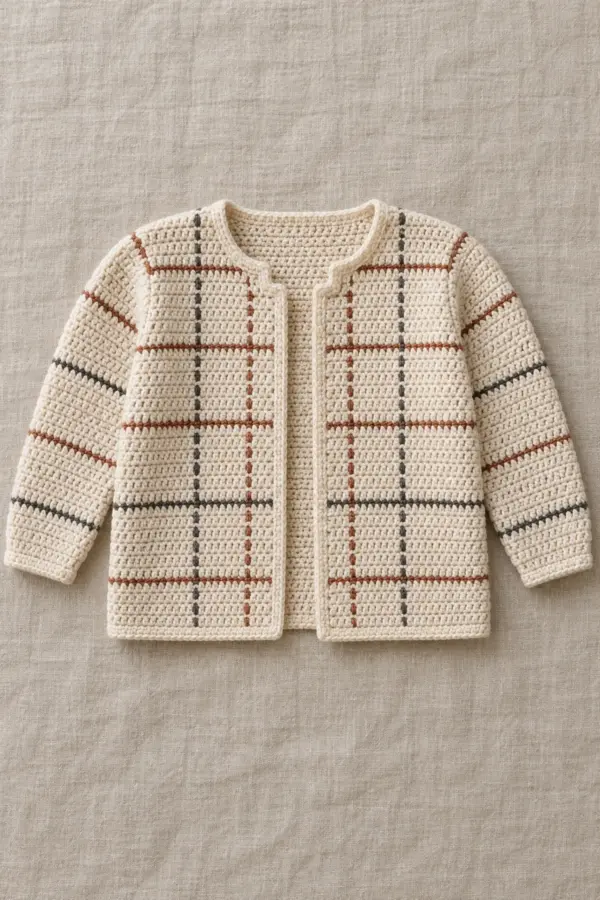
This original crochet waffle stitch baby cardigan pattern explains how to make crochet waffle-texture drop-shoulder baby cardigan from the first counted stitch through final assembly. The design is a practical free tutorial in US terms, with measurements and stitch checkpoints that you can verify as you work.
This design uses three straight waffle-textured body panels with dropped shoulders and sleeves picked up directly around the open armholes. Work the named components in their stated direction, verify each count, and baste every shaped join before finishing.
Pattern Details
- Hook Size: 4 mm, adjusted to the washed waffle swatch
- Finished Size: 12–24-month planning size:22.4-inch fabric chest,12-inch body,8.8-inch upper sleeve; sleeve extension about6.4 inches plus cuff; check dropped-shoulder fit
- Gauge: 15 waffle stitches and10 rows =4 inches;15 sc stitches =4 inches for edging
- Estimated Time: 16–24 hours plus washing and basting
- Construction: Back42 stitches, two fronts21 each; front upper shoulders15 each and back15/12/15. Sleeves33→30→27, then24-sc cuffs.
- Skill level: Intermediate
Why You’ll Love This Project
The shape comes from counted stitches rather than an unexplained diagram. You can inspect each stage against the measurements, and the finished object has a clear purpose and a distinct silhouette in photographs.
Materials
- Approximately730 yards warm-oat washable DK, including dense post-stitch fabric and swatches; not sample-measured
- 4 mm hook, markers, yarn needle, basting yarn, tape measure and scissors
Gauge, Measurements, and Planning
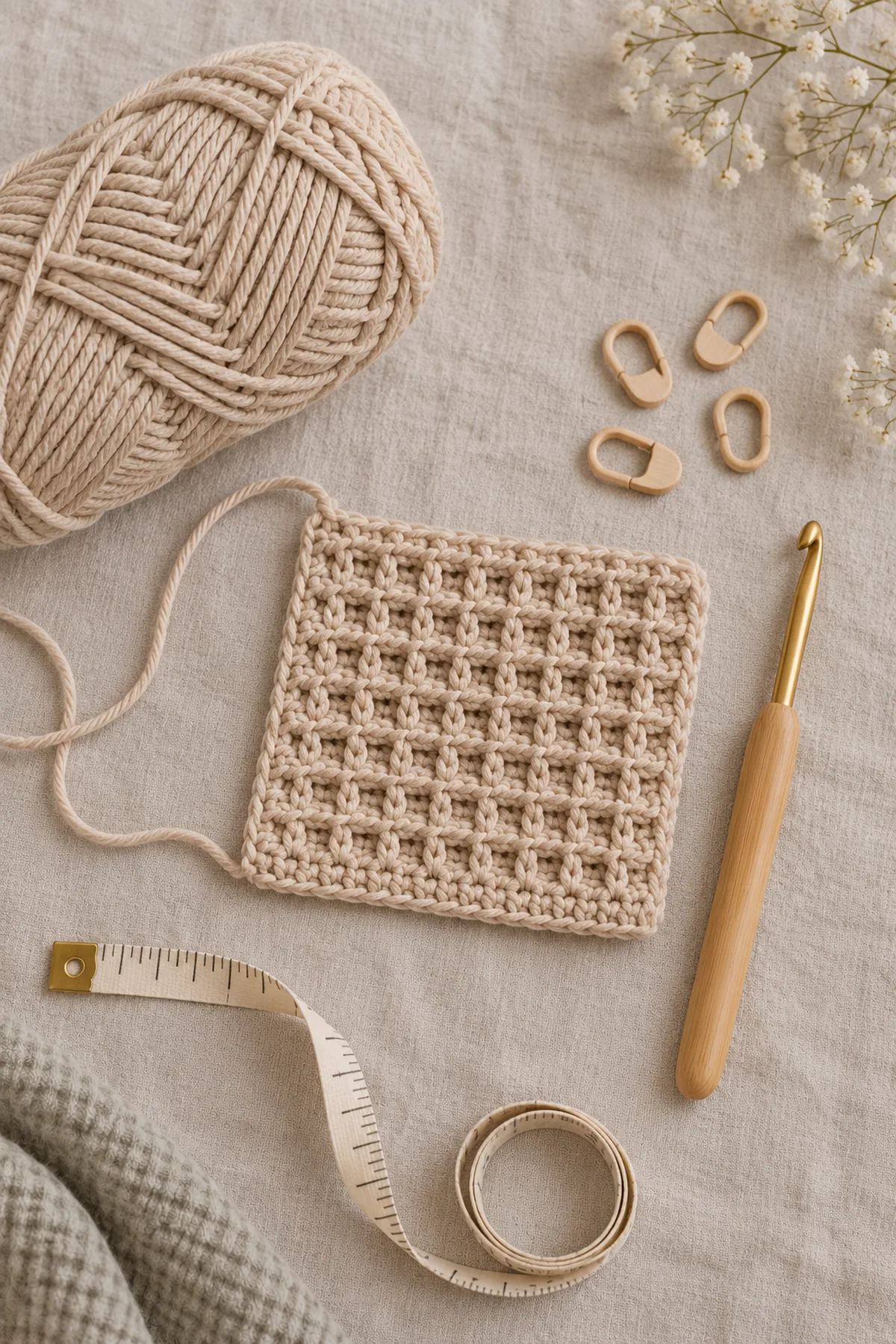
Make a27-stitch waffle swatch at least14 rows tall. Measure only after washing; the center15 stitches and10 rows should each span4 inches. Post stitches use more yarn and create a thicker fabric than ordinary dc. Back42 plus fronts21+21 gives84 stitches,22.4 inches across the open fabric. Every body panel has30 rows,12 inches. The upper11 unseamed row ends on both front and back form an8.8-inch armhole perimeter. Thirty-three sleeve stitches at the waffle stitch gauge also span8.8 inches. Compare this roomy planned fit to outerwear for the intended child; do not use the age label instead of checking chest, shoulder drop and hand opening.
Make and wash a gauge swatch before beginning. Measure only after the swatch is completely dry. If the stitch width differs, change hook size rather than pulling the working yarn tighter. Keep a written count at the end of every section so the finished edges remain balanced and the assembly points line up.
Abbreviations and Special Stitches
- ch: chain
- sc: single crochet
- sl st: slip stitch
- st(s): stitch(es)
- rnd: round
- inc: 2 sc in one stitch
- sc2tog: single crochet two stitches together
- hdc: half double crochet
- dc: double crochet
- hdc2tog: half double crochet two together
- dc2tog: double crochet two together
- RS/WS: right side/wrong side
- FPdc: front-post double crochet
Special stitch guidance: FPdc: yarn over, pass the hook front-to-back-to-front around one old dc post, draw a loop and finish the two normal dc pull-throughs; do not also crochet into that post’s top. Texture A for N divisible by3: one edge dc, [one FPdc, two dc] repeated (N−3)/3 times, then FPdc and one edge dc. Texture B: one edge dc, [one dc, two FPdc] the same number of times, then two edge dc. Each sequence occupies1+(N−3)+2=N positions. Ch2 never counts; turn after every texture row, including joined sleeve rounds. Yarn is one color throughout.
Important Notes
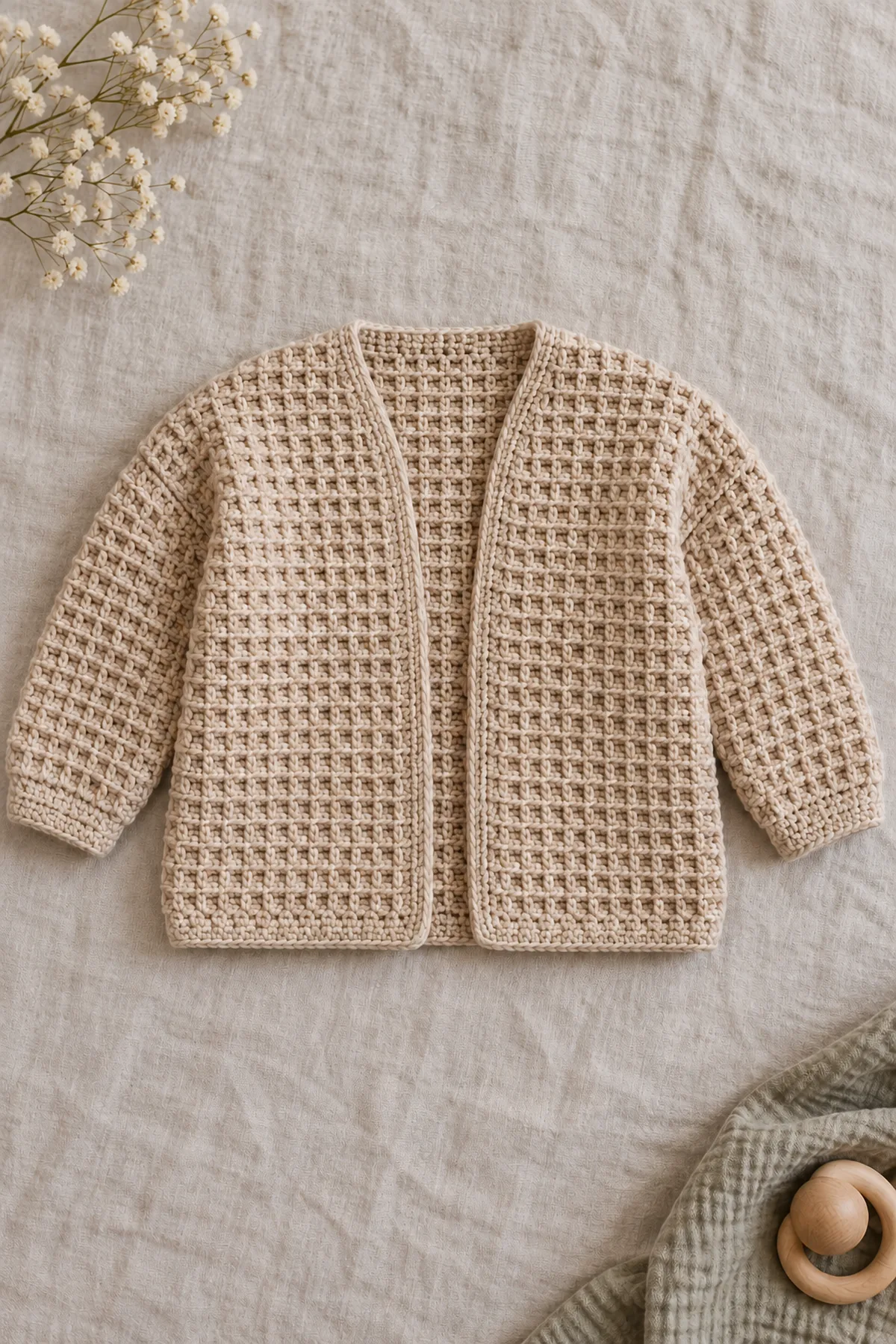
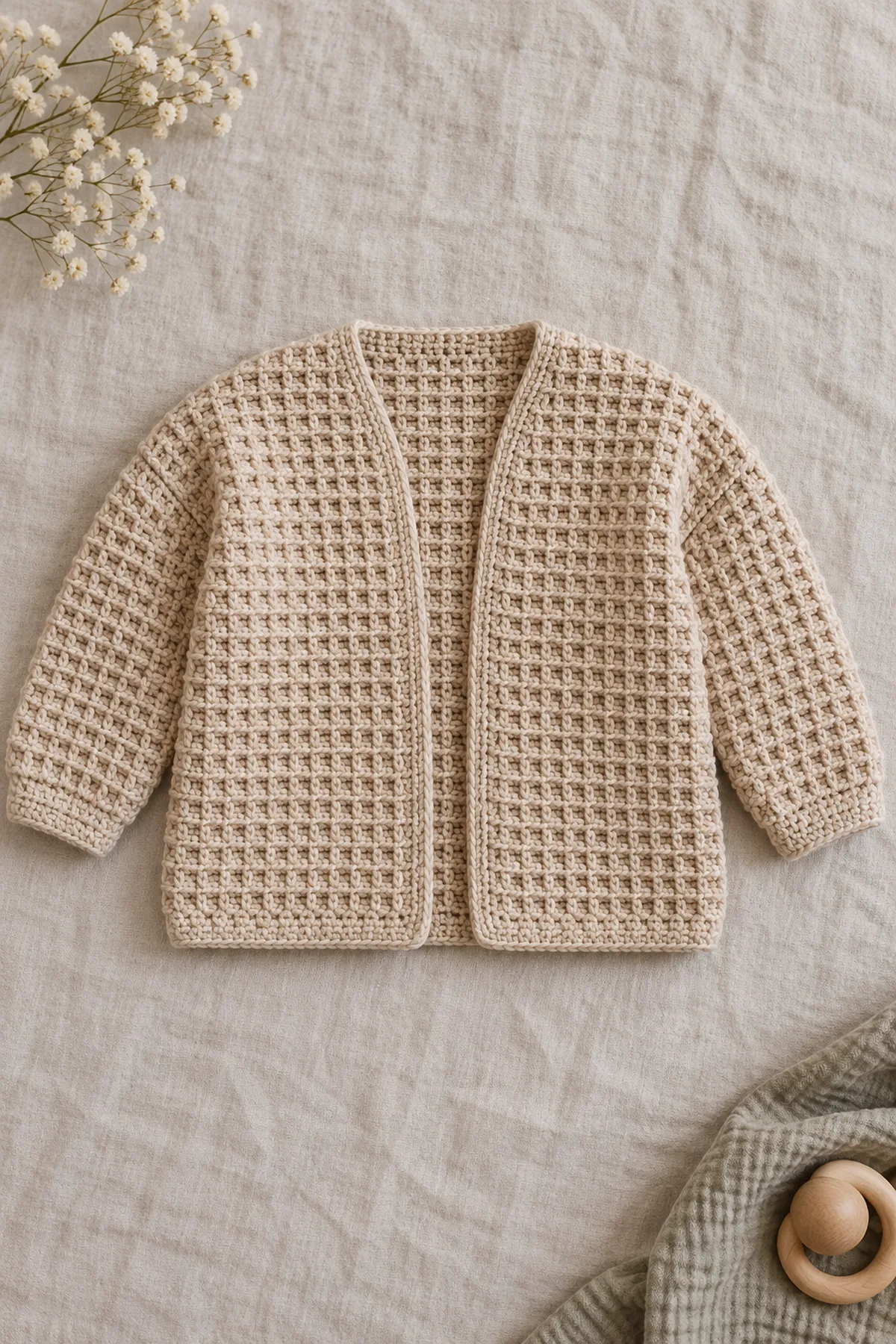
- AI-generated pictures illustrate the intended design; they are not photographs of a physically tested sample. Follow written counts rather than counting stitches in an image.
- The stitch arithmetic has been checked, but gauge, yardage and fit are planning targets until a physical sample is made. Wash a swatch and check measurements before gifting or wearing.
- A beginning ch 1 and a joining sl st never count as a stitch in this pattern. Mark the first counted stitch of each row or round.
- If a row count is wrong, return to that row. Adding an unplanned stitch later changes the shaping and the assembly alignment.
- Age labels are planning guidance only. Compare washed chest, arm openings, sleeve length and neckline to a comfortable garment for the intended child. Use as supervised awake outerwear, never for sleep.
- Arithmetic reference, not a size chart: (30 sts); (42 sts). Counts refer to the component named in the corresponding row.
Complete Instructions for Crochet Waffle-Texture Drop-Shoulder Baby Cardigan
Crochet the Waffle Back and Front Panels
Row1 is a plain dc foundation; Row2 is Texture A and Row3 Texture B. Even rows remain A and odd rows B through the upper panels. Each post replaces one counted dc, never adding a stitch.
- Back Row1: ch44; dc in the third chain and each remaining chain, turn. (42 sts) Row2: ch2, Texture A with13 internal groups, turn. Row3: ch2, Texture B with13 groups, turn. Rows4–29: alternate A on even rows and B on odd rows, maintaining42.
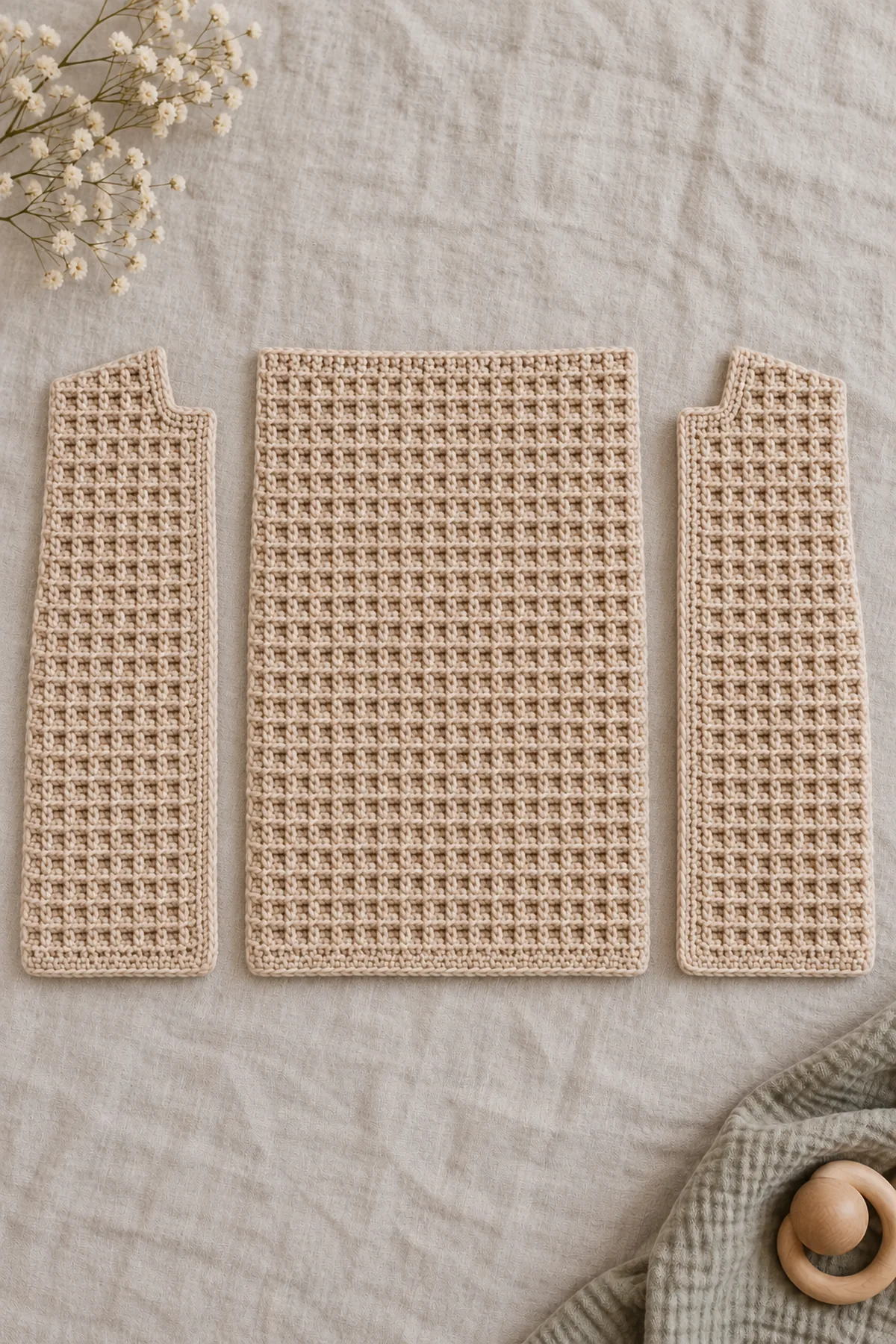
- Back Row30: with RS facing, fasten off and work the outer15 stitches at each side as separate Texture A shoulder sections, four internal groups each. Leave the central12 unworked neck stitches between them. Both shoulders finish at the same row height. This is not a yoke with raglan increases.
- Each front Row1: ch23; dc from the third chain across21, turn. (21 sts) Rows2–26 alternate A/B with six internal groups at21 stitches. Row27 leaves six INNER neck stitches unworked and works only the outer15; fasten and rejoin at the correct edge rather than dragging yarn over the neck ledge. Rows27–30 use B/A/B/A on those15 stitches with four groups each.
- Reverse the second front’s neck ledge. Place both RS faces up: the two six-stitch holds face the center opening, the full-height side edges face the armholes. Baste each15-stitch shoulder to its15-stitch back shoulder one-to-one.
- Close each side seam only along matching Rows1–19, using mattress-style passes through the row-end bars without flattening the waffle cells. Leave Rows20–30 unseamed, eleven row-end bars per half-armhole. Mark the shoulder seam and underarm before picking up a sleeve.
Pick Up and Taper Two Waffle Sleeves
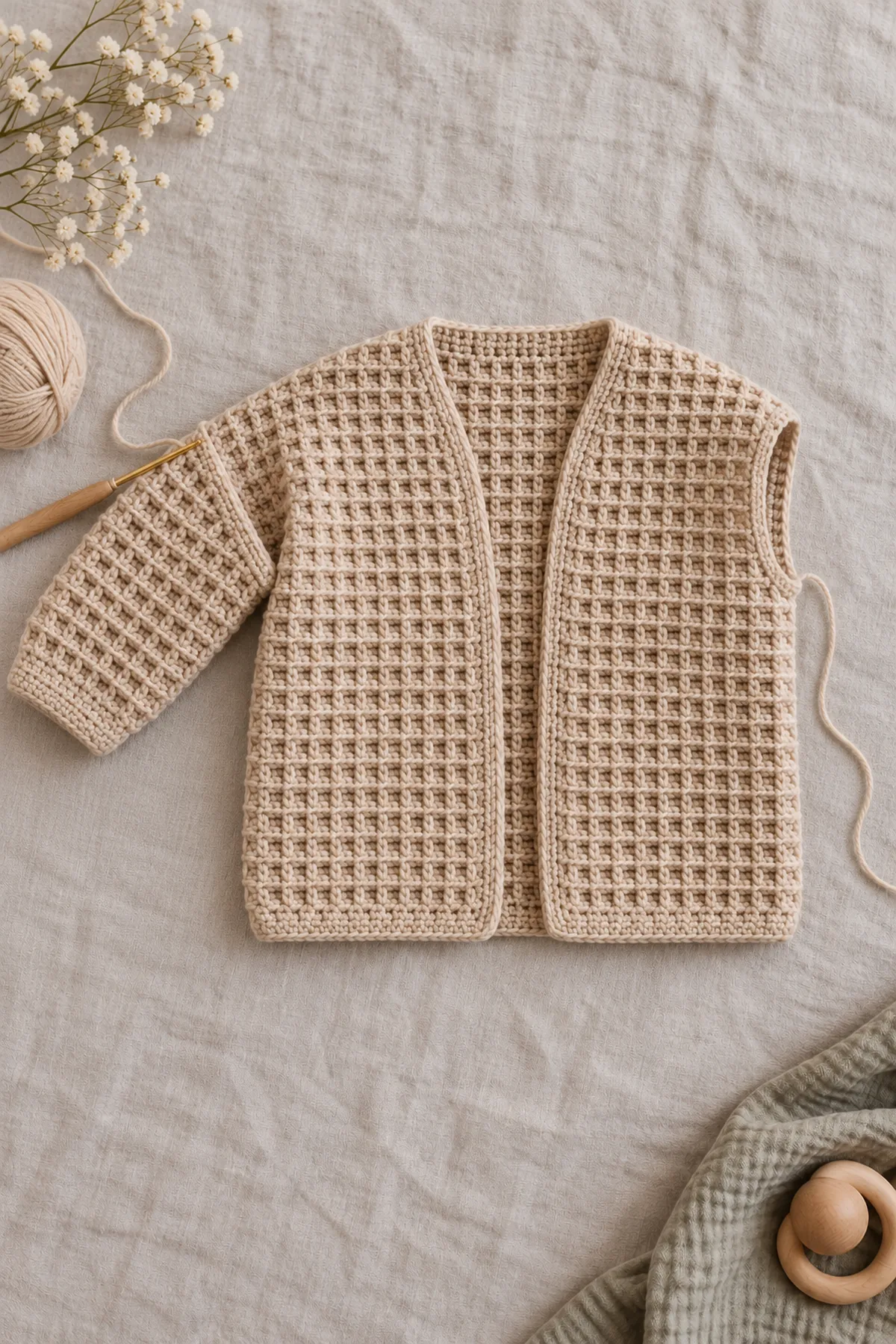
Work around each armhole in JOINED, TURNED rounds so the waffle’s public face stays consistent with the panels. Start at the underarm and exclude lift and joining slip from the stitch count. Neither join nor lift is a spare stitch.
- Sleeve Round1: with WS facing, begin at underarm, dc around all22 row-end bars, using two dc in odd-numbered bars and one in even-numbered bars. Eleven double pickups plus eleven single pickups produce33 dc. Join to the first counted dc, ch2 and turn to RS for Round2. (33 sts)
- Round2: Texture A with ten internal groups and its two finishing stitches, join, ch2, turn. Round3: Texture B with ten groups, join, ch2, turn. Rounds4/5 repeat A/B at33. Mark the first edge dc after each turn; do not count its joining slip as the next stitch.
- Round6 is a plain decrease reset on RS: [dc in next9, dc2tog over next2] three times; join, ch2, turn. This consumes3×11=33 and produces3×10=30. (30 sts) Rounds7–10 alternate B/A/B/A, using nine internal groups at30 stitches; B remains WS and A remains RS.
- Round11 is another plain decrease reset: [dc8, dc2tog] three times, join and turn. It consumes30 and produces27. (27 sts) Rounds12–16 alternate A/B/A/B/A with eight internal groups. Round17 cuff: [sc7, sc2tog] three times, join and fasten off;27 positions become24 sc. (24 sts)
- Make the second sleeve identically. The sc cuff at its own15-stitch gauge is6.4 inches around, intentionally relaxed. Try the hand opening over a reference garment; no elastic is added. If extra sleeve length is required, add a matched pair of A/B rounds at27 stitches before the cuff, record both extra rounds and re-estimate yarn. Never add a row to only one sleeve.
Edge the Open Neck and Finish the Grid
Use the washed sc stitch width stated above; it must match the waffle width rather than tighten it. The front opening below each neck ledge has26 row-end bars, not30.
- Starting at a lower front, pick up39 sc along26 bars, using [two sc in one bar, one in the next] thirteen times. Work one sc in each of six horizontal held-front-neck tops, then six sc across the four upper inner-neck bars using [two,one] twice.
- Work12 sc across the held back-neck tops, then mirror six across the opposite upper neck bars, six in the held front-neck tops and39 down the opposite26-row front. This makes39+6+6+12+6+6+39=114 sc. Fasten off; do not join the front ends. No collar, fasteners or neckline cord is created.
- Work one sc across each of the84 combined foundation positions at the hem. Keep all stitches relaxed so the narrow edge lies flat against the waffle. Weave ends and remove basting after checking the seams hold without distorting the small cells.
- Wash and dry flat without compressing the post texture. Verify equal dropped shoulders, both cuff counts, front lengths and the measured armhole/sleeve ratio. Stop using the cardigan if any seam or yarn end loosens. This warm textured layer is for supervised awake use, not sleep.
Assembly and Shaping
Back42 plus fronts21+21=84 fabric stitches. Each shoulder seam matches15 tops; the back leaves12 and each front6 neck tops. Each armhole has22 row-end bars and receives33 dc at alternating2/1 pickups. Multiples of3 are preserved through33→30→27; the cuff finishes24 sc. This construction has no saddle, circular yoke, patch pocket or separate hood.
Lay every component on a flat surface before joining. Match the marked centers first, then divide each remaining edge into equal sections. Work through both layers with consistent tension and pause after each section to check that the fabric lies flat. This measured approach prevents twisting and keeps decorative details facing the intended direction.
Finishing
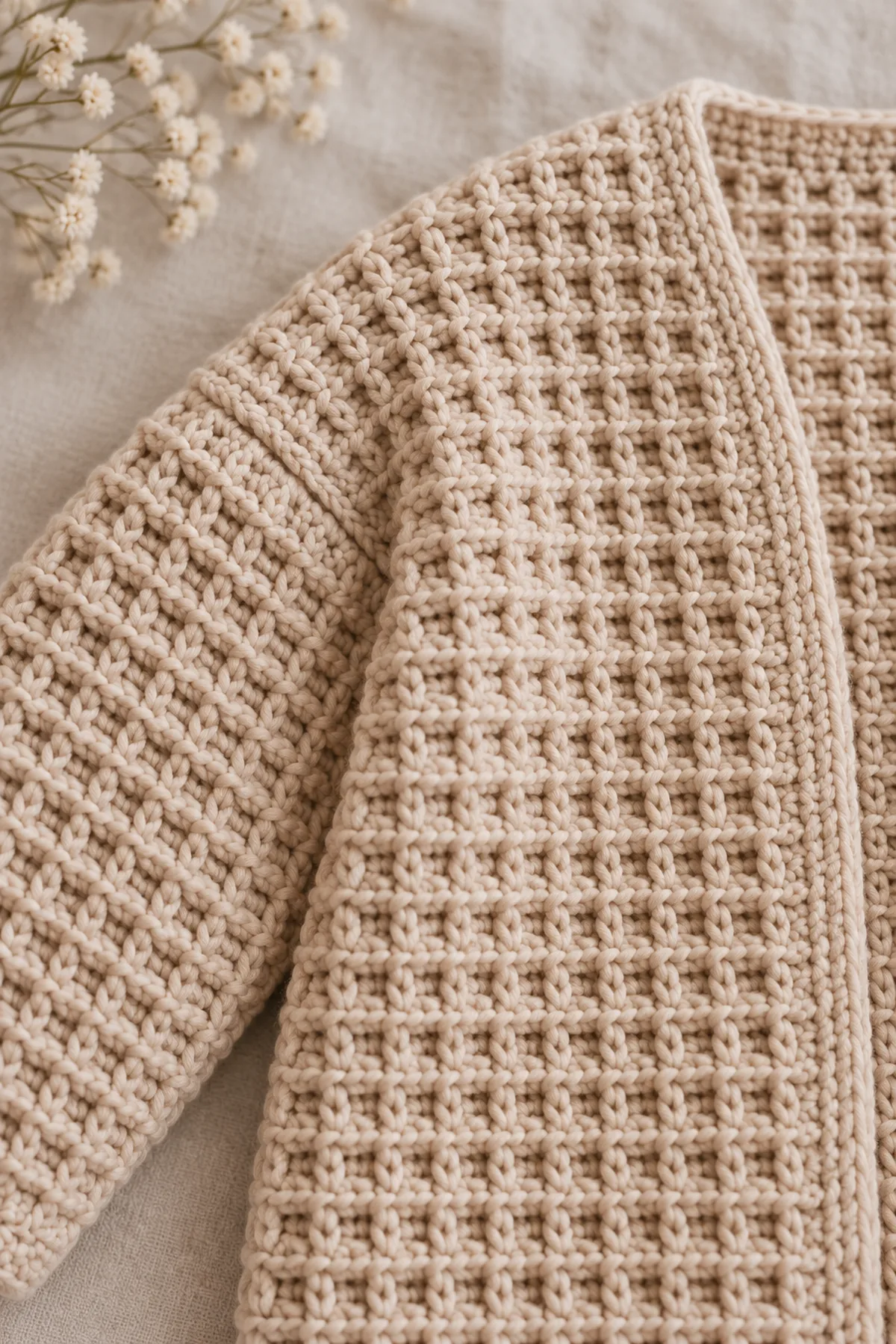
- Weave each tail along three different paths on the wrong side; reverse direction before trimming.
- Wash or damp-block according to the yarn label and allow the work to dry at its measured shape.
- Inspect every seam, edge and attachment from both faces before first use, then inspect again after laundering.
For a polished result, weave each tail through several same-color stitches, reverse direction once, and trim only after the fabric has been gently stretched. Block to the listed dimensions without flattening textured stitches. Inspect joins, borders, straps, and decorative pieces before the project is used or gifted.
Helpful Tips
- Use contrasting locking markers at shaping points and record the count after every change row.
- Change hook size when the washed swatch differs from the stated gauge; do not compensate with uneven hand tension.
- Photograph the flat components before joining so it is easy to identify an inverted or twisted piece.
Good lighting and a contrasting stitch marker make counting much easier. If a section looks uneven, compare the current count with the previous checkpoint before continuing. Fixing one missed stitch early is faster than compensating later, and it preserves the measurements used by the assembly instructions.
Frequently Asked Questions
Has this design been physically sample-tested?
No. The arithmetic and assembly plan are checked, but gauge, yarn amount, fit and seam geometry remain planning targets. The AI illustrations are not a stitch-count chart.
How do I select the size?
Use the listed fabric dimensions and a washed swatch, not the age alone. If the swatch or measured garment does not fit these targets, stop before assembly and revise the size with checked counts.
Conclusion
Counted shaping and measured joins make this an independent cardigan construction rather than a renamed raglan recipe. Wash, check fit and inspect every seam before supervised wear. No physically crocheted sample is claimed.
BabyYarnie Printable Crochet Pattern Card
BabyYarnie — easy-to-follow crochet for everyday makers.
Project: Crochet Waffle-Texture Drop-Shoulder Baby Cardigan
Skill level: Intermediate Hook: 4 mm, adjusted to the washed waffle swatch Yarn: Smooth washable DK cotton-wool blend
Finished size: 12–24-month planning size:22.4-inch fabric chest,12-inch body,8.8-inch upper sleeve; sleeve extension about6.4 inches plus cuff; check dropped-shoulder fit
Card Materials
- Approximately730 yards warm-oat washable DK, including dense post-stitch fabric and swatches; not sample-measured
- 4 mm hook, markers, yarn needle, basting yarn, tape measure and scissors
Card Instructions
- Crochet the Waffle Back and Front Panels: Back42×30 rows with final shoulders15/12 neck/15. Fronts21×26 rows then15×4 upper rows; mirror neck holds. Side seams stop after19 rows, leaving11+11 armhole bars.
- Pick Up and Taper Two Waffle Sleeves: Pick up33 dc from22 bars. Turn joined waffle rounds; reset decreases33→30 at6 and30→27 at11; finish through16 and decrease27→24 at sc cuff17.
- Edge the Open Neck and Finish the Grid: Opening edge114 sc; hem84 sc. Check waffle-to-edge gauge, matched sleeves and secure drop-shoulder seams.
Finish: Check every count, weave in all ends, block to measurement, and inspect each join.