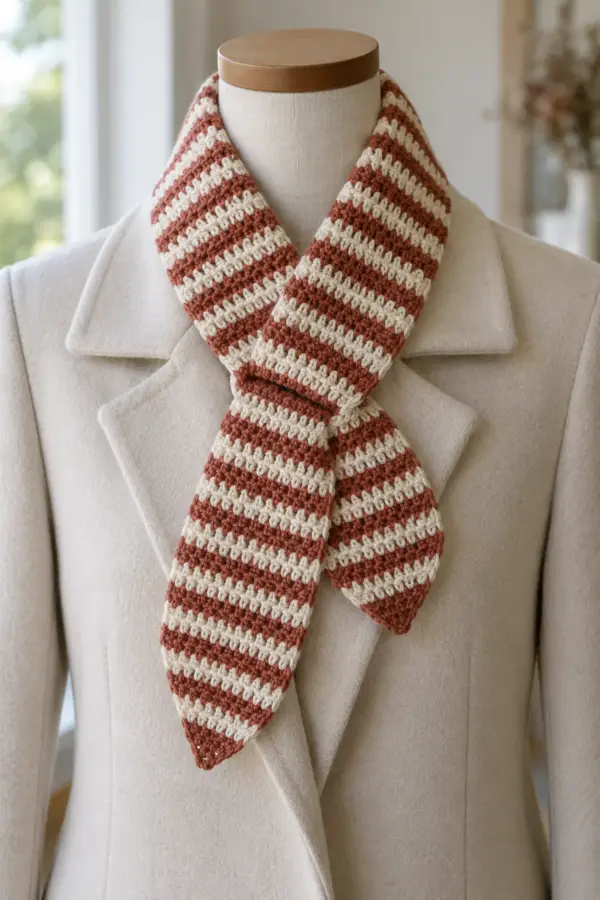
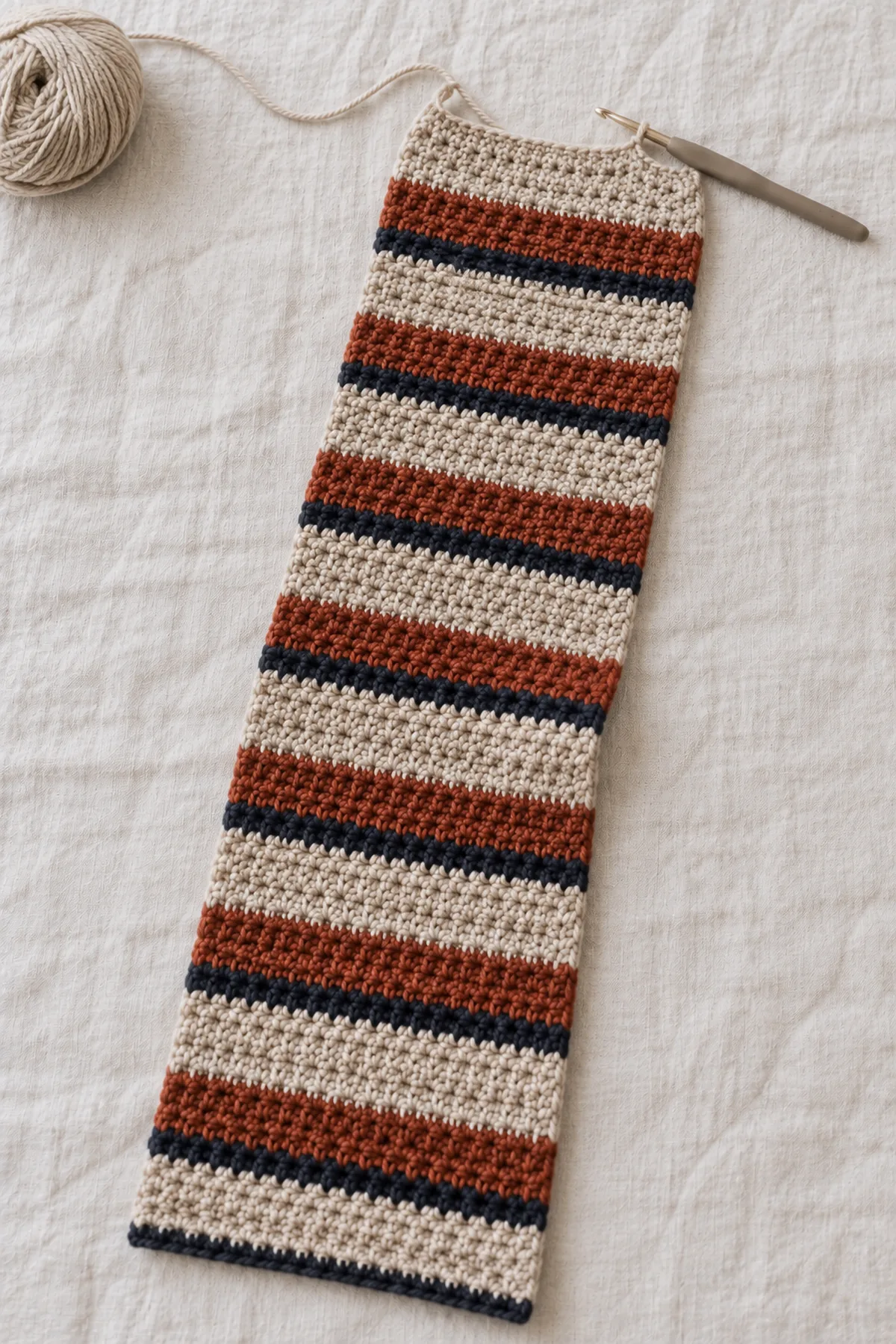
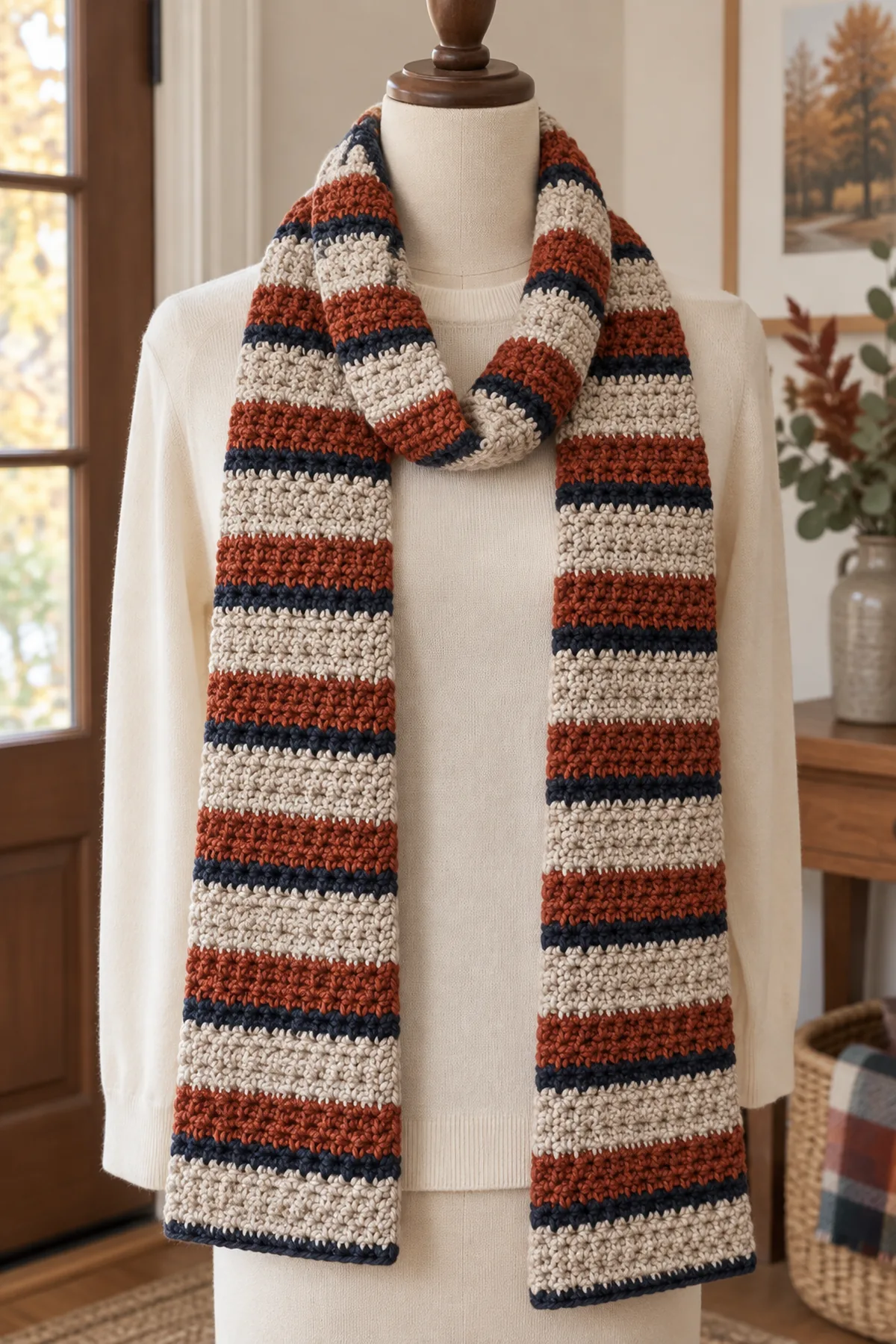
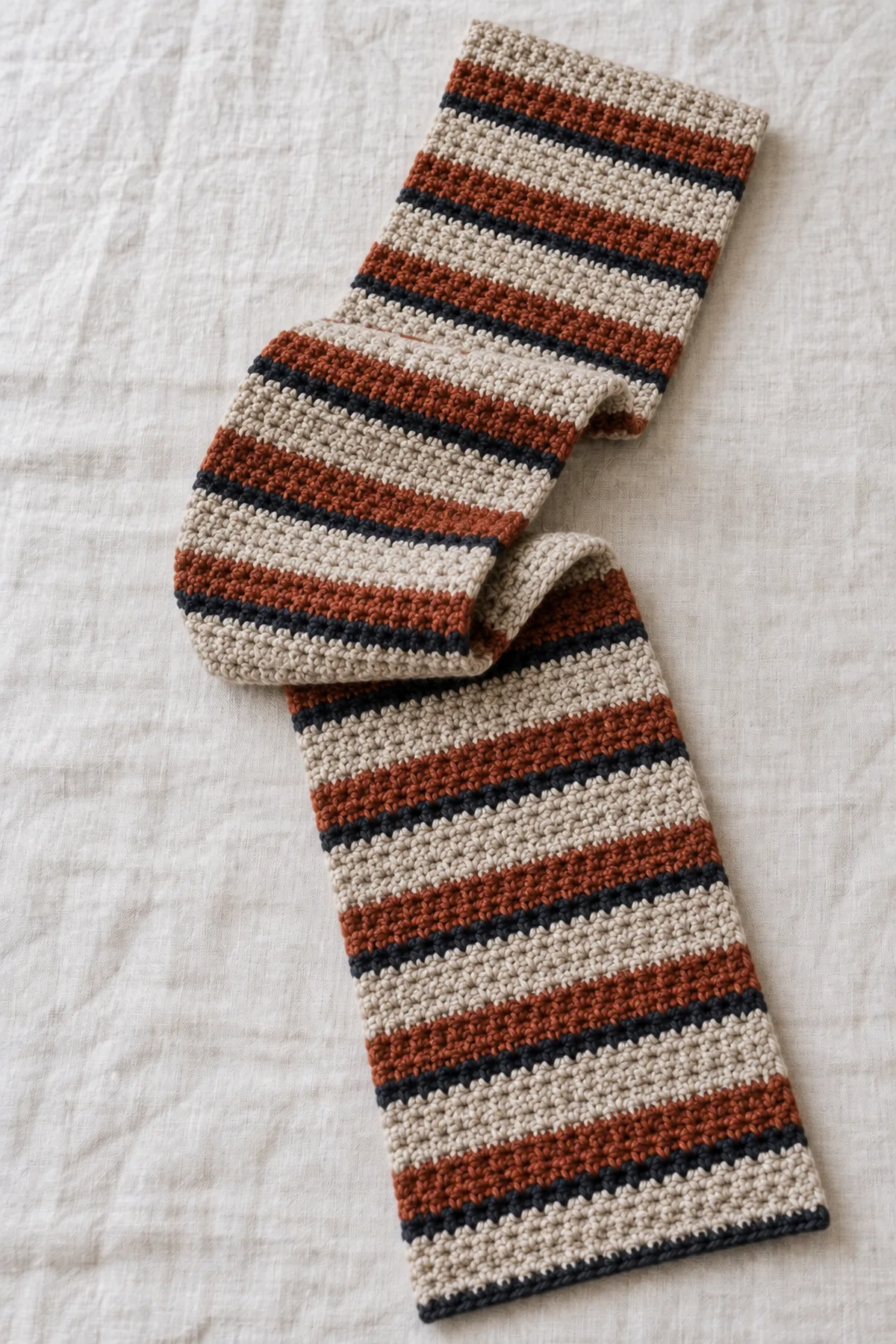
Broad oatmeal bands, medium rust bands and narrow ink lines give this adult moss-stitch scarf a relaxed, uneven rhythm. The fabric is worked across the short width, so each stripe runs from one long edge to the other. If your search is crochet scarf pattern free easy, this version provides a complete row sequence with two solid edge stitches and no fringe.
Start with one 30-single-crochet foundation row. Then work 360 rows of alternating single crochet and chain spaces, keeping one solid sc at each side. A twelve-row color cycle repeats thirty times; the main rectangle finishes at a planning size of about 7.5 by 60 inches.
Pattern Details
- Hook Size: 5 mm, adjusted to gauge
- Finished Size: Adult target approximately 7.5 by 60 inches; no fringe
- Gauge: Target 16 pattern positions (sc or ch-1) and 24 rows = 4 inches, washed
- Estimated Time: 10-14 hours
- Construction: Short-width flat rectangle; one sc foundation row plus 360 moss-stitch rows
- Skill level: Easy
Why You’ll Love This Project
The small alternating spaces make a flexible woven-looking surface. The six/four/two stripe rhythm is simple to record yet avoids evenly spaced bands. Plain ends and no fringe keep the finish restrained, with no sewing or separate trim.
Materials
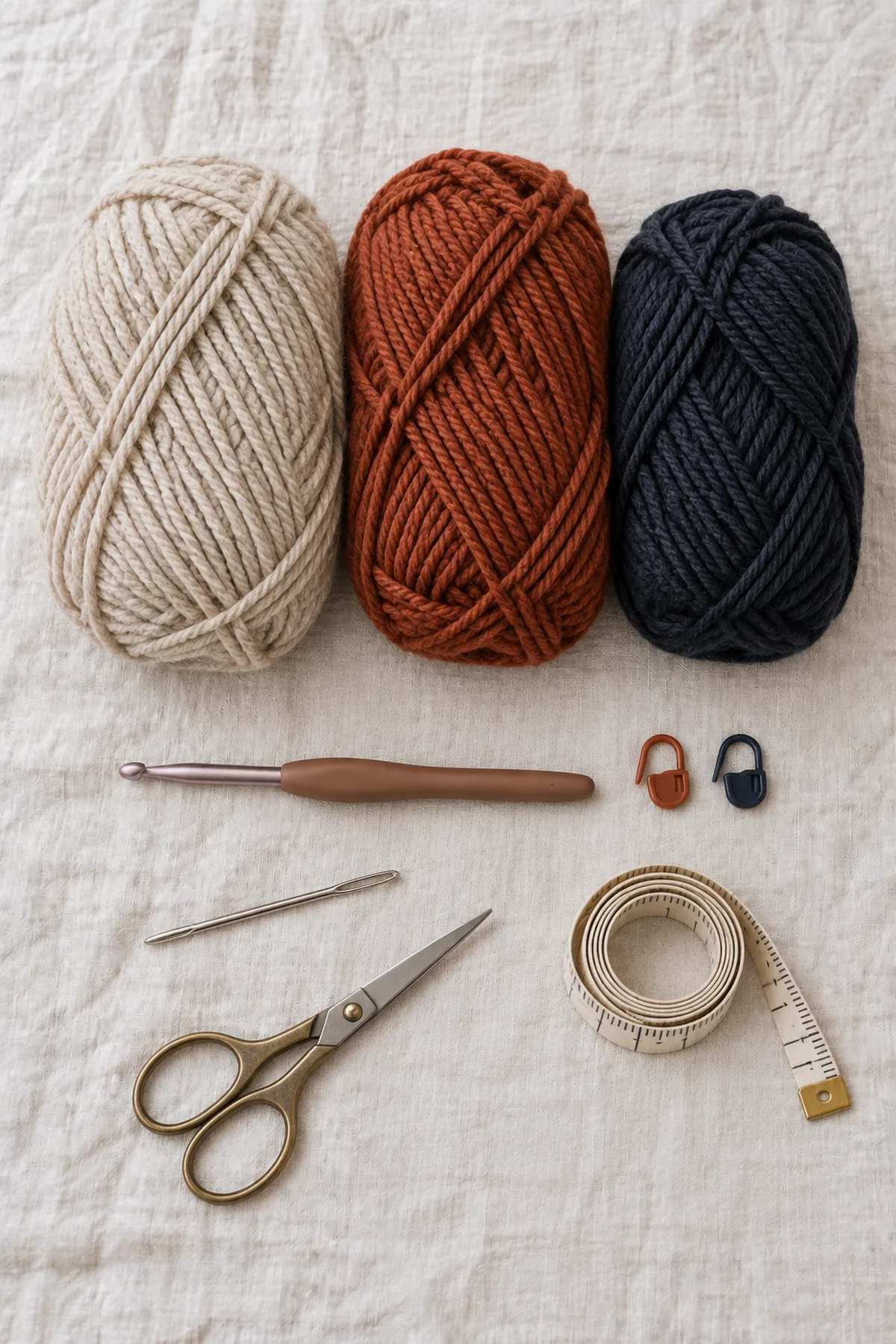
- Planning allowance: 300 yards oatmeal, 180 yards rust and 100 yards ink worsted yarn of matching fiber and weight
- 5 mm hook; two markers; tapestry needle; scissors; measuring tape
Gauge, Measurements, and Planning
Count both sc and each ch-1 space as one horizontal pattern position: 30 positions at four per inch gives 7.5 inches. Six rows per inch gives about 60 inches over the 361 total rows. Make a 30-position swatch of at least 24 rows. The listed yardage includes tail and swatch allowance; it is not a measured sample yield. For a wider or narrower scarf choose any even body count of at least six, chain one more, and use (count minus 2) divided by 2 moss repeats. Add or remove whole twelve-row color cycles for two-inch length increments at target gauge.
Make and wash a gauge swatch before beginning. Measure only after the swatch is completely dry. If the stitch width differs, change hook size rather than pulling the working yarn tighter. Keep a written count at the end of every section so the finished edges remain balanced and the assembly points line up.
Abbreviations and Special Stitches
- ch: chain
- sc: single crochet
- hdc: half double crochet
- dc: double crochet
- sl st: slip stitch
- st(s): stitch(es)
- rnd: round
- BLO: back loop only
- inc: 2 stitches in one stitch
- sc2tog: single crochet two stitches together
- sp: space
- RS: right side
- WS: wrong side
- dc3tog: double crochet three together
- sc3tog: single crochet three together
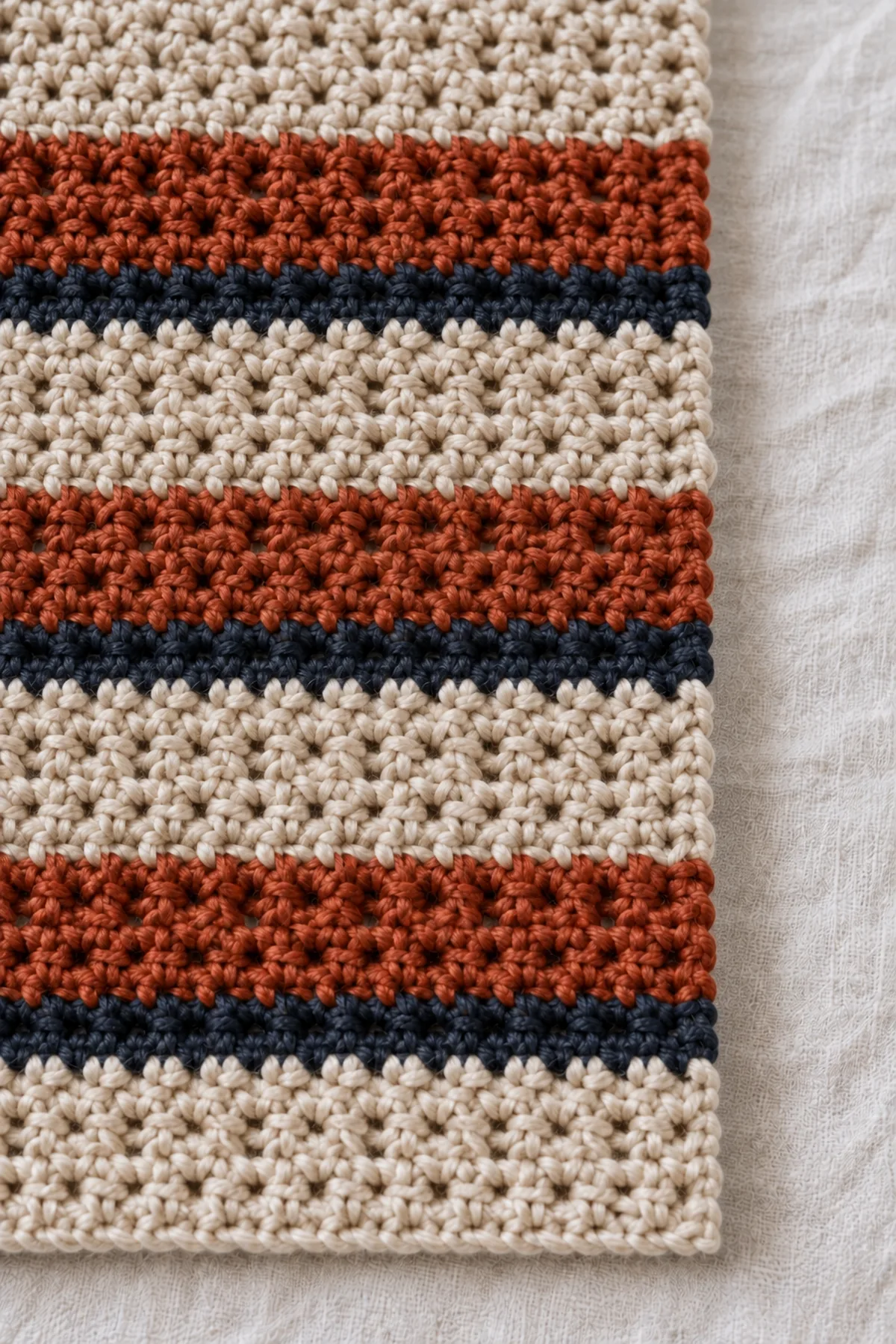
Special stitch guidance: Moss repeat = ch 1, skip the next sc, sc in the next ch-1 space. The first setup moss row works into the solid foundation instead. Each row has two solid edge sc plus fourteen interior sc/ch pairs: 16 sc and 14 ch-1 spaces, 30 pattern positions total. Ch 1 for turning does not count. The final sc is always in the last edge sc, never into the turning chain.
Important Notes
- Pattern development note: stitch arithmetic and written construction have been reviewed computationally; this design has not been physically sample-tested. Gauge, yardage and finished measurements are planning targets, not a tested guarantee. Swatch and check fit before making a gift.
- Use US crochet terms. The stitch and turning-chain conventions in the instructions for this project take precedence over generic conventions.
- Turn after every flat row unless the instructions explicitly say otherwise. Mark both end stitches and count before beginning the next row.
- Change color on the final yarn-over of the preceding stitch, leaving 6-inch tails. Weave ends into their own color on the wrong side.
- Images are AI-generated design illustrations, not stitch charts or photographs of a physically tested sample. Follow the written stitch counts and measurements.
- These are adult accessories. Remove scarves for sleeping, machinery, vigorous activity or any situation in which fabric could catch; do not adapt the long wraps for babies.
Complete Instructions for Crochet Moss Stitch Striped Scarf with Uneven Bands
Set Up the Straight Edges
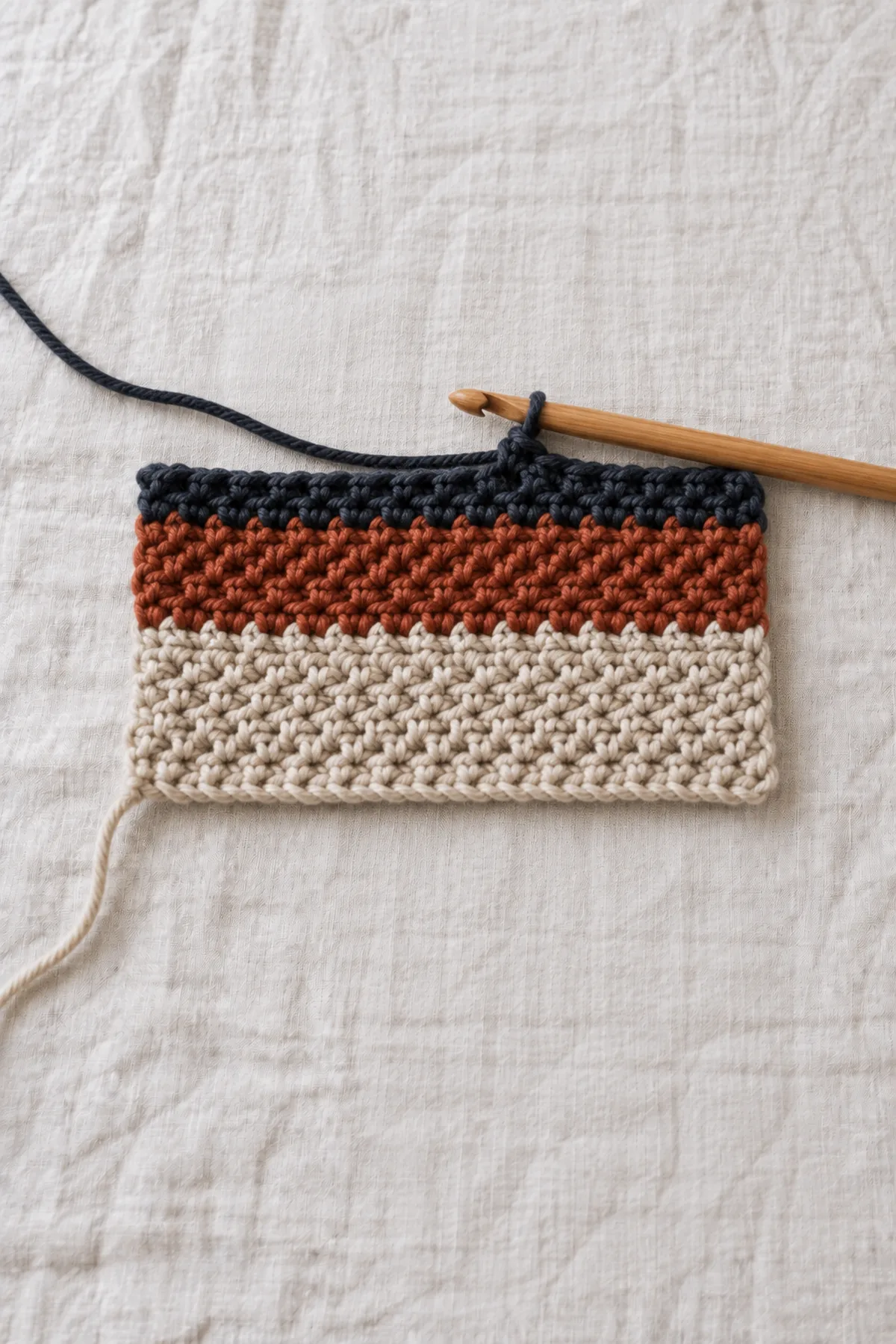
- With oatmeal, ch 31. Row 1: sc in second chain and each remaining chain. Ch 1 and turn. (30 sts)
- Row 2: sc in first stitch; [ch 1, skip one foundation sc, sc in next sc] fourteen times; sc in the final stitch. Ch 1 and turn. (30 sts) when each ch-1 counts as one position: 16 sc plus 14 spaces.
- Mark the first and last sc. The final two stitches are both sc; after turning they become the first two sc. Do not mistake the second of those sc for a chain space.
Work the Moss Stitch and Uneven Bands
- Row 3 and every later row through Row 361: sc in first edge sc; [ch 1, skip next sc, sc in next ch-1 space] fourteen times; sc in the last edge sc. Ch 1 and turn after every row except Row 361. (30 sts) counting 16 sc and 14 ch-1 spaces.
- Follow the table below. Row 1 is oatmeal and is outside the thirty cycles; the first oatmeal band therefore includes the foundation row. Change color on the final yarn-over of the last sc before a new band. Cut each old color with a 6-inch tail rather than carrying it up a long exposed edge.
-
Cycle Oatmeal: 6 rows Rust: 4 rows Ink: 2 rows 1 2-7 8-11 12-13 2 14-19 20-23 24-25 3 26-31 32-35 36-37 4 38-43 44-47 48-49 5 50-55 56-59 60-61 6 62-67 68-71 72-73 7 74-79 80-83 84-85 8 86-91 92-95 96-97 9 98-103 104-107 108-109 10 110-115 116-119 120-121 11 122-127 128-131 132-133 12 134-139 140-143 144-145 13 146-151 152-155 156-157 14 158-163 164-167 168-169 15 170-175 176-179 180-181 16 182-187 188-191 192-193 17 194-199 200-203 204-205 18 206-211 212-215 216-217 19 218-223 224-227 228-229 20 230-235 236-239 240-241 21 242-247 248-251 252-253 22 254-259 260-263 264-265 23 266-271 272-275 276-277 24 278-283 284-287 288-289 25 290-295 296-299 300-301 26 302-307 308-311 312-313 27 314-319 320-323 324-325 28 326-331 332-335 336-337 29 338-343 344-347 348-349 30 350-355 356-359 360-361 - Check after each cycle: fourteen chain spaces, sixteen sc, and two straight long edges. At Row 121 there are ten completed cycles plus the foundation; at Row 241 there are twenty; Row 361 ends the thirtieth cycle.
Finish and Adjust the Length
- Fasten off after Row 361 and weave in tails before washing. Lay the scarf flat at its natural width, square both ends and let it dry fully.
- For a shorter version, stop after Row 301 (25 cycles, about 50 inches). For a longer version, stop after Row 421 (35 cycles, about 70 inches); extend the same twelve-row cycle and increase all yarn allowances in proportion to the length.
- Do not add an edging that tightens one side. If the two edges differ, find and correct the row with a lost edge sc before finishing.
Assembly and Shaping
No seams or attached pieces are needed. Finish the last ink row, weave all tails along matching bands on the wrong side, and block the rectangle without stretching its chain spaces. Keep both short ends straight and leave them fringe-free.
Use the project-specific finishing above. Do not join a scarf that is meant to stay open; only the infinity-loop and sleeve-wrap designs have the explicitly described seams.
Finishing
- Fasten off with a 6-inch tail; weave through three separate groups of stitches, changing direction twice.
- Damp-block gently according to the fiber label, check the intended shape, and dry fully before assembly or use.
- Inspect both sides, all joins, and every decorative attachment; resecure a loose stitch before gifting.
- Include the fiber content and washing instructions with the finished item. Keep the item away from candles and other heat sources.
For a polished result, weave each tail through several same-color stitches, reverse direction once, and trim only after the fabric has been gently stretched. Block to the listed dimensions without flattening textured stitches. Inspect joins, borders, straps, and decorative pieces before the project is used or gifted.
Helpful Tips
- Wash and dry the swatch before measuring; fiber and tension affect the drape.
- Use removable markers at both ends and a row tally for each color block.
- Check the shape on a flat surface after every color change rather than pulling an uneven edge into place.
- Keep the yarn label and your actual measurements with the finished project.
Good lighting and a contrasting stitch marker make counting much easier. If a section looks uneven, compare the current count with the previous checkpoint before continuing. Fixing one missed stitch early is faster than compensating later, and it preserves the measurements used by the assembly instructions.
Frequently Asked Questions
Can I change the colors?
Yes. Keep the yarn weight and fiber behavior consistent and use enough contrast for the decorative detail. Make a washed swatch with every major yarn substitution.
Is this pattern physically tested?
No physical sample test is claimed. The stitch counts are computationally checked and the written construction is reviewed. Make a gauge swatch, use the measurement checkpoints, and test fit or assembly before gifting.
Is the foundation count odd or even?
The starting chain is odd: 31. It produces 30 usable positions, an even count. Keep two edge stitches and an even number of interior positions; each repeat uses two.
Conclusion
Keep the completed measurements and your yarn details with your pattern notes. The finished piece should match the described construction before it is styled or gifted. If a checkpoint does not match, correct the underlying count or gauge instead of concealing the difference during finishing.
BabyYarnie Printable Crochet Pattern Card
BabyYarnie — easy-to-follow crochet for everyday makers.
Project: Crochet Moss Stitch Striped Scarf with Uneven Bands
Skill level: Easy Hook: 5 mm, adjusted to gauge Yarn: Worsted
Finished size: Adult target approximately 7.5 by 60 inches; no fringe
Card Materials
- Planning allowance: 300 yards oatmeal, 180 yards rust and 100 yards ink worsted yarn of matching fiber and weight
- 5 mm hook; two markers; tapestry needle; scissors; measuring tape
Card Instructions
- Set Up the Straight Edges: Ch 31, foundation 30 sc; setup row has 16 sc and 14 ch-1 spaces.
- Work the Moss Stitch and Uneven Bands: Repeat 6 oatmeal, 4 rust and 2 ink moss rows thirty times after the foundation; end at Row 361.
- Finish and Adjust the Length: Weave ends, wash gently and block flat; no edging or fringe.
Finish: Check every count, weave in all ends, block to measurement, and inspect each join.