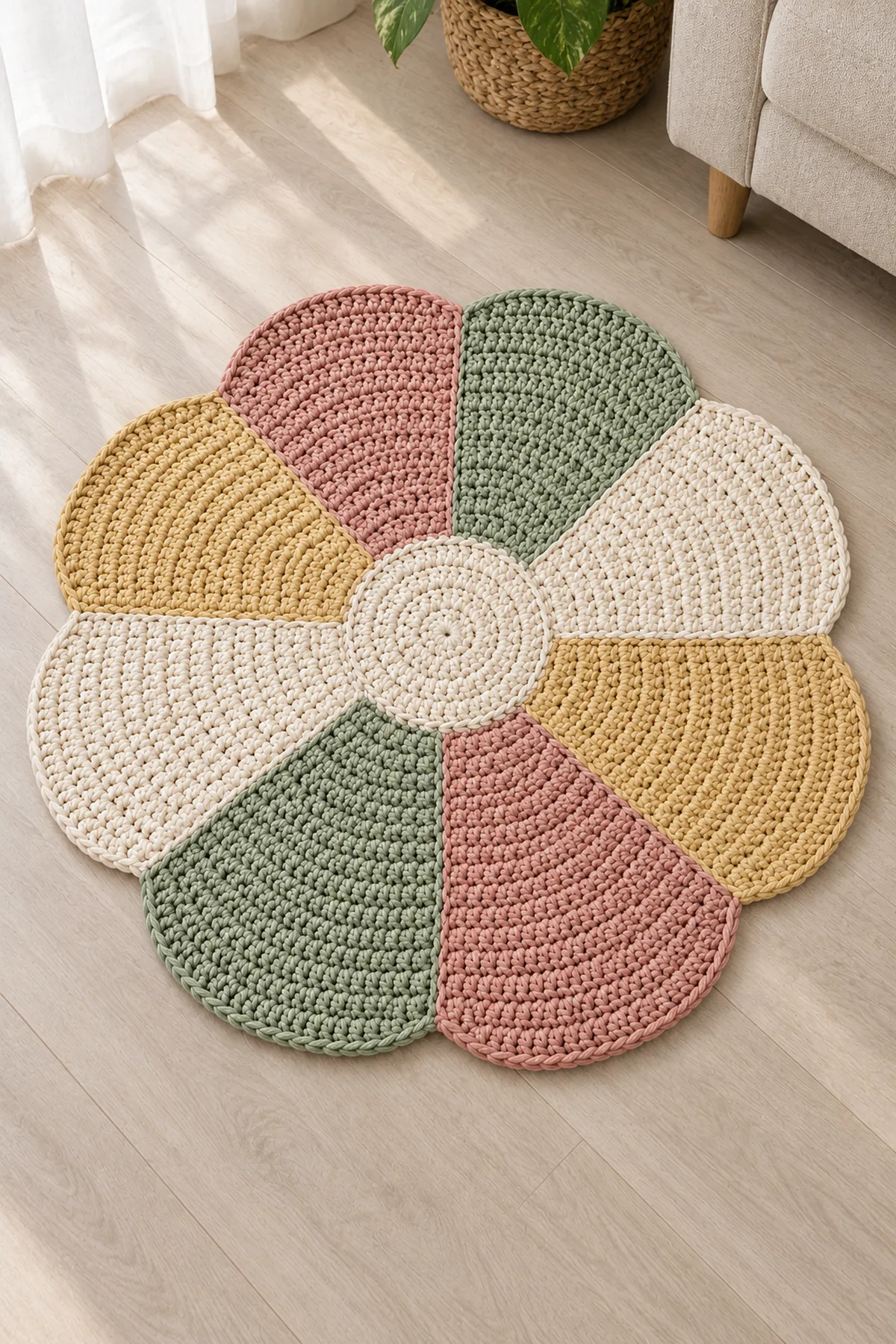
This original crochet patchwork petal baby play mat answers the crochet baby play mat search with a complete construction rather than a decorative idea alone. The written instructions use US crochet terms and explicitly name shaping, assembly and fit checks. Gauge and measurements are planning targets; make a washed swatch before committing to a size.
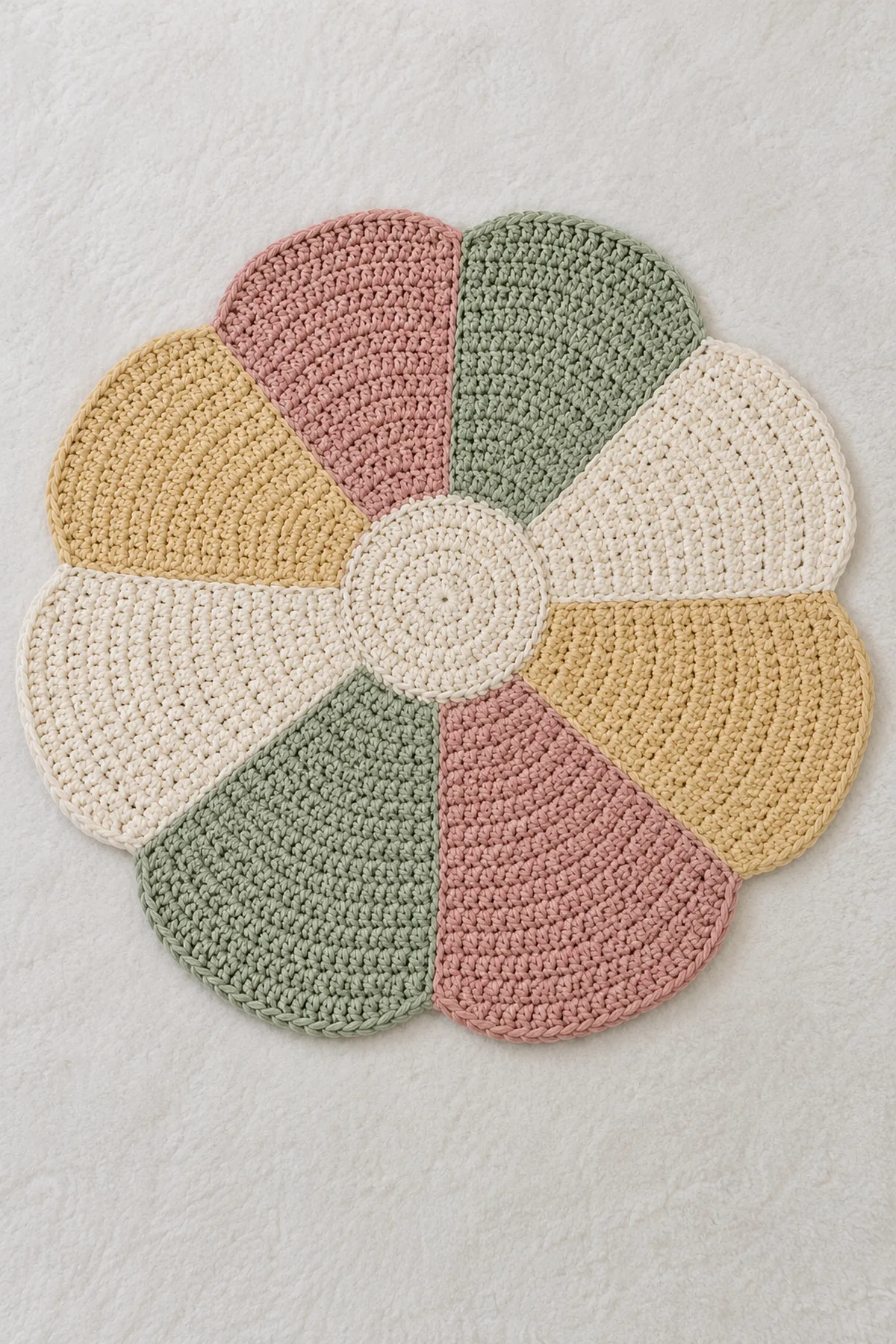
Eight flat cotton wedges increase from two to 42 stitches and join around a fully closed circular center, creating petal-like color segments without detachable pieces. A separately crocheted solid circular backing matches the 336-stitch outside circumference. Low-profile cotton batting is enclosed between layers and quilted through all layers so it cannot shift.
Pattern Details
- Hook Size: 5 mm, adjusted to gauge
- Finished Size: Approximately 36 inches diameter after washing and joining
- Gauge: Target 12 hdc and 10 rows or rounds = 4 inches after washing
- Estimated Time: 20-28 hours
- Construction: Eight 41-row flat wedge panels, 32-stitch center disc, 42-round solid backing and enclosed quilted batting
- Skill level: Intermediate
Why You’ll Love This Project
The project has a practical use and a recognizable silhouette. Each component has its own checkpoint so you can compare the count and size before joining. The stitch choices and finishing are intended to give the object a distinctive handmade texture without relying on another pattern or image.
Materials
- Approximately 1,800 yards smooth washable cotton worsted yarn divided among four muted petal colors and 1,300 yards cream cotton worsted yarn for the backing
- 5 mm hook, eight removable markers, blunt yarn needle, sewing needle, strong matching cotton quilting thread and tape measure
- One prewashed low-loft cotton batting circle about 35 inches across; no beads, snaps, tassels or detachable appliques
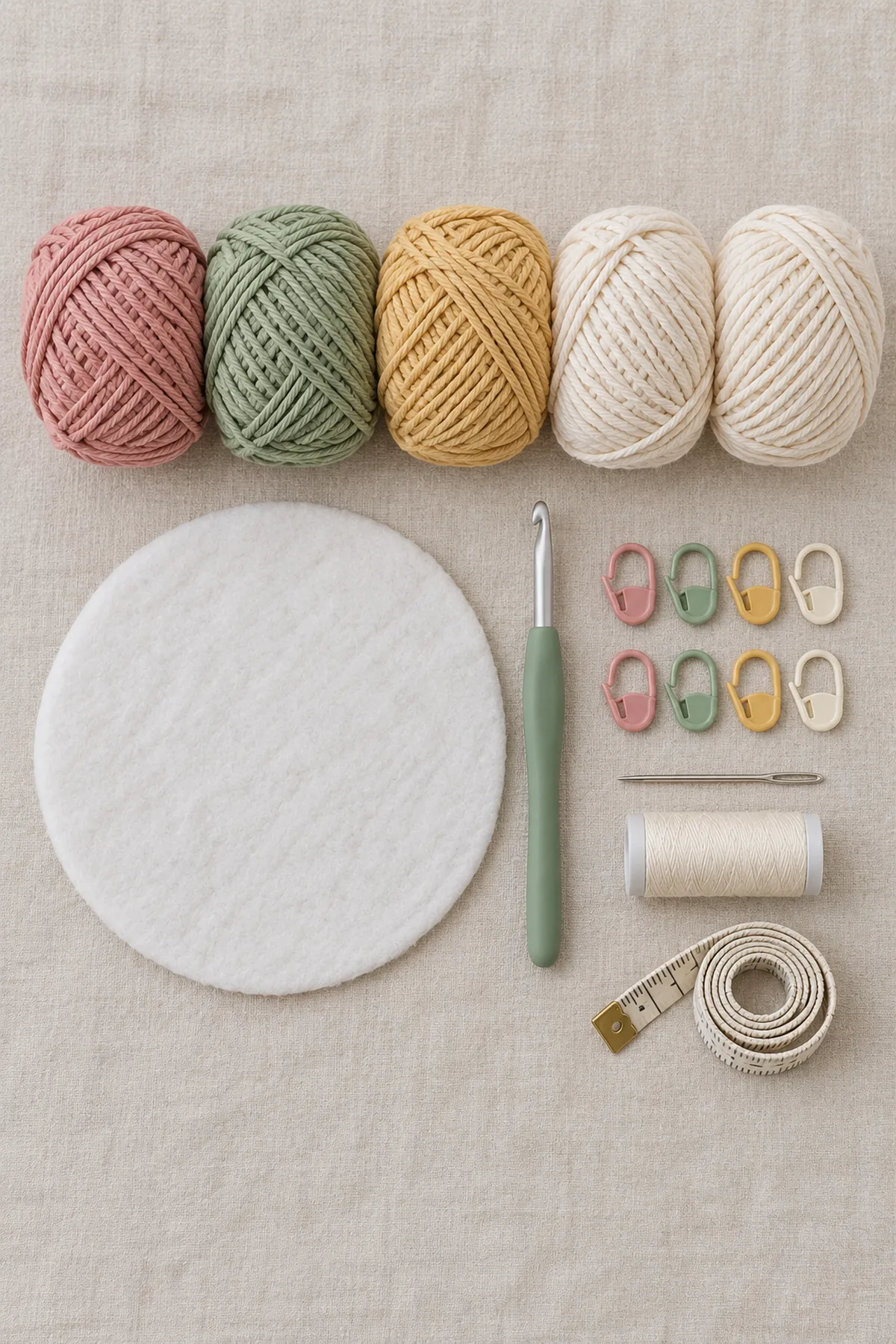
Gauge, Measurements, and Planning
Each wedge’s 42-stitch outer edge measures about 14 inches at three hdc per inch; eight edges total 112 inches, close to the circumference of a 36-inch circle. Forty-one rows at 2.5 rows per inch give a 16.4-inch radial length. A small closed center adds approximately 1.5-2 inches of radius. The solid backing ends at 336 stitches, exactly eight times 42. Treat final diameter as a planning estimate; block both layers to match before enclosing batting.
Make and wash a gauge swatch before beginning. Measure only after the swatch is completely dry. If the stitch width differs, change hook size rather than pulling the working yarn tighter. Keep a written count at the end of every section so the finished edges remain balanced and the assembly points line up.
Abbreviations and Special Stitches
- ch: chain
- sc: single crochet
- hdc: half double crochet
- dc: double crochet
- sl st: slip stitch
- st(s): stitch(es)
- rnd: round
- BLO: back loop only
- inc: two stitches in one stitch
- sc2tog: single-crochet two stitches together
- hdc2tog: half-double-crochet two stitches together
Special stitch guidance: One hdc increase is 2 hdc in one old stitch. On even wedge rows place the increase in the first old stitch; on odd wedge rows place it in the last old stitch, after working all preceding stitches. This alternation keeps the wedge approximately symmetric. The backing uses eight evenly marked hdc increases every round. Beginning ch 2 and joining slip stitches do not count.
Important Notes
- Pattern development note: stitch arithmetic and assembly counts are computationally checked; no physical sample or safety certification is claimed. Swatch and measure all components before use.
- The mat is for supervised, awake floor play on a stable, non-slip surface only. It is not a sleep surface and must never be placed in a crib, bassinet or play yard.
- Use washable cotton, low-loft batting and closed seams. Do not add loops, ties, beads, buttons, detachable petals or loose stuffing.
- Inspect the mat after every laundering for lifted quilting stitches, exposed batting, seam gaps or fabric bunching. Stop use until repaired.
Complete Instructions for Crochet Patchwork Petal Baby Play Mat
Crochet Eight Flat Petal Wedges
- Make eight flat wedges, two in each of four muted colors. For each wedge, ch 4; Row 1: hdc in the third chain and final chain, ch 2 and turn. (2 sts)
- Wedge Row 2: 2 hdc in first old stitch, then hdc once in each of the remaining 1 old stitches; ch 2 and turn except after Row 41. (3 sts)
- Wedge Row 3: hdc once in the first 2 old stitches, then 2 hdc in last old stitch; ch 2 and turn except after Row 41. (4 sts)
- Wedge Row 4: 2 hdc in first old stitch, then hdc once in each of the remaining 3 old stitches; ch 2 and turn except after Row 41. (5 sts)
- Wedge Row 5: hdc once in the first 4 old stitches, then 2 hdc in last old stitch; ch 2 and turn except after Row 41. (6 sts)
- Wedge Row 6: 2 hdc in first old stitch, then hdc once in each of the remaining 5 old stitches; ch 2 and turn except after Row 41. (7 sts)
- Wedge Row 7: hdc once in the first 6 old stitches, then 2 hdc in last old stitch; ch 2 and turn except after Row 41. (8 sts)
- Wedge Row 8: 2 hdc in first old stitch, then hdc once in each of the remaining 7 old stitches; ch 2 and turn except after Row 41. (9 sts)
- Wedge Row 9: hdc once in the first 8 old stitches, then 2 hdc in last old stitch; ch 2 and turn except after Row 41. (10 sts)
- Wedge Row 10: 2 hdc in first old stitch, then hdc once in each of the remaining 9 old stitches; ch 2 and turn except after Row 41. (11 sts)
- Wedge Row 11: hdc once in the first 10 old stitches, then 2 hdc in last old stitch; ch 2 and turn except after Row 41. (12 sts)
- Wedge Row 12: 2 hdc in first old stitch, then hdc once in each of the remaining 11 old stitches; ch 2 and turn except after Row 41. (13 sts)
- Wedge Row 13: hdc once in the first 12 old stitches, then 2 hdc in last old stitch; ch 2 and turn except after Row 41. (14 sts)
- Wedge Row 14: 2 hdc in first old stitch, then hdc once in each of the remaining 13 old stitches; ch 2 and turn except after Row 41. (15 sts)
- Wedge Row 15: hdc once in the first 14 old stitches, then 2 hdc in last old stitch; ch 2 and turn except after Row 41. (16 sts)
- Wedge Row 16: 2 hdc in first old stitch, then hdc once in each of the remaining 15 old stitches; ch 2 and turn except after Row 41. (17 sts)
- Wedge Row 17: hdc once in the first 16 old stitches, then 2 hdc in last old stitch; ch 2 and turn except after Row 41. (18 sts)
- Wedge Row 18: 2 hdc in first old stitch, then hdc once in each of the remaining 17 old stitches; ch 2 and turn except after Row 41. (19 sts)
- Wedge Row 19: hdc once in the first 18 old stitches, then 2 hdc in last old stitch; ch 2 and turn except after Row 41. (20 sts)
- Wedge Row 20: 2 hdc in first old stitch, then hdc once in each of the remaining 19 old stitches; ch 2 and turn except after Row 41. (21 sts)
- Wedge Row 21: hdc once in the first 20 old stitches, then 2 hdc in last old stitch; ch 2 and turn except after Row 41. (22 sts)
- Wedge Row 22: 2 hdc in first old stitch, then hdc once in each of the remaining 21 old stitches; ch 2 and turn except after Row 41. (23 sts)
- Wedge Row 23: hdc once in the first 22 old stitches, then 2 hdc in last old stitch; ch 2 and turn except after Row 41. (24 sts)
- Wedge Row 24: 2 hdc in first old stitch, then hdc once in each of the remaining 23 old stitches; ch 2 and turn except after Row 41. (25 sts)
- Wedge Row 25: hdc once in the first 24 old stitches, then 2 hdc in last old stitch; ch 2 and turn except after Row 41. (26 sts)
- Wedge Row 26: 2 hdc in first old stitch, then hdc once in each of the remaining 25 old stitches; ch 2 and turn except after Row 41. (27 sts)
- Wedge Row 27: hdc once in the first 26 old stitches, then 2 hdc in last old stitch; ch 2 and turn except after Row 41. (28 sts)
- Wedge Row 28: 2 hdc in first old stitch, then hdc once in each of the remaining 27 old stitches; ch 2 and turn except after Row 41. (29 sts)
- Wedge Row 29: hdc once in the first 28 old stitches, then 2 hdc in last old stitch; ch 2 and turn except after Row 41. (30 sts)
- Wedge Row 30: 2 hdc in first old stitch, then hdc once in each of the remaining 29 old stitches; ch 2 and turn except after Row 41. (31 sts)
- Wedge Row 31: hdc once in the first 30 old stitches, then 2 hdc in last old stitch; ch 2 and turn except after Row 41. (32 sts)
- Wedge Row 32: 2 hdc in first old stitch, then hdc once in each of the remaining 31 old stitches; ch 2 and turn except after Row 41. (33 sts)
- Wedge Row 33: hdc once in the first 32 old stitches, then 2 hdc in last old stitch; ch 2 and turn except after Row 41. (34 sts)
- Wedge Row 34: 2 hdc in first old stitch, then hdc once in each of the remaining 33 old stitches; ch 2 and turn except after Row 41. (35 sts)
- Wedge Row 35: hdc once in the first 34 old stitches, then 2 hdc in last old stitch; ch 2 and turn except after Row 41. (36 sts)
- Wedge Row 36: 2 hdc in first old stitch, then hdc once in each of the remaining 35 old stitches; ch 2 and turn except after Row 41. (37 sts)
- Wedge Row 37: hdc once in the first 36 old stitches, then 2 hdc in last old stitch; ch 2 and turn except after Row 41. (38 sts)
- Wedge Row 38: 2 hdc in first old stitch, then hdc once in each of the remaining 37 old stitches; ch 2 and turn except after Row 41. (39 sts)
- Wedge Row 39: hdc once in the first 38 old stitches, then 2 hdc in last old stitch; ch 2 and turn except after Row 41. (40 sts)
- Wedge Row 40: 2 hdc in first old stitch, then hdc once in each of the remaining 39 old stitches; ch 2 and turn except after Row 41. (41 sts)
- Wedge Row 41: hdc once in the first 40 old stitches, then 2 hdc in last old stitch; ch 2 and turn except after Row 41. (42 sts)
- At Row 41 each wedge has 42 outer stitches and 41 row ends along each sloping side. Block all eight wedges to the same gauge and lay them in color order before sewing.
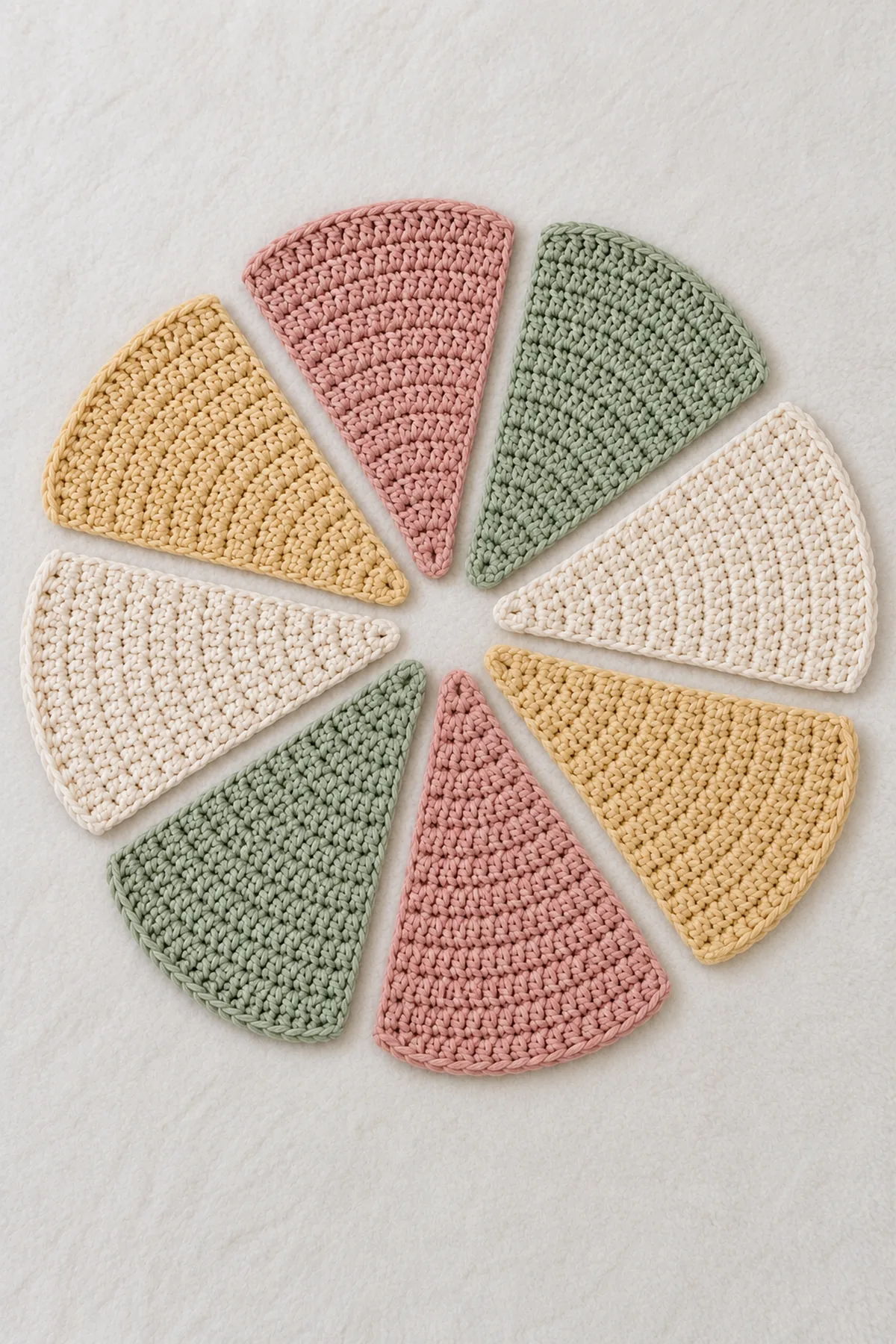
Close the Center and Make the Solid Backing
- Center disc: make a magic ring and work 8 hdc; join. Rnd 2: 2 hdc in each old stitch (16 sts). Rnd 3: [hdc in next stitch, 2 hdc in next] eight times (24 sts). Rnd 4: [hdc in next two stitches, 2 hdc in next] eight times (32 sts). Join and leave a long sewing tail.
- With cream make a magic ring. Backing Rnd 1: 8 hdc in the ring, join first hdc and place a marker after each stitch to establish eight sectors. (8 sts)
- Backing Rnd 2: in each of eight marked sectors, hdc in the next 0 old stitches (omit when zero), then 2 hdc in the final old stitch; join and move markers, do not turn. (16 sts)
- Backing Rnd 3: in each of eight marked sectors, hdc in the next 1 old stitches (omit when zero), then 2 hdc in the final old stitch; join and move markers, do not turn. (24 sts)
- Backing Rnd 4: in each of eight marked sectors, hdc in the next 2 old stitches (omit when zero), then 2 hdc in the final old stitch; join and move markers, do not turn. (32 sts)
- Backing Rnd 5: in each of eight marked sectors, hdc in the next 3 old stitches (omit when zero), then 2 hdc in the final old stitch; join and move markers, do not turn. (40 sts)
- Backing Rnd 6: in each of eight marked sectors, hdc in the next 4 old stitches (omit when zero), then 2 hdc in the final old stitch; join and move markers, do not turn. (48 sts)
- Backing Rnd 7: in each of eight marked sectors, hdc in the next 5 old stitches (omit when zero), then 2 hdc in the final old stitch; join and move markers, do not turn. (56 sts)
- Backing Rnd 8: in each of eight marked sectors, hdc in the next 6 old stitches (omit when zero), then 2 hdc in the final old stitch; join and move markers, do not turn. (64 sts)
- Backing Rnd 9: in each of eight marked sectors, hdc in the next 7 old stitches (omit when zero), then 2 hdc in the final old stitch; join and move markers, do not turn. (72 sts)
- Backing Rnd 10: in each of eight marked sectors, hdc in the next 8 old stitches (omit when zero), then 2 hdc in the final old stitch; join and move markers, do not turn. (80 sts)
- Backing Rnd 11: in each of eight marked sectors, hdc in the next 9 old stitches (omit when zero), then 2 hdc in the final old stitch; join and move markers, do not turn. (88 sts)
- Backing Rnd 12: in each of eight marked sectors, hdc in the next 10 old stitches (omit when zero), then 2 hdc in the final old stitch; join and move markers, do not turn. (96 sts)
- Backing Rnd 13: in each of eight marked sectors, hdc in the next 11 old stitches (omit when zero), then 2 hdc in the final old stitch; join and move markers, do not turn. (104 sts)
- Backing Rnd 14: in each of eight marked sectors, hdc in the next 12 old stitches (omit when zero), then 2 hdc in the final old stitch; join and move markers, do not turn. (112 sts)
- Backing Rnd 15: in each of eight marked sectors, hdc in the next 13 old stitches (omit when zero), then 2 hdc in the final old stitch; join and move markers, do not turn. (120 sts)
- Backing Rnd 16: in each of eight marked sectors, hdc in the next 14 old stitches (omit when zero), then 2 hdc in the final old stitch; join and move markers, do not turn. (128 sts)
- Backing Rnd 17: in each of eight marked sectors, hdc in the next 15 old stitches (omit when zero), then 2 hdc in the final old stitch; join and move markers, do not turn. (136 sts)
- Backing Rnd 18: in each of eight marked sectors, hdc in the next 16 old stitches (omit when zero), then 2 hdc in the final old stitch; join and move markers, do not turn. (144 sts)
- Backing Rnd 19: in each of eight marked sectors, hdc in the next 17 old stitches (omit when zero), then 2 hdc in the final old stitch; join and move markers, do not turn. (152 sts)
- Backing Rnd 20: in each of eight marked sectors, hdc in the next 18 old stitches (omit when zero), then 2 hdc in the final old stitch; join and move markers, do not turn. (160 sts)
- Backing Rnd 21: in each of eight marked sectors, hdc in the next 19 old stitches (omit when zero), then 2 hdc in the final old stitch; join and move markers, do not turn. (168 sts)
- Backing Rnd 22: in each of eight marked sectors, hdc in the next 20 old stitches (omit when zero), then 2 hdc in the final old stitch; join and move markers, do not turn. (176 sts)
- Backing Rnd 23: in each of eight marked sectors, hdc in the next 21 old stitches (omit when zero), then 2 hdc in the final old stitch; join and move markers, do not turn. (184 sts)
- Backing Rnd 24: in each of eight marked sectors, hdc in the next 22 old stitches (omit when zero), then 2 hdc in the final old stitch; join and move markers, do not turn. (192 sts)
- Backing Rnd 25: in each of eight marked sectors, hdc in the next 23 old stitches (omit when zero), then 2 hdc in the final old stitch; join and move markers, do not turn. (200 sts)
- Backing Rnd 26: in each of eight marked sectors, hdc in the next 24 old stitches (omit when zero), then 2 hdc in the final old stitch; join and move markers, do not turn. (208 sts)
- Backing Rnd 27: in each of eight marked sectors, hdc in the next 25 old stitches (omit when zero), then 2 hdc in the final old stitch; join and move markers, do not turn. (216 sts)
- Backing Rnd 28: in each of eight marked sectors, hdc in the next 26 old stitches (omit when zero), then 2 hdc in the final old stitch; join and move markers, do not turn. (224 sts)
- Backing Rnd 29: in each of eight marked sectors, hdc in the next 27 old stitches (omit when zero), then 2 hdc in the final old stitch; join and move markers, do not turn. (232 sts)
- Backing Rnd 30: in each of eight marked sectors, hdc in the next 28 old stitches (omit when zero), then 2 hdc in the final old stitch; join and move markers, do not turn. (240 sts)
- Backing Rnd 31: in each of eight marked sectors, hdc in the next 29 old stitches (omit when zero), then 2 hdc in the final old stitch; join and move markers, do not turn. (248 sts)
- Backing Rnd 32: in each of eight marked sectors, hdc in the next 30 old stitches (omit when zero), then 2 hdc in the final old stitch; join and move markers, do not turn. (256 sts)
- Backing Rnd 33: in each of eight marked sectors, hdc in the next 31 old stitches (omit when zero), then 2 hdc in the final old stitch; join and move markers, do not turn. (264 sts)
- Backing Rnd 34: in each of eight marked sectors, hdc in the next 32 old stitches (omit when zero), then 2 hdc in the final old stitch; join and move markers, do not turn. (272 sts)
- Backing Rnd 35: in each of eight marked sectors, hdc in the next 33 old stitches (omit when zero), then 2 hdc in the final old stitch; join and move markers, do not turn. (280 sts)
- Backing Rnd 36: in each of eight marked sectors, hdc in the next 34 old stitches (omit when zero), then 2 hdc in the final old stitch; join and move markers, do not turn. (288 sts)
- Backing Rnd 37: in each of eight marked sectors, hdc in the next 35 old stitches (omit when zero), then 2 hdc in the final old stitch; join and move markers, do not turn. (296 sts)
- Backing Rnd 38: in each of eight marked sectors, hdc in the next 36 old stitches (omit when zero), then 2 hdc in the final old stitch; join and move markers, do not turn. (304 sts)
- Backing Rnd 39: in each of eight marked sectors, hdc in the next 37 old stitches (omit when zero), then 2 hdc in the final old stitch; join and move markers, do not turn. (312 sts)
- Backing Rnd 40: in each of eight marked sectors, hdc in the next 38 old stitches (omit when zero), then 2 hdc in the final old stitch; join and move markers, do not turn. (320 sts)
- Backing Rnd 41: in each of eight marked sectors, hdc in the next 39 old stitches (omit when zero), then 2 hdc in the final old stitch; join and move markers, do not turn. (328 sts)
- Backing Rnd 42: in each of eight marked sectors, hdc in the next 40 old stitches (omit when zero), then 2 hdc in the final old stitch; join and move markers, do not turn. (336 sts)
- Stop after Rnd 42 with 336 stitches. Lay the backing under the blocked eight-wedge top; their outside stitch totals must both be 336 before the batting is added.
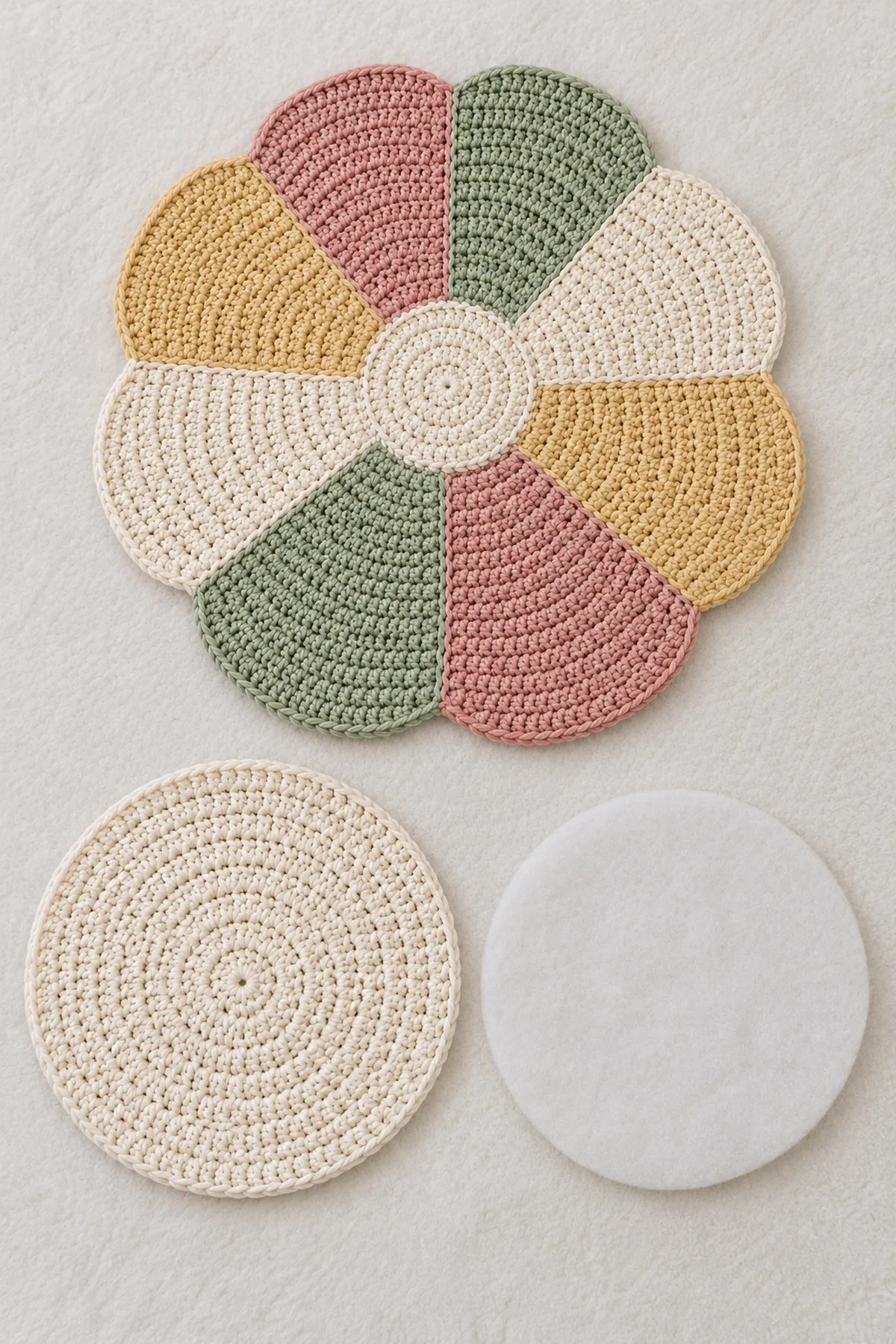
Join the Flat Layers and Enclose Batting
- Sew the eight wedge sloping edges together in order with one seam stitch per matched row end from Row 1 to Row 41. Do not overlap outer stitches. The top outside edge contains eight times 42, or 336 stitches. Stitch the center disc over all wedge tips as described in Assembly so no central opening remains.
- Cut prewashed low-loft cotton batting as a circle 1/2 inch smaller than the blocked top radius, so no batting reaches the perimeter seam. Lay top, batting and solid backing in that order, with wrong sides facing the batting. Use removable markers to align every 42nd outer stitch on both crocheted layers.
- With strong matching cotton thread, baste through all three layers in eight radial lines over the wedge seams. Quilt two additional continuous circles roughly 6 and 12 inches from center, keeping stitches short and knots fully buried. The batting must lie flat with no pockets of bunching or loose thread.
- Perimeter: with cream and hook, ch 1 and sc through one top outer stitch and its matching backing outer stitch; repeat around all 336 matched pairs. Join first sc and fasten off. (336 sts) Inspect every inch of the low-profile edge and all quilting before supervised floor use.
Assembly and Shaping
Sew the 41-row sloping edge of each wedge to the next wedge, matching one row end to one row end with the right sides outward, to form a complete flat disk. Place the small center disc over all eight wedge tips; sew its 32 perimeter stitches through four sites of each wedge-tip area, with a second seam pass. Lay the solid backing wrong-side to wrong-side under the top, inserting the prewashed cotton batting trimmed 1/2 inch short of the outer edge. Baste, quilt eight radial lines over wedge seams plus two closed circles at roughly 6 and 12 inches from center, then join 336 matched outer stitches one-to-one with sc. This low, flat mat is for supervised floor play only, never infant sleep, crib or unsupervised use.
Lay every component on a flat surface before joining. Match the marked centers first, then divide each remaining edge into equal sections. Work through both layers with consistent tension and pause after each section to check that the fabric lies flat. This measured approach prevents twisting and keeps decorative details facing the intended direction.
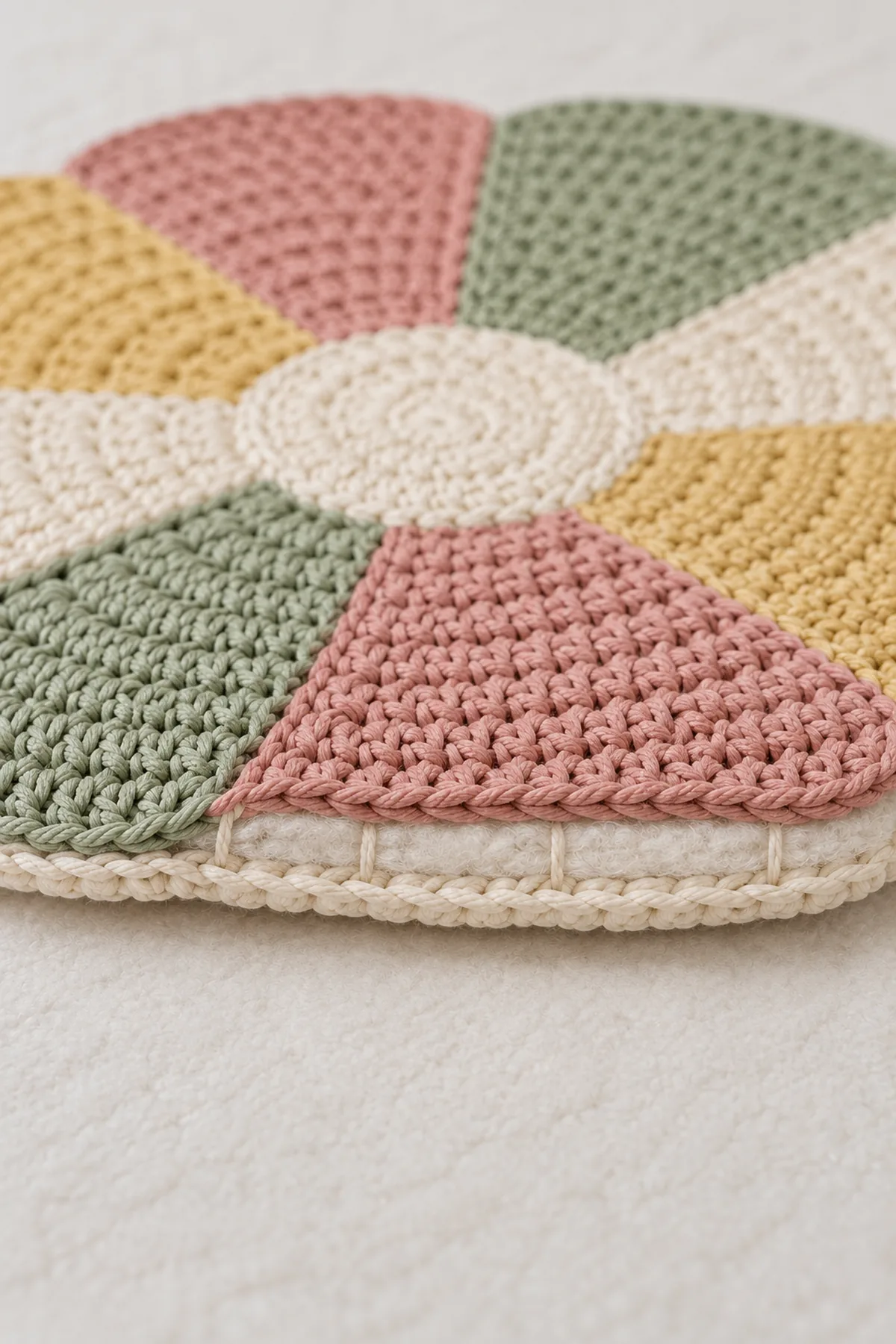
Finishing
- Weave every yarn tail inside the paired layers, reverse direction twice and close each seam end securely.
- Wash and dry according to the cotton and batting labels. Reblock flat without stretching individual petals.
- Inspect the center, all eight wedge seams, quilting paths and the full perimeter from both sides after washing.
- Use only on a clean non-slip floor with an adult present. Remove it when the child becomes sleepy.
For a polished result, weave each tail through several same-color stitches, reverse direction once, and trim only after the fabric has been gently stretched. Block to the listed dimensions without flattening textured stitches. Inspect joins, borders, straps, and decorative pieces before the project is used or gifted.
Helpful Tips
- Place removable markers at each shaping repeat and record the count before beginning the next row.
- Use a contrasting cloth behind dark yarn so it is easier to see both loops of every stitch.
- Lay the piece flat and compare opposite sides at each measurement checkpoint rather than pulling one side to match.
- If an edge ripples or cups unexpectedly, stop and check stitch count and washed gauge before adding a border.
Good lighting and a contrasting stitch marker make counting much easier. If a section looks uneven, compare the current count with the previous checkpoint before continuing. Fixing one missed stitch early is faster than compensating later, and it preserves the measurements used by the assembly instructions.
Frequently Asked Questions
Can a baby sleep on this mat?
No. It is only for supervised awake floor play on a stable surface, not for a crib, bassinet, play yard or sleep.
Are the petals detachable?
No. The eight wedges are fully seamed into one top disk, the center is sewn closed, and the backing is joined all the way around.
Why quilt the batting?
The radial and circular stitches keep the low-loft batting from shifting or bunching between the two crocheted layers. Inspect these stitches after every wash.
Conclusion
Keep the measured dimensions and yarn details with your pattern notes. Check the construction and safety guidance before styling or gifting the finished crochet project.
BabyYarnie Printable Crochet Pattern Card
BabyYarnie — easy-to-follow crochet for everyday makers.
Project: Crochet Patchwork Petal Baby Play Mat
Skill level: Intermediate Hook: 5 mm, adjusted to gauge Yarn: Worsted
Finished size: Approximately 36 inches diameter after washing and joining
Card Materials
- Approximately 1,800 yards smooth washable cotton worsted yarn divided among four muted petal colors and 1,300 yards cream cotton worsted yarn for the backing
- 5 mm hook, eight removable markers, blunt yarn needle, sewing needle, strong matching cotton quilting thread and tape measure
- One prewashed low-loft cotton batting circle about 35 inches across; no beads, snaps, tassels or detachable appliques
Card Instructions
- Crochet Eight Flat Petal Wedges: Eight wedges grow from 2 to 42 hdc across 41 rows, with the increase alternating edges.
- Close the Center and Make the Solid Backing: Center disc ends at 32 stitches; solid backing grows from 8 to 336 over 42 joined rounds.
- Join the Flat Layers and Enclose Batting: Join eight wedges, sew center closed, sandwich low-loft batting, quilt it flat and seam 336 matched perimeter stitches.
Finish: Check every count, weave in all ends, block to measurement, and inspect each join.